Water is faintly blue
A glass of water looks clear, but a deep pool looks blue, and the reason lies in the water itself. Water molecules absorb light at the red end of the spectrum much more strongly than at the blue end. Over a short distance the effect is invisible, but over metres it adds up. In very clear, deep ocean, sunlight that enters the water loses its red, then its orange and yellow, and much of its green, while blue penetrates far deeper and is scattered back towards the surface. That is why the open ocean, far from land and low in plankton, looks a rich, dark blue.
How turquoise happens
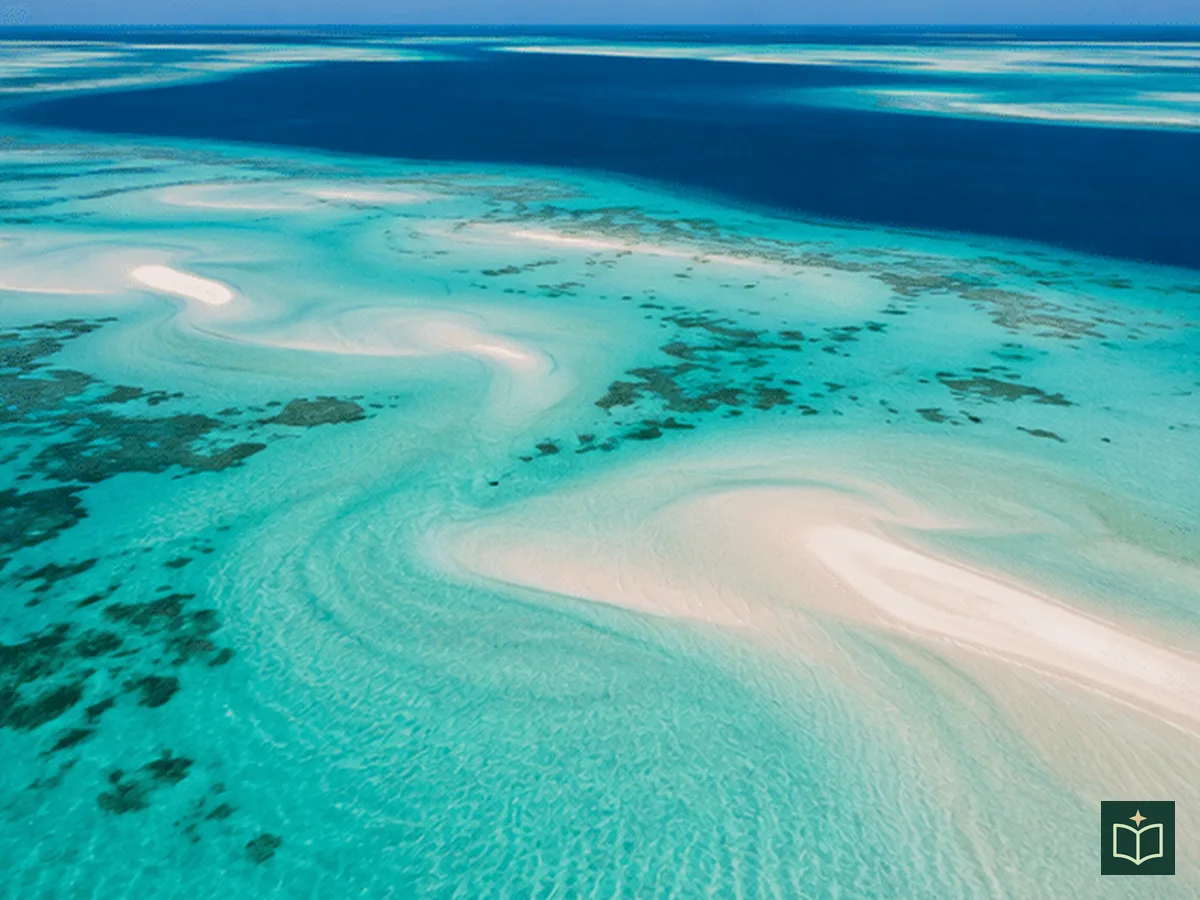
In shallow water over a pale, sandy bottom, a different colour appears. Sunlight travels down through a few metres of water, bounces off the bright sand and travels back up. Along that short path the water absorbs most of the red light but lets through plenty of blue and green. The light that reaches the eye is therefore a bright mix of blue and green: turquoise. A worked example shows the scale. With red light absorbed at about 0.6 per metre, a round trip of six metres leaves only around 3 per cent of the red, while blue loses only a few per cent. The paler the bottom, the brighter the colour.
The Gulf’s bright shallows
The Gulf is a natural showcase of the effect. Much of it is shallow, and its floor and beaches are covered in pale carbonate sand made of shell fragments, coral debris and grains formed directly from warm, salty water. Around Abu Dhabi’s islands, Qatar’s coast and the lagoons behind sandbars, sunlight reflects off this white sand through a few metres of clear water, producing vivid turquoise that changes to deeper blue where channels cut through. Seen from an aircraft, the patterns map the sea floor: pale lagoons, darker seagrass beds and the deep blue of channels and the open Gulf beyond.
Green and brown seas
Living things change the colour too. Phytoplankton contain chlorophyll, which absorbs blue and red light and reflects green. Where nutrients are plentiful, such as upwelling zones and coastal waters, plankton blooms turn the sea green, sometimes in vast swirls visible from orbit. Rivers add sediment, so the waters off the mouths of the Amazon or the Yellow River run muddy brown. Dissolved organic matter from decaying plants, common in the Baltic Sea and near forested coasts, stains water yellow-brown. Glacial meltwater full of fine rock flour gives some fjords and lakes a milky blue-green. Algal blooms of certain species can even tint the water red, the phenomenon known as a red tide.
Sky, angle and waves
Part of what we see is not from the water at all. The sea surface reflects the sky, so grey clouds make it look grey and a clear sky makes it look bluer, especially when viewed at a low angle. Waves break up reflections and expose more of the light coming from below, while calm water mirrors the sky. Viewing from a height, such as a hotel tower or an aircraft, reduces glare and makes the true colour of the water easier to see. Photographers use polarising filters for the same reason, cutting surface reflection to reveal the turquoise beneath.
Reading the ocean by colour
Because colour reveals what is in the water, satellites use it to monitor the ocean. Instruments on satellites run by NASA, the European Space Agency and others measure the precise mix of wavelengths leaving the sea surface to estimate chlorophyll, sediment and water clarity worldwide. Scientists use these data to track plankton blooms, map seagrass and coral reefs, follow river plumes and warn of harmful algal blooms that threaten fisheries and desalination plants. So a change in the colour of a familiar beach is worth noticing: it may simply reflect a passing storm, or it may signal a bloom or a change in the sea floor.
Sources & further reading
- NOAA Ocean Service · Why is the ocean blue? ↗
- NASA Ocean Color ↗
- Britannica · Seawater: optical properties ↗
Figures are rounded and widely published; check the linked organisations for the latest editions. These organisations do not endorse this website.