Rice does not need a pond
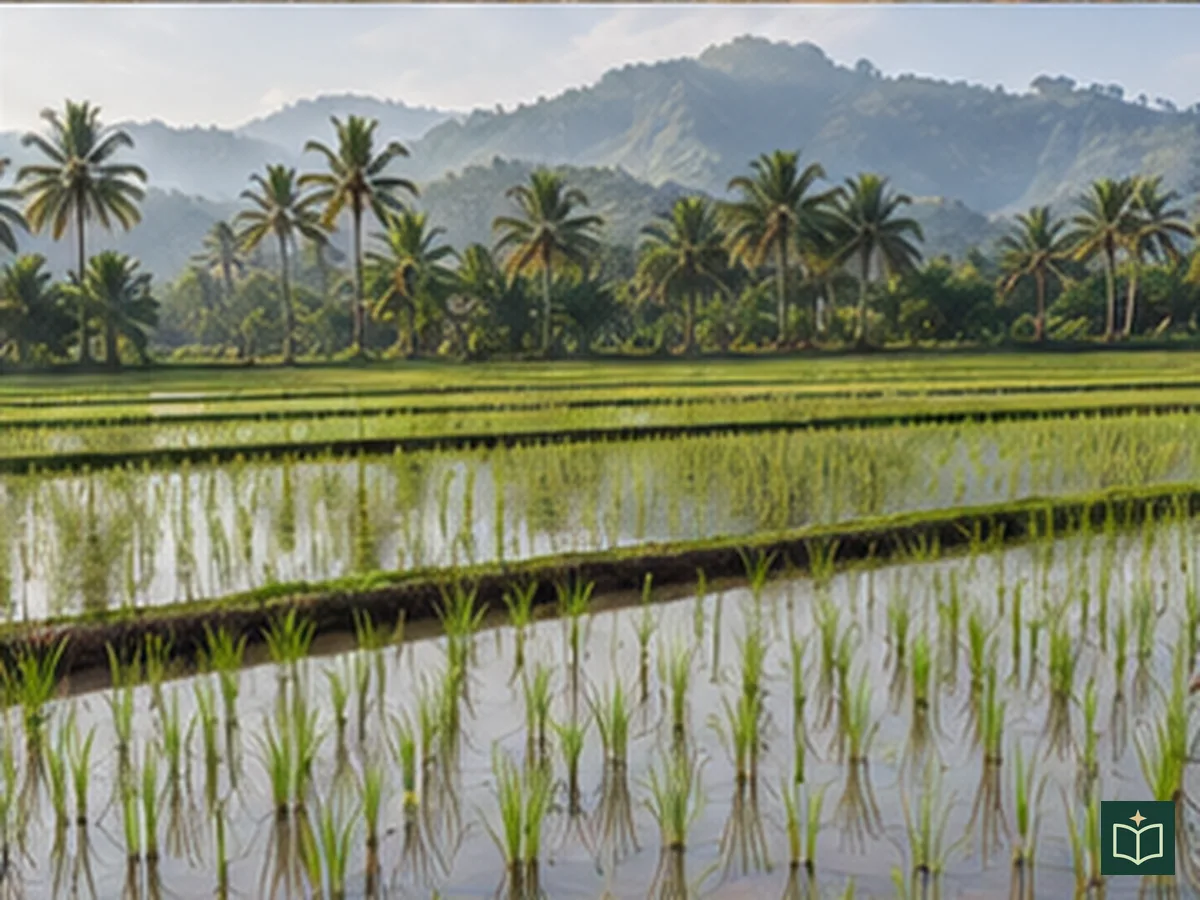
Rice is not strictly an aquatic plant. Some varieties, called upland rice, grow in ordinary rain-fed fields like wheat. But most of the world's rice is grown in paddies, fields kept under a few centimetres of standing water for much of the season. Farmers chose flooding because it brings several benefits at once, from weed control to stable yields. It works because rice, unlike most crops, copes with waterlogged soil. In a flooded field, oxygen in the soil is quickly used up by microbes. The roots of maize or wheat would suffocate there within days. Rice roots keep breathing. The difference lies inside the plant itself.
A plant with air channels
The secret is aerenchyma, spongy tissue full of connected air spaces that runs from the leaves down through the stems to the roots. Oxygen moves through these channels to the roots, and some leaks out to form a thin oxidised zone in the surrounding mud. Many wetland plants, including reeds and water lilies, use the same strategy. Some rice varieties go further: in deep-water areas of Bangladesh and South-East Asia, floating rice can lengthen its stems quickly as floodwaters rise, and newer varieties carry a gene that lets them survive being completely submerged for up to about two weeks. Breeders keep looking for traits that help rice cope with both flood and drought.
Water as a weedkiller
Before herbicides, weeds were a farmer's biggest enemy, and a layer of standing water is an effective control. Many weed seeds cannot germinate or grow without oxygen at the soil surface, while transplanted rice seedlings already stand above the water. Flooding also brings other advantages. Water evens out temperatures, protecting young plants from cold nights and hot days. Waterlogged soils release phosphorus and iron more readily, and blue-green algae in the water fix nitrogen from the air. This helps explain why some paddies have produced crops for centuries without the steady decline in fertility seen in many dry fields. Flooding, in effect, did much of the farmer's work.
Landscapes built for water
Paddy farming reshaped monsoon Asia. Fields must be almost perfectly flat so that water lies at an even depth, so farmers level the land, surround it with low earth walls called bunds, and dig channels to share water. On river deltas such as the Mekong, the Ganges–Brahmaputra and the Chao Phraya, paddies stretch to the horizon. On hillsides they climb as terraces. Monsoon rain fits the crop well, delivering heavy summer rains that fill fields. Sharing water required cooperation, and systems such as Bali's subak, recognised by UNESCO, organise irrigation through communities and temples that have managed channels for centuries.
The costs of flooding
Flooded rice carries environmental costs. It is a thirsty crop, using a large share of the world's irrigation water. Waterlogged soils also produce methane, a powerful greenhouse gas, because microbes break down organic matter there without oxygen. Rice paddies account for roughly a tenth of human-caused methane emissions. Researchers promote alternate wetting and drying, a technique in which fields are allowed to dry briefly before being reflooded. It can cut both water use and methane substantially with little loss of yield. Direct seeding, which avoids raising and transplanting seedlings, is spreading too, partly because labour on farms has grown scarcer.
Why it matters in the Gulf
The UAE grows very little rice, but it eats a great deal, from biryani to machboos, importing almost all of it from producers such as India and Pakistan. That means the region depends on monsoon rains, river flows and paddy landscapes thousands of kilometres away. When a big exporter restricts sales after a poor harvest, prices can rise across import-dependent markets. Understanding why rice grows in flooded fields therefore helps explain more than farming. It links Asian river deltas, the timing of the monsoon, global greenhouse emissions and the food security of desert countries that cannot grow the staple at home.
Sources & further reading
- FAO · Food and Agriculture Organization ↗
- International Rice Research Institute ↗
- UNESCO · Cultural Landscape of Bali Province: the Subak System ↗
Figures are rounded and widely published; check the linked organisations for the latest editions. These organisations do not endorse this website.