Not seaweed
Seagrasses are often mistaken for seaweed, but they are a different kind of life. Seaweeds are algae. Seagrasses are flowering plants whose ancestors lived on land and returned to the sea; they have roots, veins, flowers and seeds, and some release pollen that drifts through the water. They grow in shallow, clear water where enough sunlight reaches the bottom, spreading by underground stems into dense meadows. Only a few species tolerate the Gulf's harsh conditions, with summer water above 30°C and high salinity. Abu Dhabi's broad, shallow western waters, sheltered by islands and sandbanks, host some of the largest seagrass beds in the region.
Meadows that store carbon
Seagrass meadows are a form of blue carbon, coastal ecosystems that remove carbon dioxide from the air and lock it into sediment. Their leaves slow currents so that fine particles settle, and dead roots and leaves are buried in mud where low oxygen slows decay. The carbon can remain there for centuries or longer if the meadow is left undisturbed. The UN Environment Programme estimates that seagrasses cover only about 0.1% of the ocean floor but account for roughly a tenth of the carbon buried in ocean sediments each year. When meadows are dredged or destroyed, some of that stored carbon can be released.
Nurseries and shelter
Seagrass meadows are also nurseries. Their leaves offer cover from predators for juvenile fish, shrimp and crabs, including species later caught in commercial fisheries. Green turtles graze on them. The roots bind sand and mud, reducing erosion along the coast, and the leaves calm waves and help keep the water clear by trapping sediment. In the Gulf, where coral reefs face heat stress, seagrass beds are among the most important habitats for young fish. They support a food web that extends from tiny snails grazing algae on the leaves to the large animals that feed on the seagrass itself. Healthy meadows therefore mean healthier coastal fisheries.
The dugong's pasture
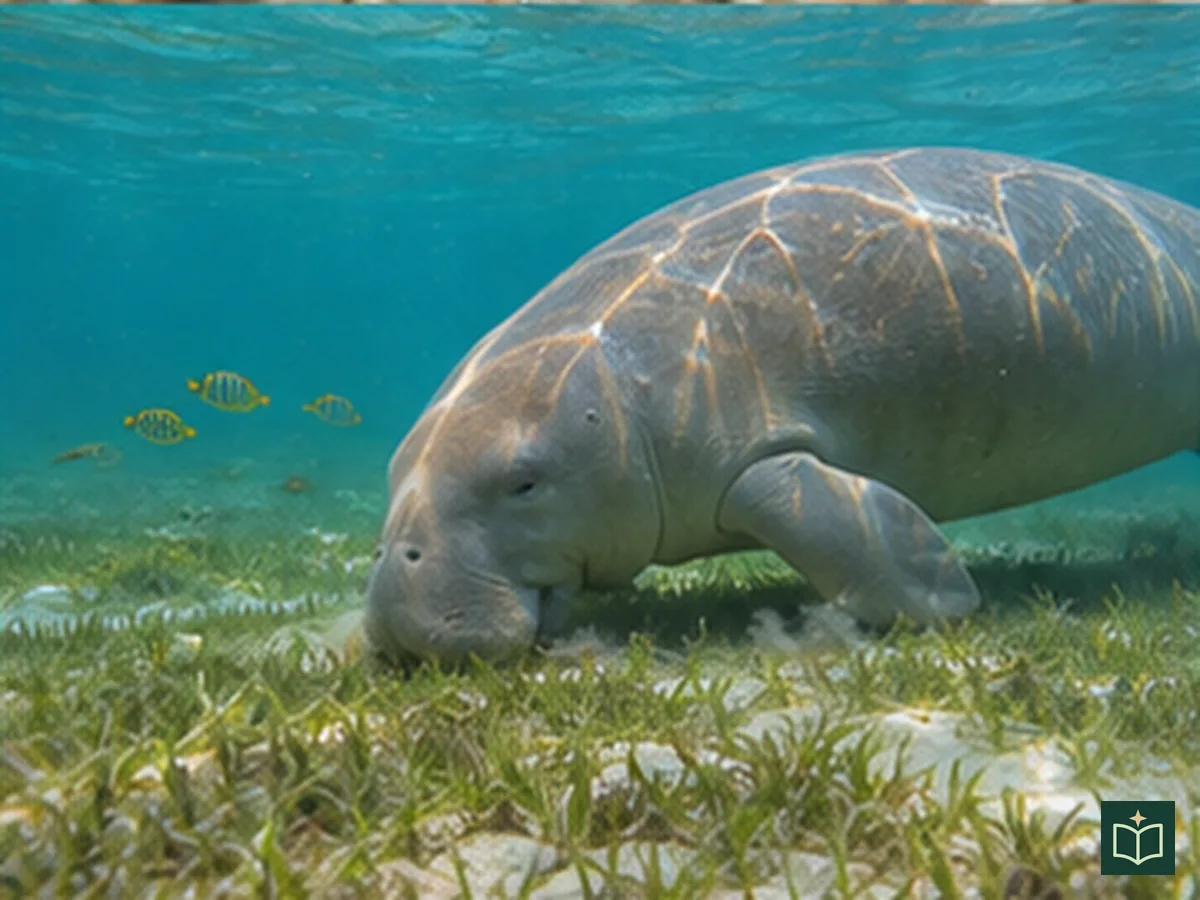
The dugong is the only strictly marine mammal that lives mainly on plants. A cousin of the manatee, it can grow to around three metres long and live for decades. It grazes by rooting through seagrass beds, leaving winding feeding trails in the sand, and an adult needs tens of kilograms of seagrass a day. Dugongs live in warm coastal waters from East Africa to Australia, which holds the largest population. The waters off Abu Dhabi are home to around 3,000, the world's second-largest group, concentrated in the west around Marawah and Bu Tinah, where meadows are extensive and shallow.
A long shared history
People in the Gulf have known dugongs for thousands of years. On Akab Island in Umm Al Quwain, archaeologists found a mound of dugong bones arranged by people more than 4,000 years ago, one of the oldest such sites in the world. Dugongs were once hunted for meat and oil; hunting is now illegal in the UAE. Today the main threats are accidental entanglement in fishing nets, damage to meadows from dredging and coastal development, and spells of extreme marine heat. Abu Dhabi has protected large areas, including the Marawah Marine Biosphere Reserve, and has introduced rules to limit harmful fishing gear.
Why it matters
Seagrass meadows rarely get the attention given to coral reefs or mangroves, yet they quietly support fisheries, coastal stability and carbon storage. Worldwide they have declined over the past century because of pollution, dredging and warming seas, and restoring them is slow. For the Gulf, keeping meadows healthy is also the best way to protect dugongs, which depend on them entirely and reproduce slowly, with a single calf every few years. Regular aerial and boat surveys, satellite mapping and tagging studies now track both meadows and dugongs, giving early warning if either begins to decline. Those surveys suggest the Gulf population is one of the most important anywhere for the species' future.
Sources & further reading
Figures are rounded and widely published; check the linked organisations for the latest editions. These organisations do not endorse this website.