Rocks from space fall everywhere
Every day, tonnes of material from space reach Earth, most of it as dust. A small fraction arrives as stones large enough to survive the fiery passage through the atmosphere and land on the ground: meteorites. They fall roughly evenly across the planet's surface. Yet the places where they are found are strikingly uneven. About seven tenths of Earth is ocean, and on land most meteorites drop into forests, fields or cities, where they are hidden, buried or quickly broken down. Only a handful of falls each year are seen and recovered. The great majority of meteorites in collections come instead from two kinds of place: Antarctica and the world's hot deserts.
Why dryness matters
Many meteorites contain metallic iron and nickel, along with minerals formed in the airless conditions of space. On Earth, water and oxygen attack them. In a humid climate an ordinary stony meteorite may rust and crumble within decades or centuries. In a hot desert, rainfall is so scarce that weathering slows dramatically. Meteorites can lie on the surface for tens of thousands of years, and the oldest finds in hot deserts have been on Earth for longer still. Desert surfaces called deflation plains, where wind has removed fine sand and left a stable pavement of pebbles, can stay almost unchanged for very long periods, steadily accumulating stones from the sky.
Easy to spot
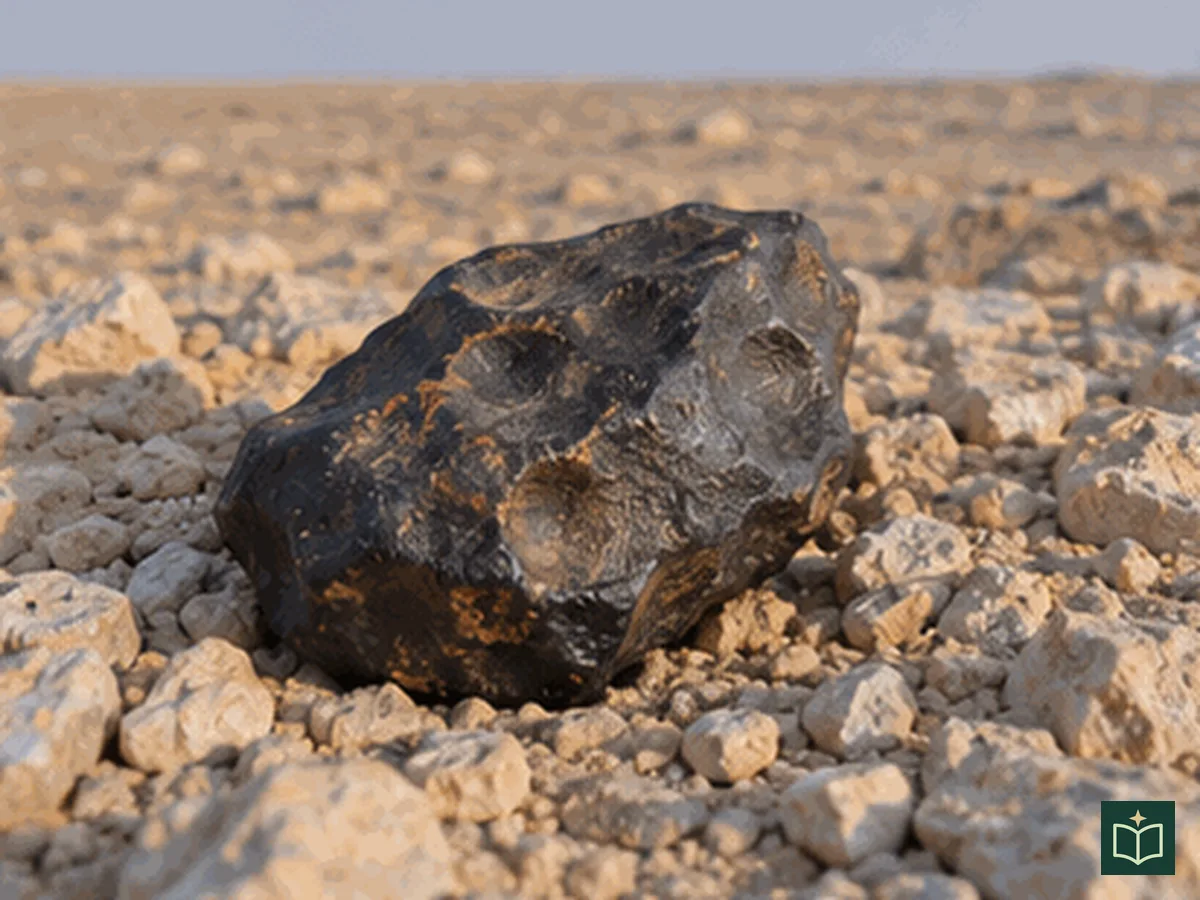
Preservation is only half the story. A meteorite also has to be found. As it plunges through the atmosphere, its outer surface melts and then hardens into a thin, dark coating called a fusion crust, usually black or dark brown. On a pale background of limestone gravel or light sand, such a stone stands out clearly. Searchers walk or drive slowly in lines across open ground, scanning for anything dark that should not be there. Vegetation is sparse, so little hides the surface. In Antarctica, moving ice carries meteorites and concentrates them where it meets mountains, and wind strips away snow, leaving dark rocks exposed on blue ice.
Oman's meteorite fields
Since the late 1990s, the deserts of central and southern Oman, including the Dhofar region and the gravel plains of Sayh al Uhaymir, have become one of the world's most productive hunting grounds. Thousands of meteorites have been recovered there, many by international research teams working with Omani authorities. The finds include rare samples from the Moon and Mars, blasted off those bodies by impacts and eventually captured by Earth. The Sahara, the deserts of north-west Africa, Libya and Algeria, and the Atacama in Chile are also rich sources. Many countries now regulate the collection and export of meteorites, treating them as part of their natural heritage and scientific resources.
How to tell a real one
Most rocks brought to museums as possible meteorites turn out to be ordinary Earth stones or industrial slag, nicknamed meteorwrongs. Genuine meteorites usually have several tell-tale features. A fresh one has a dark fusion crust, sometimes with shallow thumbprint-like dents called regmaglypts. Most feel unusually heavy for their size, because of their metal content, and most will attract a magnet. They rarely contain bubbles, which are common in slag and volcanic rock. A cut and polished surface may reveal flecks of shiny metal or small round grains called chondrules. Confirmation requires laboratory analysis, and accepted finds are officially named and recorded by the Meteoritical Society.
Why the hunt matters
Meteorites are the cheapest way to obtain samples of other worlds. Most are fragments of asteroids, and many have changed little since the solar system formed about 4.6 billion years ago, preserving a record of its earliest chemistry. Some carry organic molecules, including amino acids, which help scientists study how the ingredients of life were spread through space. Lunar and Martian meteorites add samples from places few missions have visited. Because desert finds accumulate over long periods, they also help scientists estimate how often rocks of different types hit Earth. The stony plains of Arabia, quiet and unchanging, turn out to be some of the best archives of the solar system.
Sources & further reading
- Britannica · Meteorite ↗
- Meteoritical Society · Meteoritical Bulletin Database ↗
- NASA · Meteors and meteorites ↗
Figures are rounded and widely published; check the linked organisations for the latest editions. These organisations do not endorse this website.