Life without air
Most of the energy your cells use comes from burning sugar completely with oxygen, producing carbon dioxide and water. Many microbes, and our own muscles in a pinch, have a back-up plan for when oxygen is scarce. They break glucose down only partway, in a sequence of reactions called glycolysis, which splits each six-carbon sugar into two smaller molecules and releases a modest amount of energy. To keep the process going, the cell must then dispose of those halves. The way it does so defines the type of fermentation. Yeasts typically make ethanol and carbon dioxide. Lactic acid bacteria make lactic acid. Both reshape the food they live in.
Pasteur's discovery
Humans fermented food for thousands of years without knowing why it worked. Bread, cheese, vinegar and sour milk appear in the records of ancient Egypt and Mesopotamia. In the 1850s and 1860s the French scientist Louis Pasteur showed that fermentation is carried out by living microorganisms, and that different microbes produce different products. He described it memorably as life without air. In 1897 the German chemist Eduard Buchner showed that juice squeezed from yeast cells, with no living cells left, could still ferment sugar. This proved that the work is done by proteins inside the cells, which we now call enzymes, and helped launch the science of biochemistry.
How bread rises
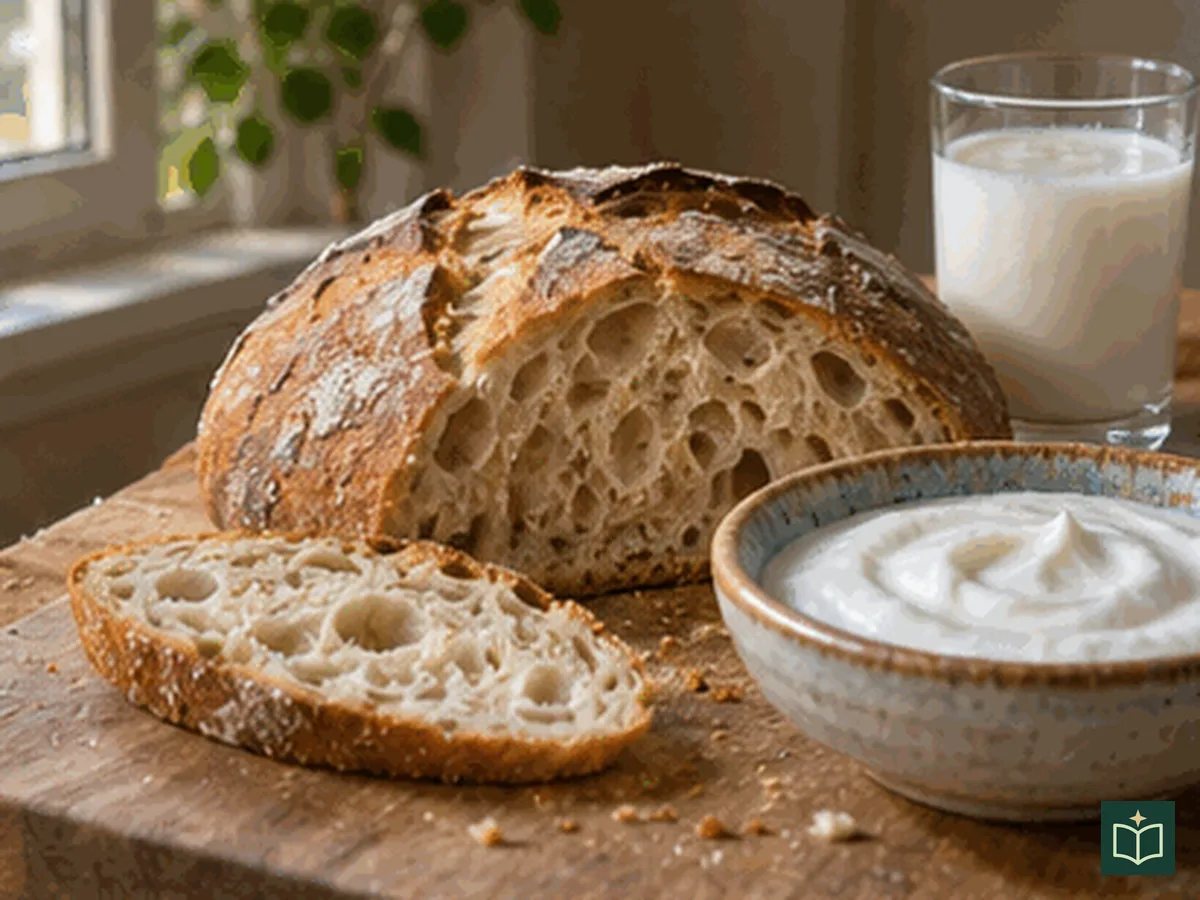
Baker's yeast is a single-celled fungus. Mixed into dough, it feeds on sugars released from flour starch and, short of oxygen inside the dough, ferments them. Each molecule of glucose becomes two molecules of ethanol and two of carbon dioxide. By mass, 180 grams of glucose yields about 92 grams of ethanol and 88 grams of carbon dioxide. The gas forms bubbles trapped by the stretchy network of gluten proteins, so the dough swells. In the oven the bubbles expand, the alcohol evaporates and the structure sets into a light, open crumb. Longer, slower fermentation allows more flavour compounds to form, which is why traditionally made breads often taste richer.
Milk turned sour, on purpose
Yoghurt is made by warming milk and adding lactic acid bacteria, traditionally Streptococcus thermophilus and Lactobacillus delbrueckii subspecies bulgaricus. They ferment lactose, the sugar in milk, into lactic acid. As acidity rises, milk proteins called caseins lose their charge and clump together into a soft gel, thickening the milk and giving it a pleasant tang. The acid also discourages many harmful bacteria, which is why fermented milk keeps longer than fresh. In the Gulf, laban, a drinkable cultured milk, is a staple, traditionally made from the soured liquid left after churning butter from fermented milk. Today it is mostly produced commercially with selected cultures.
The same trick in many kitchens
Lactic fermentation preserves vegetables as well as milk. Cabbage becomes sauerkraut or kimchi, cucumbers become sour pickles, and fermented dough gives sourdough its sharp flavour. Soy sauce, miso and many cheeses rely on moulds and bacteria working together over months. Vinegar is a two-step process: yeast first makes alcohol, then bacteria convert the alcohol into acetic acid. Cocoa beans and coffee cherries are fermented before roasting, shaping their final flavours. In each case, the cook creates conditions such as salt, warmth or lack of air that favour helpful microbes and keep harmful ones out. That is why fermentation can be described as spoilage carefully controlled.
Fermentation beyond food
Our own muscles ferment too. During intense exercise, when oxygen cannot be supplied quickly enough, muscle cells convert sugar to lactic acid to keep producing energy for a short time. Industry has scaled up the process enormously. Fermentation tanks grow microbes that make bioethanol fuel, citric acid for soft drinks, enzymes for detergents and many medicines, including antibiotics and insulin made by genetically modified microbes. Scientists are also exploring precision fermentation, in which engineered microbes produce specific proteins, such as those found in milk or eggs, without animals. The process Pasteur called life without air turns out to be one of humanity's oldest and most versatile technologies.
Sources & further reading
Figures are rounded and widely published; check the linked organisations for the latest editions. These organisations do not endorse this website.