Sound is moving air
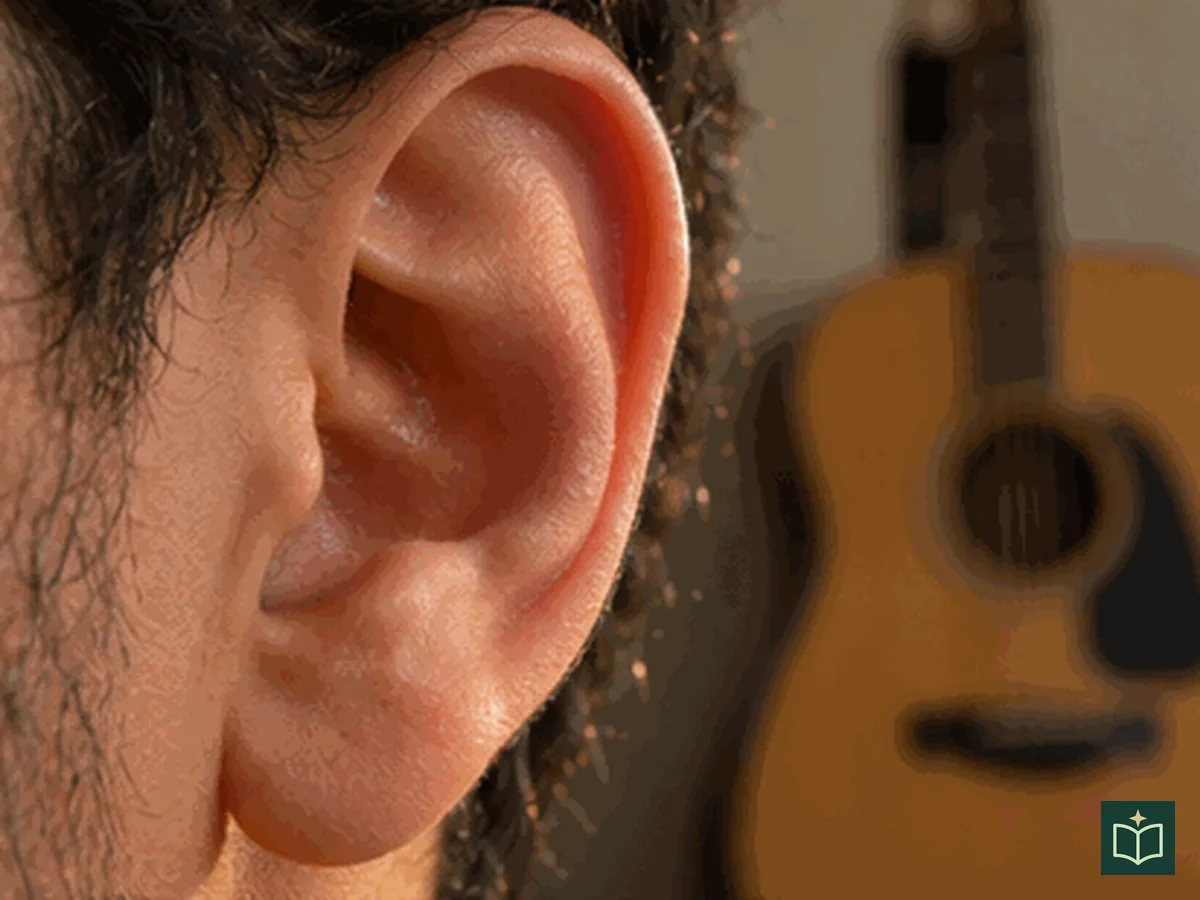
Sound is a pressure wave: a pattern of slight squeezing and stretching of air that travels at about 343 metres per second at room temperature. The pitch we hear depends on how many waves arrive each second, measured in hertz, and loudness on how strongly the pressure swings. The outer ear, the visible flap called the pinna, gathers these waves and guides them down the ear canal, about 2.5 centimetres long. Its folds subtly alter sounds depending on where they come from, which helps the brain locate them. At the end of the canal lies the eardrum, or tympanic membrane, a thin, taut sheet that vibrates in step with the incoming waves.
The smallest bones
Behind the eardrum lies the air-filled middle ear and a chain of three tiny bones, the ossicles. They are known as the malleus, incus and stapes, or the hammer, anvil and stirrup. The stapes is the smallest bone in the human body, about 3 millimetres long. Together they carry the eardrum's vibrations to the oval window, a membrane-covered opening into the inner ear. The middle ear connects to the back of the throat through the Eustachian tube, which keeps air pressure equal on both sides of the eardrum. Tiny muscles attached to the ossicles tighten in response to very loud sounds, offering some protection.
Why the amplifier is needed
The inner ear is filled with fluid, and moving fluid takes much more force than moving air. If sound struck the fluid directly, most of its energy would bounce off, much as voices from the shore are hard to hear underwater. The middle ear solves this mismatch. The eardrum has an area roughly 17 times that of the stapes footplate, so the same force is concentrated onto a much smaller area, and the lever action of the bones adds a little more. Overall, pressure at the oval window is increased by around 20 times. Without this mechanism, a large share of sound energy would be lost before it reached the cochlea.
A tuned spiral
The cochlea is a coiled, fluid-filled tube about the size of a pea, with roughly two and a half turns. Running along its length is the basilar membrane. When the stapes pushes on the oval window, it sets up a travelling wave in the fluid that ripples along this membrane. The membrane is narrow and stiff near the entrance and wider and floppier at the far end, so each frequency peaks at a particular place: high pitches near the base, low pitches near the tip. The Hungarian-born physicist Georg von Békésy mapped this travelling wave, work that won him the Nobel Prize in Physiology or Medicine in 1961.
Hair cells make the signal
Sitting on the basilar membrane are about 15,000 sensory hair cells in each ear, arranged in rows. Each has a bundle of tiny projections on top. When the membrane moves, the bundles bend, opening channels that let charged particles flow into the cell. This converts mechanical motion into an electrical signal, which is passed to fibres of the auditory nerve and on to the brain. One row, the inner hair cells, does most of the signalling. The outer hair cells act as amplifiers, changing length in time with the sound to boost faint vibrations and sharpen tuning. This active process explains the ear's remarkable sensitivity to quiet sounds.
Protecting a fragile system
In humans and other mammals, hair cells do not regrow once they are lost. Loud noise, ageing, some infections and certain medicines can damage them, and the resulting hearing loss is usually permanent. High frequencies tend to go first, which is why older adults often struggle with consonants and conversations in noisy rooms. The World Health Organization estimates that over a billion young people are at risk of hearing loss from unsafe listening through personal devices and loud venues. Keeping volume moderate, limiting time in loud places and using ear protection all help. Hearing aids and cochlear implants can restore much function, and anyone noticing changes should seek a hearing check.
Sources & further reading
Figures are rounded and widely published; check the linked organisations for the latest editions. These organisations do not endorse this website.