Why voltage changes
When electricity flows through a wire, some energy is lost as heat. The loss depends on the current, so engineers prefer to send power at very high voltage and low current. For the same amount of power, doubling the voltage halves the current and cuts heat losses to roughly a quarter. That is why long-distance transmission lines run at hundreds of thousands of volts. But such voltages would be lethal in homes, so the voltage has to be stepped up after generation and stepped down again before use.
The transformer at the heart
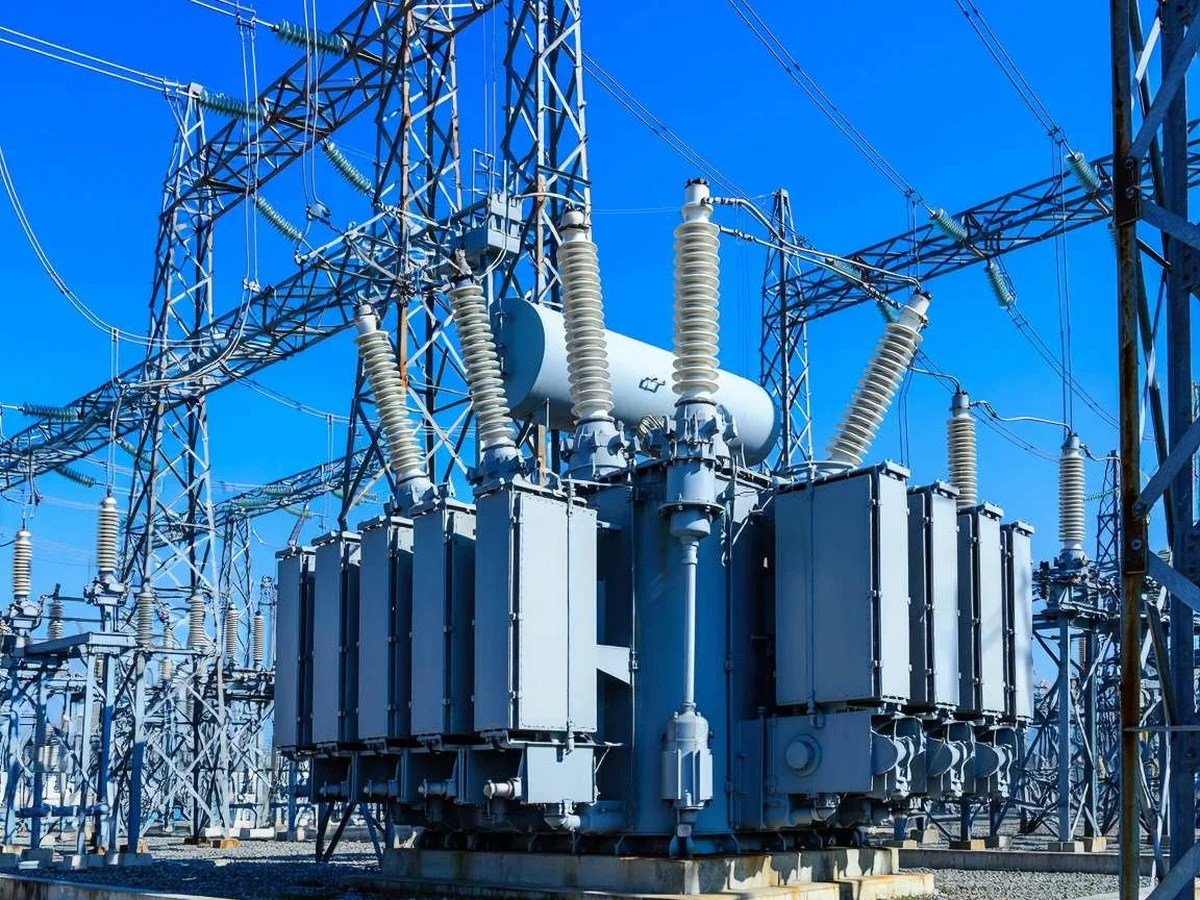
The key machine in a substation is the transformer. It has two coils of wire wound around an iron core. Alternating current in the first coil creates a changing magnetic field, which induces a current in the second coil. If the second coil has more turns, the voltage rises; if it has fewer, the voltage falls. Large power transformers weigh hundreds of tonnes, are filled with insulating oil for cooling, and can run for decades with regular maintenance.
Step-up substations
Next to a power plant, a step-up substation raises the generator's output, often around 11,000 to 25,000 volts, to transmission levels such as 220,000 or 400,000 volts. Solar parks and wind farms need step-up substations too, gathering power from thousands of panels or turbines and feeding it onto the high-voltage grid. These substations also measure how much electricity each plant is supplying, which helps grid operators balance supply and demand every second of the day.
Switching and protection
Substations are also the grid's safety system. Circuit breakers can interrupt huge currents in a fraction of a second if lightning strikes a line or a cable is damaged. Protection relays constantly watch voltages and currents, and trip the breakers automatically when they detect a fault. Disconnect switches let engineers isolate equipment for repairs. Busbars, thick conductors made of copper or aluminium, connect incoming and outgoing lines so power can be routed along different paths if one fails.
Step-down and distribution
Near cities, transmission substations lower the voltage, for example to 132,000 volts, and distribution substations lower it again to around 11,000 volts for local networks. Finally, small transformers, sometimes on poles and often in green metal cabinets or small rooms in buildings, bring it down to the 230 volts used by household sockets, or 400 volts for three-phase supplies to larger buildings. Each step is matched to the job: moving bulk power far, or delivering it safely to a street.
Indoor and gas-insulated designs
Traditional substations are open-air yards that need a lot of space, because high-voltage equipment needs wide gaps of air for insulation. In dense cities, engineers often use gas-insulated switchgear instead. The live parts are sealed inside metal enclosures filled with an insulating gas, which allows the equipment to be many times more compact. Such substations can fit inside ordinary-looking buildings or even underground, which is useful in fast-growing cities with valuable land.
Control rooms and automation
Modern substations are rarely staffed around the clock. Sensors and computers report their status to regional control centres, where operators can open and close breakers remotely. Digital substations replace much of the copper wiring between devices with fibre-optic communication, making them faster to monitor and easier to upgrade. Cyber-security has become as important as physical fences, because the grid is critical infrastructure and must be protected from attacks as well as from storms.
Keeping it cool and quiet
Transformers lose a small share of the energy passing through them as heat, so cooling is vital, especially in hot climates. Large units circulate oil through radiators, often helped by fans and pumps. The low hum heard near a substation comes from the iron core vibrating as the magnetic field changes, fifty times a second in the UAE. Fire walls and oil-catching pits keep any failure contained.
Substations and the energy transition
As more solar, wind and batteries join the grid, substations are being upgraded to handle power flowing in new directions, including from rooftop panels back into the network. Some now include large battery systems and devices that stabilise voltage when renewable output changes quickly. Utilities in the UAE, including DEWA in Dubai, have built hundreds of substations to keep pace with growth. These quiet fenced yards are where a reliable, cleaner grid is actually assembled.
Sources & further reading
- Wikipedia · Electrical substation ↗
- Wikipedia · Transformer ↗
- U.S. Energy Information Administration · Electricity explained ↗
Voltages shown are typical examples; networks differ between countries and utilities. Photograph: original AI-generated illustration (Adobe Firefly). Reference organisations do not endorse this website.