A star's dramatic end
Stars shine by fusing light elements into heavier ones in their cores, releasing energy. When a star runs out of fuel, its fate depends on its mass. Small stars like the Sun swell into red giants and then shrink into white dwarfs. But in certain cases, a star ends its life in a gigantic explosion called a supernova. For a few weeks, a single supernova can shine as brightly as billions of ordinary stars, before slowly fading.
Core-collapse supernovae
Stars born with more than about eight times the mass of the Sun build up layers of heavier elements, ending with an iron core. Iron cannot release energy through fusion, so when the core grows too heavy, it collapses in less than a second. Its atoms are crushed into neutrons, and the collapse rebounds, sending a shock wave outwards. Together with a flood of tiny particles called neutrinos, this blows the star's outer layers into space.
Type Ia supernovae
Another kind of supernova happens in pairs of stars. A white dwarf, the dense leftover core of a Sun-like star, can pull material from a nearby companion or merge with another white dwarf. If it grows close to a critical mass, about 1.4 times the Sun's mass, a runaway nuclear reaction can blow the white dwarf apart completely. These Type Ia supernovae reach similar peak brightness, which makes them valuable for measuring distances across the universe.
Measuring the universe
Because astronomers know roughly how bright Type Ia supernovae really are, they can compare that with how bright they appear to work out their distance. In the late 1990s, two teams used distant supernovae to discover that the expansion of the universe is speeding up, not slowing down. The finding pointed to a mysterious dark energy. Saul Perlmutter, Brian Schmidt and Adam Riess shared the 2011 Nobel Prize in Physics for this discovery.
Supernovae in history
Observers in China, the Middle East, Europe and elsewhere recorded new stars that were supernovae. In 1006, a supernova appeared so bright it may have cast shadows at night; it was described by the Egyptian astronomer Ali ibn Ridwan and by Chinese observers. In 1054, Chinese astronomers recorded the explosion that created the Crab Nebula. Tycho Brahe observed one in 1572 and Johannes Kepler in 1604, the last confirmed supernova seen with the naked eye in our galaxy.
SN 1987A
In February 1987, a supernova was seen in the Large Magellanic Cloud, a small galaxy near the Milky Way. Known as SN 1987A, it was the closest observed supernova in centuries and visible to the naked eye from the Southern Hemisphere. Detectors in Japan and the United States caught a burst of neutrinos hours before the light appeared, confirming theories of core collapse. Astronomers have studied its expanding debris with telescopes ever since.
Forging the elements
Supernovae are vital for chemistry in the universe. Elements up to iron are made by fusion inside stars, and supernova explosions scatter them into space. The explosions and related events, such as collisions of neutron stars, also help create some heavier elements. This material mixes with gas clouds that later form new stars and planets. The calcium in our bones and the iron in our blood were made in stars long before the Sun existed.
What is left behind
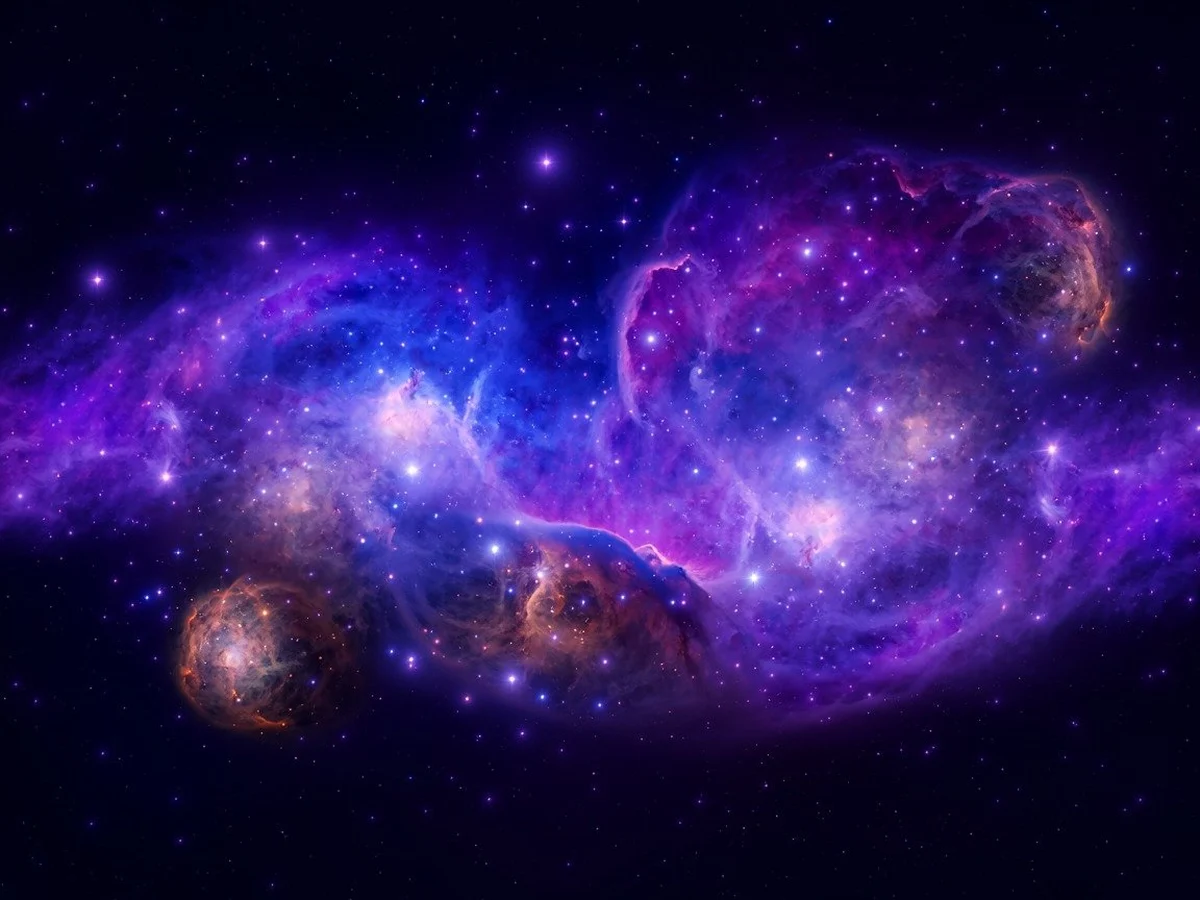
A core-collapse supernova often leaves a neutron star, an object about 20 kilometres across but heavier than the Sun, spinning rapidly. Some neutron stars are pulsars, sending out beams of radio waves like a lighthouse. If the collapsing core is heavy enough, it becomes a black hole. Around the remnant, the blasted gas forms an expanding cloud, a supernova remnant, glowing in many colours and rich in newly made elements.
Could one affect Earth?
A supernova would need to be very close, within a few dozen light years, to seriously harm life on Earth, and no star that close is expected to explode soon. Betelgeuse, a red supergiant in the constellation Orion, is a famous candidate for a future supernova, but it is about 550 to 700 light years away, far enough to be safe. When it explodes, perhaps within the next 100,000 years, it could be visible in daylight for weeks.
Sources & further reading
Rates and distances are estimates and may be revised by new observations. Photograph: original AI-generated illustration (Adobe Firefly). Reference organisations do not endorse this website.