Faces as data
People recognise faces almost instantly, but teaching computers to do it has taken decades. Early systems in the 1960s required people to mark points on photos by hand, such as the corners of the eyes and the tip of the nose. Today, face recognition is mostly done with deep learning, a type of AI trained on huge collections of face images. The system learns which patterns help tell one person from another, even with different lighting, angles and expressions.
Step one: detection
Before recognising anyone, a system must find faces in an image or video. Face detection algorithms scan the picture for patterns typical of faces: two eyes, a nose and a mouth in a familiar arrangement. Your phone's camera does this when it draws a box around faces to focus. Detection simply says a face is here; it does not know whose face it is. Once found, the face is cropped and adjusted so that it is upright and a standard size.
Step two: the faceprint
Next, a neural network converts the face into a long list of numbers, often called an embedding or faceprint. These numbers describe features in a way that is hard for humans to interpret but useful for comparison. Two photos of the same person should produce faceprints that are close together, while photos of different people should be far apart. Modern systems are trained to make this distinction even when someone ages, grows a beard or wears glasses.
Verification and identification
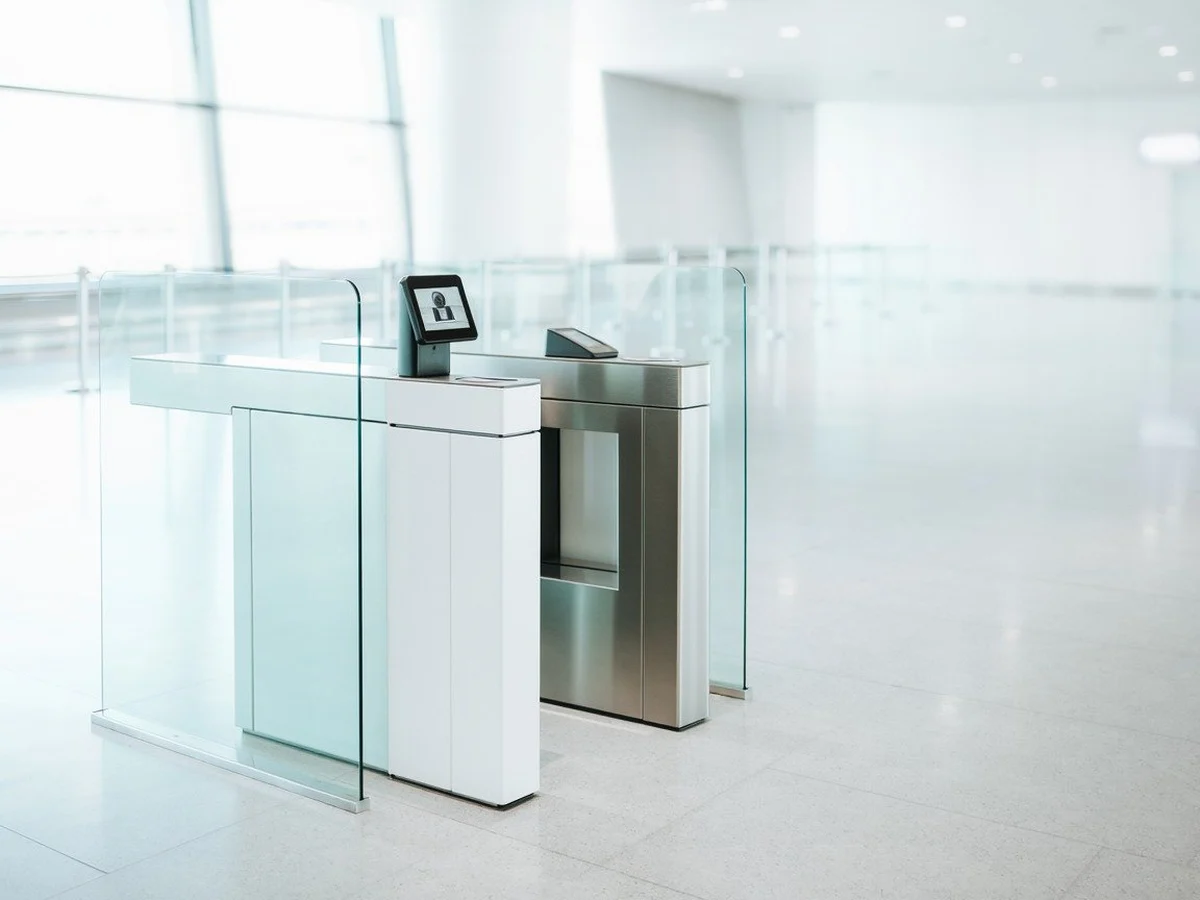
There are two main tasks. Verification is one-to-one: is this person who they claim to be? Unlocking a phone or passing through an airport e-gate works this way, comparing a live face with one stored template. Identification is one-to-many: who is this person, among a large database? That is used in some security and police investigations. Identification is technically harder and raises bigger privacy concerns, because it can be used to track people without their knowledge.
Face ID and 3D sensing
Apple introduced Face ID with the iPhone X in 2017. Instead of using only a normal camera, it projects thousands of invisible infrared dots onto the face and measures their positions, building a 3D map. This makes it much harder to fool with a printed photo. Apple states that the chance of a random person unlocking a phone with Face ID is about one in a million. The face data is stored securely on the device rather than sent to a server.
Accuracy and bias
Accuracy has improved greatly. The US National Institute of Standards and Technology tests many algorithms and has found that the best are extremely accurate in good conditions. But performance can drop with poor lighting, low-quality images, masks or unusual angles. Earlier studies found that some systems made more errors for women and people with darker skin, because their training data was unbalanced. Developers now work to test and reduce such differences.
Smart gates in the UAE
The UAE has been an early adopter of face recognition at airports. At Dubai International and Abu Dhabi airports, smart gates allow registered travellers to pass through immigration by looking at a camera, comparing their faces with stored records. Some airlines and airports have introduced biometric boarding, using face recognition instead of showing boarding passes. These systems aim to speed up journeys while maintaining security at some of the world's busiest airports.
Privacy and rules
Because faces cannot be changed like passwords, the use of face recognition raises serious privacy questions. Laws differ widely between countries. The European Union's AI Act places strict limits on real-time remote biometric identification in public spaces by police, with narrow exceptions. Data protection laws in many places require clear consent and secure storage. Many experts argue that transparency about when and why the technology is used is essential for public trust.
Using it wisely
For individuals, face recognition on personal devices is generally convenient and secure, especially when data stays on the device. It is still wise to keep a strong backup passcode. When an app or service asks to use your face data, check how it is stored and shared. As the technology spreads into shops, offices and public spaces, informed public debate will shape how its benefits are balanced against the right to privacy.
Sources & further reading
- NIST · Face Recognition Technology Evaluation ↗
- Apple · About Face ID advanced technology ↗
- Wikipedia · Facial recognition system ↗
General information; accuracy figures depend on the system, conditions and testing method. Photograph: original AI-generated illustration (Adobe Firefly). Reference organisations do not endorse this website.