A unit borrowed from heat
The calorie began as a unit of heat in nineteenth-century science, long before it appeared on food packets. One small calorie is the energy needed to raise the temperature of one gram of water by one degree Celsius. That is tiny, so nutrition uses a unit a thousand times larger: the kilocalorie, enough to warm one kilogram of water, about a litre, by one degree. Confusingly, the 'calories' on food labels and in diet advice are kilocalories, sometimes written as Calories with a capital C. The scientific unit of energy is the joule, and one kilocalorie equals 4.184 kilojoules. Many labels give both figures side by side.
Setting food on fire
The energy in food was first measured by burning it. In a bomb calorimeter, a dried sample is sealed in a strong steel container filled with pure oxygen and immersed in water. An electric spark ignites it, and the rise in the water's temperature reveals how much heat the food released. In the late nineteenth century, the American chemist Wilbur Atwater combined such measurements with careful studies of what people ate and excreted. He found that the body cannot use all the energy a calorimeter detects: some food passes through undigested, and the nitrogen in protein leaves in urine. His adjusted results gave the factors still used for labelling today.
The four, four, nine rule
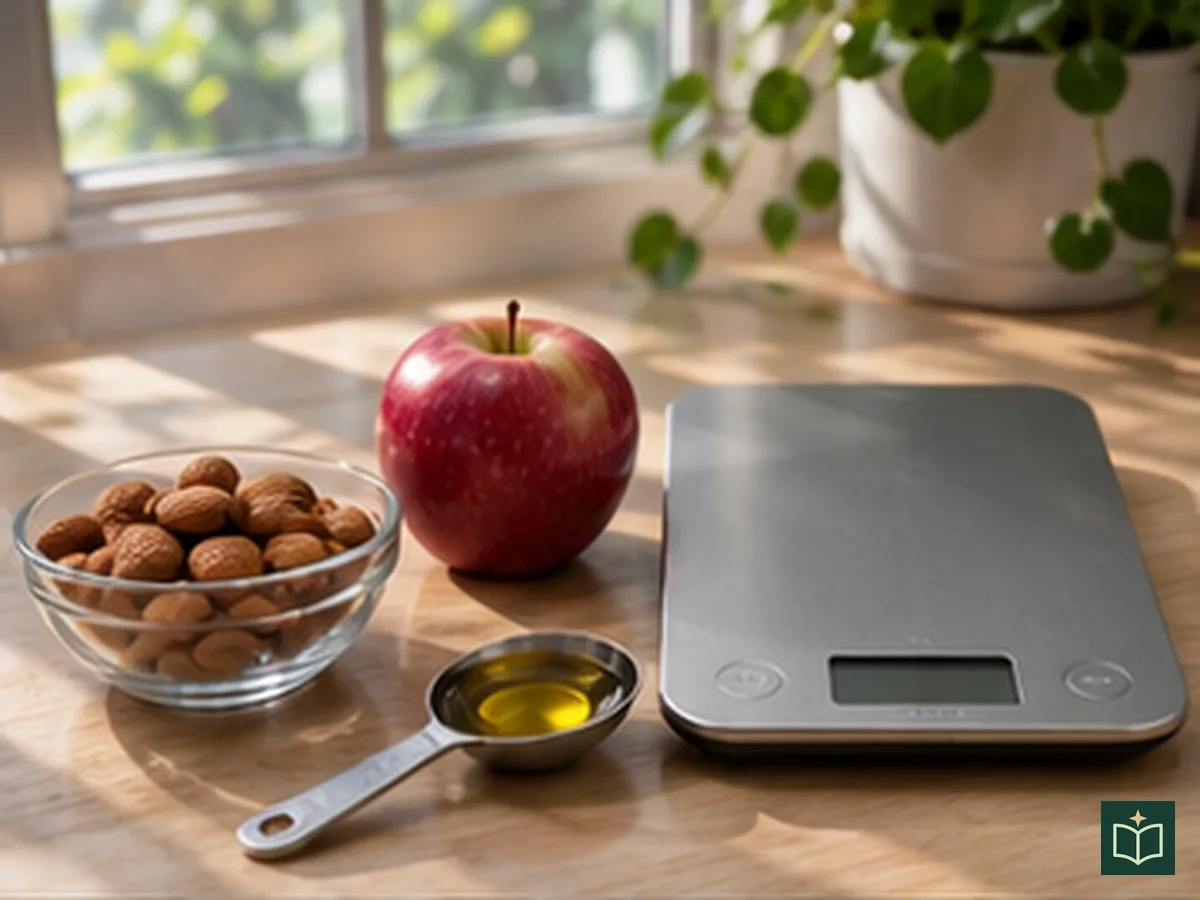
Atwater's general factors are about 4 kilocalories per gram for carbohydrate, 4 for protein and 9 for fat. Alcohol provides about 7, and fibre, which gut bacteria partly ferment, is often counted at about 2. To produce a label, manufacturers usually measure the grams of each nutrient and multiply. Take a snack containing 30 grams of carbohydrate, 10 grams of protein and 10 grams of fat: that gives 120 plus 40 plus 90, or 250 kilocalories, about 1,046 kilojoules. Fat's higher figure explains why oily foods are so energy-dense. A level tablespoon of cooking oil, about 14 grams, carries roughly 125 kilocalories, similar to a large apple.
The body is not a furnace
A calorimeter burns food completely and instantly. The body works through digestion, absorption and metabolism, and the results depend on the food. Nuts are a well-studied example: their tough cell walls trap some of the fat, and controlled studies found that people absorbed noticeably fewer calories from whole almonds than standard factors predict, roughly a fifth fewer. Cooking and processing generally make food easier to digest, releasing more of its energy. Protein also costs more energy to process than carbohydrate or fat, a difference known as the thermic effect of food. And each person's gut bacteria extract energy a little differently. Labels are therefore averages, with legal margins of error.
How much energy do we need?
A person's daily energy needs depend on body size, age, sex and activity. Much of the energy goes simply to keeping the body alive: running the brain, heart, liver and kidneys and maintaining body temperature. This basal metabolism usually accounts for most of the daily total in people who are not very active. Reference values on labels are often based on 2,000 kilocalories a day for an average adult, but real needs vary widely. A small, sedentary older adult may need much less; a tall, active young adult much more. For personal advice on weight or diet, especially alongside a health condition, a doctor or registered dietitian is the right source.
A useful but blunt tool
Calories measure energy, not nutrition. Two foods with the same number can differ enormously in protein, fibre, vitamins and how filling they are. A 330-millilitre can of sugary soft drink and a small handful of nuts carry similar energy, yet they affect hunger, blood sugar and health very differently. Counting calories can help people understand portion sizes and energy-dense foods, and it underpins public-health tools such as menu labelling, now required in some countries. But the number on a label is best seen for what it is: a nineteenth-century unit of heat, refined by careful science, estimating the energy a typical body can draw from a meal.
Sources & further reading
- Britannica · Calorie ↗
- World Health Organization · Healthy diet ↗
- Food and Agriculture Organization of the UN ↗
Figures are rounded and widely published; check the linked organisations for the latest editions. These organisations do not endorse this website.