Where wave energy comes from
Ocean waves are produced by wind blowing across the sea surface. The longer the wind blows, the stronger it is and the greater the distance of open water, called the fetch, the larger the waves become. Once formed, swell can travel thousands of kilometres with relatively little loss, carrying energy from distant storms to far-off coasts. The strongest wave resources are found on west-facing coasts at mid to high latitudes, such as those of Ireland, Scotland, Portugal, Chile, southern Australia and the Pacific Northwest of North America. There, the average power reaching a metre of coastline can reach several tens of kilowatts.
Many ways to catch a wave
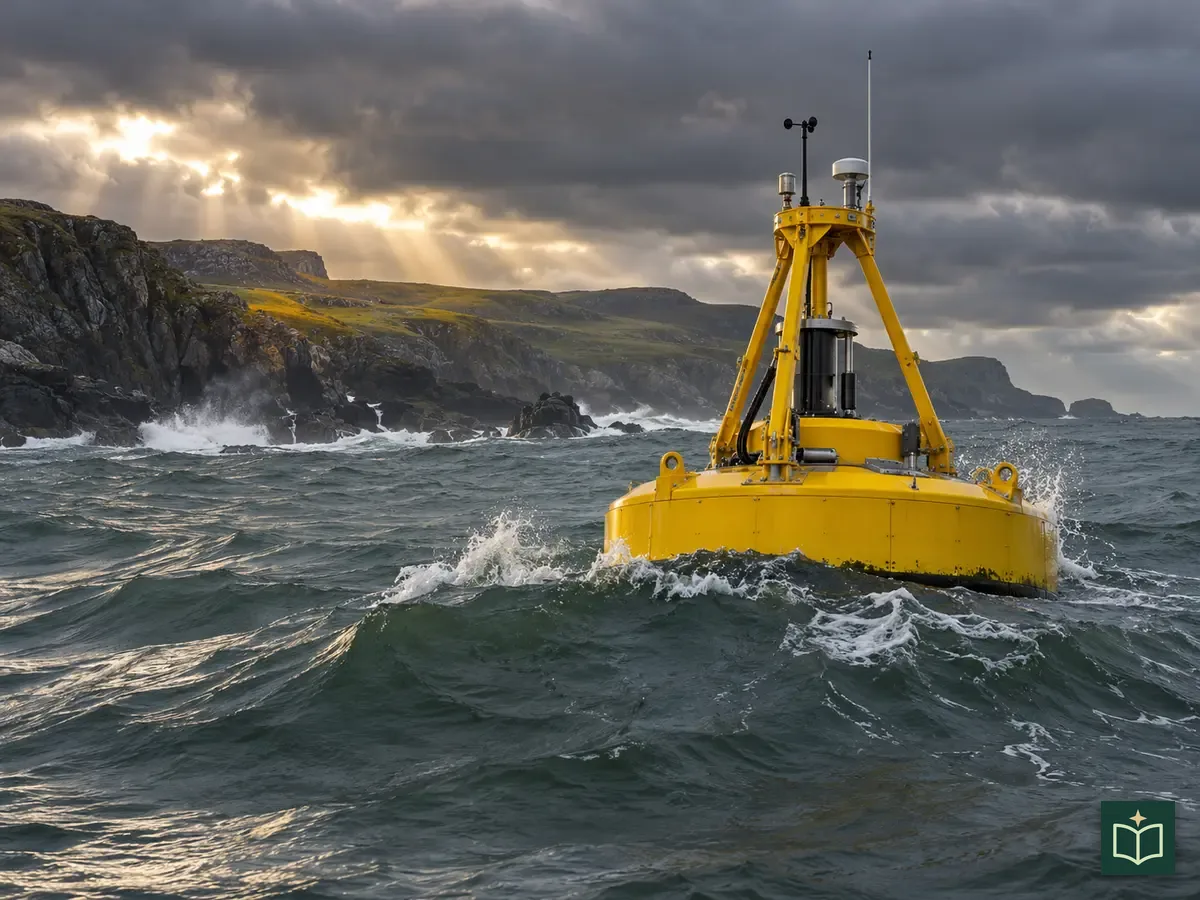
Unlike wind power, where the three-bladed turbine became standard, wave energy has no dominant design. Point absorbers are buoys that bob up and down and drive a generator. Attenuators are long, jointed floating structures that flex as waves pass; the Pelamis machine, nicknamed the ‘sea snake’, was a well-known example. Oscillating wave surge converters are hinged flaps on the seabed that rock back and forth. Oscillating water columns are partly submerged chambers in which waves push air up and down through a turbine. Overtopping devices let waves spill into a reservoir, then release the water through low-head turbines. Each design suits different water depths and wave climates.
Lessons from real projects
Several devices have been tested at sea for years, especially at the European Marine Energy Centre in Orkney, Scotland, established in 2003. Spain’s Mutriku plant, built into a breakwater in the Basque Country, has operated an oscillating water column array since 2011, showing how wave devices can share costs with coastal protection. Yet the sector has also seen setbacks. Pelamis Wave Power and Aquamarine Power, two leading Scottish developers, went into administration in 2014 and 2015 respectively, after struggling to cut costs and raise funding. Their experience showed how long and expensive the path from prototype to commercial power station can be.
The engineering challenge
Wave devices must harvest energy from ordinary waves efficiently while surviving storms that may be ten or more times more powerful. Designing for both is difficult and expensive. Salt water corrodes metals, marine organisms foul surfaces, and moving parts wear under constant motion. Installation and maintenance require specialist vessels and calm weather windows, which can be rare on the very coasts with the best resources. Connecting devices to the grid via subsea cables adds cost. These factors explain why wave energy’s cost per megawatt-hour remains far higher than that of offshore wind, which shares many of the same marine challenges but uses simpler, standardised machines.
Why it still attracts interest
Wave energy has attractive features. Waves are generally more consistent than wind and more predictable over hours and days, since swell can be observed approaching. Wave and wind output do not always peak together, so combining them could smooth supply. Devices sit low in the water and can have little visual impact from shore. Small islands and remote communities, which pay high prices for diesel-generated electricity, are seen as early markets. Navies and offshore operators are also interested in wave power for sensors and equipment at sea. In the sheltered Arabian Gulf, waves are relatively small, so the resource there is limited.
What to watch
Progress in wave energy is likely to come from convergence on fewer, proven designs, as happened with wind turbines, along with shared test sites and steady public funding. Indicators to watch include the number of devices operating continuously for several years, independently verified performance data and the first arrays of multiple machines delivering power to the grid. Hybrid platforms combining wave devices with floating wind turbines are another area of research. Wave power is unlikely to become a major global energy source soon, but it remains one of the largest untapped renewable resources, and incremental engineering advances could make it practical in the right places.
Sources & further reading
- US Energy Information Administration · Wave power ↗
- European Marine Energy Centre ↗
- NOAA Ocean Service · What is a wave? ↗
Figures are rounded and widely published; check the linked organisations for the latest editions. These organisations do not endorse this website.