Why go small?
For decades, nuclear power stations grew larger to benefit from economies of scale. Modern large reactors produce over 1,000 megawatts each; the UAE’s Barakah plant, for example, has four units of around 1,400 megawatts. But large projects in Europe and the United States have suffered long delays and cost overruns, making investors wary. Small modular reactors, or SMRs, take a different approach. Instead of building one huge custom plant, the idea is to manufacture smaller, standardised reactors in factories, ship them to site and install them like modules. Supporters hope repetition will bring the cost reductions that mass production delivered for aircraft and ships.
How they differ
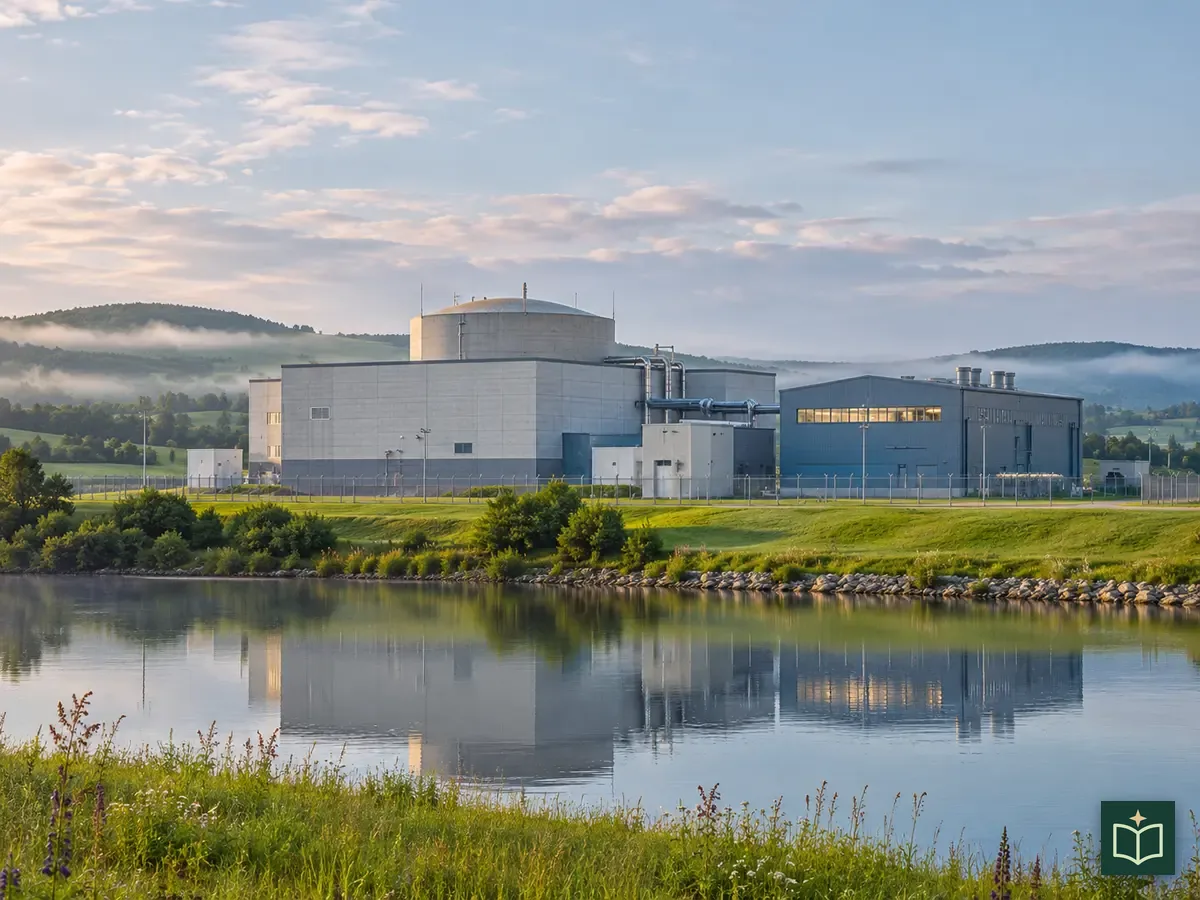
SMRs generally produce up to about 300 megawatts of electricity per unit, according to the International Atomic Energy Agency’s definition; very small designs, under about 10 megawatts, are often called microreactors. Many use the same basic light-water technology as large reactors, while others use high-temperature gas, molten salt or liquid metal coolants. Their smaller cores and lower power make it easier to use passive safety systems, which rely on natural forces such as gravity and convection to cool the reactor without pumps or operator action. Some designs sit below ground level or in water pools. Their size also suits replacing retiring coal plants on existing grid connections.
Operating examples
A few SMR-type reactors are already running. Russia’s Akademik Lomonosov, a floating power plant with two 35-megawatt reactors adapted from icebreaker designs, began commercial operation in the Arctic town of Pevek in 2020. China connected the HTR-PM, a high-temperature gas-cooled demonstration plant at Shidaowan, to the grid in 2021, and is building the ACP100, also called Linglong One, on Hainan island. In North America, projects in Canada and the United States are under development, with Ontario’s Darlington site selected for one of the first grid-scale SMRs in the West. Dozens of other designs remain on paper or in licensing, and only a minority are likely to reach commercial service.
The cost question
The central question is whether SMRs can be cheaper per megawatt-hour than large reactors. Smaller reactors lose economies of scale, so they must win back costs through factory production, shorter construction and simpler safety systems. That requires a steady order book: factories only become efficient after building many units. Early projects are likely to be expensive. In 2023, NuScale Power and a group of US utilities cancelled a planned project in Idaho after estimated electricity costs rose and too few customers signed up. Supporters say such setbacks are normal for first-of-a-kind technology; sceptics argue the economics may never match the promises.
Waste, fuel and safety
SMRs face the same issues as all nuclear power. They produce spent fuel that must be stored safely for very long periods, and some studies suggest certain small designs may generate more waste per unit of electricity, a claim that designers dispute. Several advanced designs need high-assay low-enriched uranium, or HALEU, enriched to between 5 and 20 per cent, which is currently produced in very limited quantities. Licensing new designs takes years, and regulators must decide how to handle smaller emergency planning zones. Security and non-proliferation safeguards apply as for any reactor, overseen internationally by the IAEA, and spreading many small units across more sites raises its own security questions.
What to watch
Interest in SMRs has grown because of the need for reliable low-carbon electricity, rising power demand from industry and data centres, and the desire to replace coal plants. Several Gulf and Middle Eastern countries, building on the experience of Barakah, have explored SMRs, including for desalination and industrial heat. Key signals to watch include the first SMRs reaching commercial operation on time and budget in Western countries, the number of firm orders for a single design, progress in HALEU supply and regulatory approvals. SMRs could become an important part of future power systems, but for now they remain a promising idea with limited real-world evidence.
Sources & further reading
- IAEA · Small modular reactors ↗
- World Nuclear Association · Small nuclear power reactors ↗
- US Department of Energy · Advanced small modular reactors ↗
Figures are rounded and widely published; check the linked organisations for the latest editions. These organisations do not endorse this website.