Before the pile
In the late eighteenth century, electricity came in sparks. Scientists stored static charge in Leyden jars and released it in a single snap, useful for demonstrations but useless for sustained experiments. In the 1780s the Bologna anatomist Luigi Galvani noticed that dissected frog legs twitched when touched with two different metals. He concluded that the animal tissue itself held a special 'animal electricity'. Alessandro Volta, a physics professor at the University of Pavia, was intrigued but unconvinced. He suspected that the metals, not the frog, were the source. The disagreement drove him into years of experiments with different metal pairs, and eventually to a device that needed no animal at all.
How the pile was built
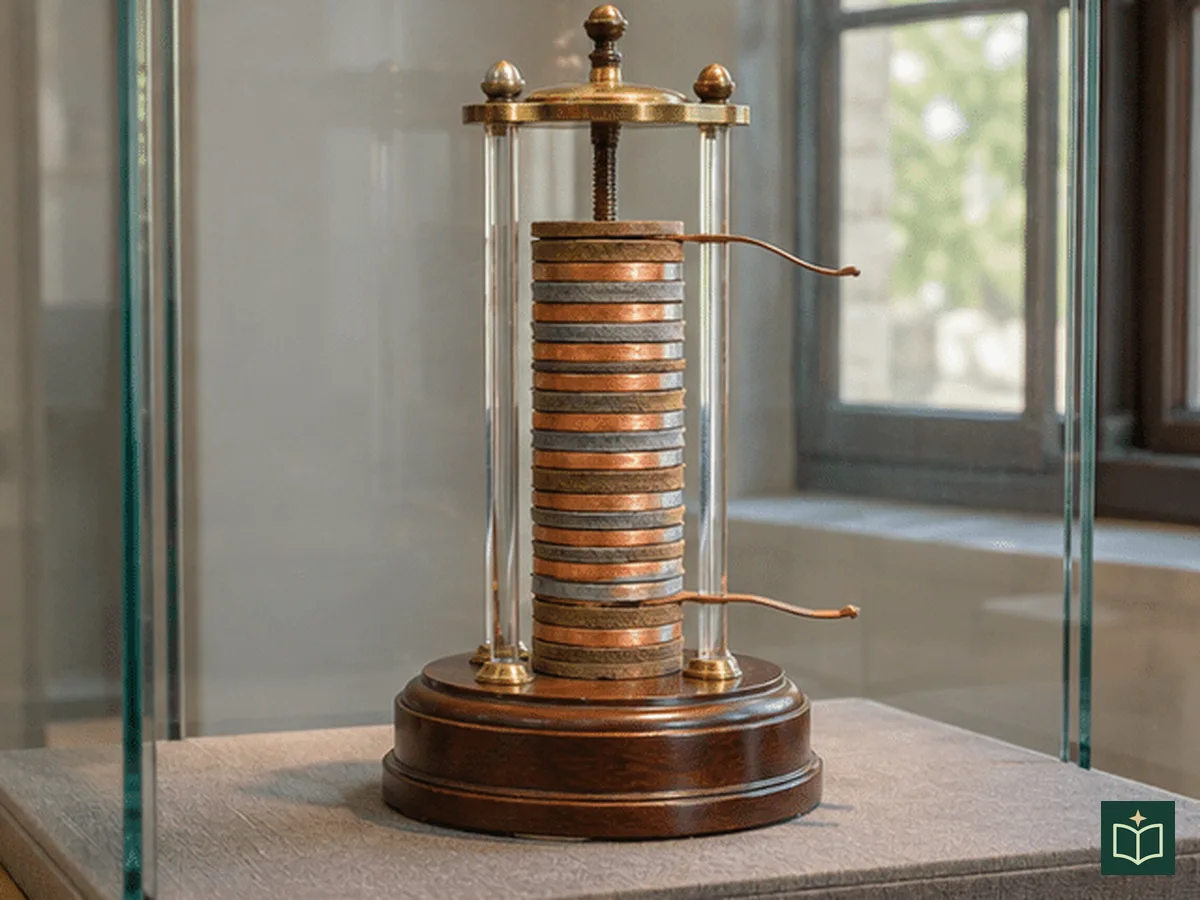
Volta's apparatus was strikingly simple. He stacked alternating discs of zinc and copper, or silver, separating each pair with a piece of cardboard or cloth soaked in salt water. A wire connecting the top of the column to the bottom carried a continuous current, and touching both ends produced a distinct shock. He also built a version called the crown of cups, a ring of bowls filled with brine and linked by metal strips. In a letter to Sir Joseph Banks, President of the Royal Society, dated 20 March 1800, he described both. The letter was published that year, and instrument makers and scientists across Europe were soon building their own piles.
Adding up the volts
Each zinc and copper pair in brine produces a modest push, less than one volt in modern units. The key to the pile was that cells connected in series add together. Twenty cells of roughly 0.8 volts each give about 16 volts, enough to deliver a noticeable shock and drive chemical reactions. Larger piles with hundreds of pairs produced far higher voltages. The trade-off was that the wet card dried out, and bubbles of hydrogen gathered on the copper, weakening the current within hours. That effect, called polarisation, was not properly solved until John Frederic Daniell's two-fluid cell of 1836, which gave a steadier output for telegraphs and laboratories.
A wrong theory, a right device
Volta believed the current arose simply from contact between two different metals. That explanation turned out to be incomplete. The energy actually comes from chemistry: zinc dissolves into the electrolyte, giving up electrons that travel through the external wire to the copper side, where they are taken up in a second reaction. The pile was, in effect, slowly consuming its zinc. Galvani had not been entirely wrong either, since nerves and muscles do use electrical signals. Both men were partly right, and the debate between them pushed physiology and physics forward. Volta's practical achievement, a reliable source of continuous current, mattered far more than his theory.
The birth of electrochemistry
Within weeks of the announcement, the London chemists William Nicholson and Anthony Carlisle passed a current from a pile through water and saw it split into hydrogen and oxygen, the first electrolysis. Humphry Davy then built large batteries at the Royal Institution and, in 1807 and 1808, used them to isolate potassium, sodium, calcium and other elements that ordinary chemistry could not separate. Later researchers, including Michael Faraday, used batteries to explore the links between electricity and magnetism, laying foundations for motors and generators. For several decades, until mechanical generators took over in the later nineteenth century, chemical batteries were the main practical source of electric current.
Volta's legacy
Volta was widely honoured in his lifetime; Napoleon invited him to demonstrate the pile in Paris in 1801 and later made him a count. In 1881 an international congress of electricians adopted the volt, the unit of electrical potential, in his name. The basic architecture he found still defines every battery: two electrodes made of different materials, an electrolyte that lets ions move between them, and an external circuit through which electrons flow. Today's lithium-ion cells use far more sophisticated materials and can be recharged thousands of times, but a phone battery and a stack of coins and salty card share the same underlying principle.
Sources & further reading
Figures are rounded and widely published; check the linked organisations for the latest editions. These organisations do not endorse this website.