A dose delivered. A system built.
An international catch-up effort reached millions of children. The next challenge is making access dependable for every new birth cohort.
 View full-size infographic
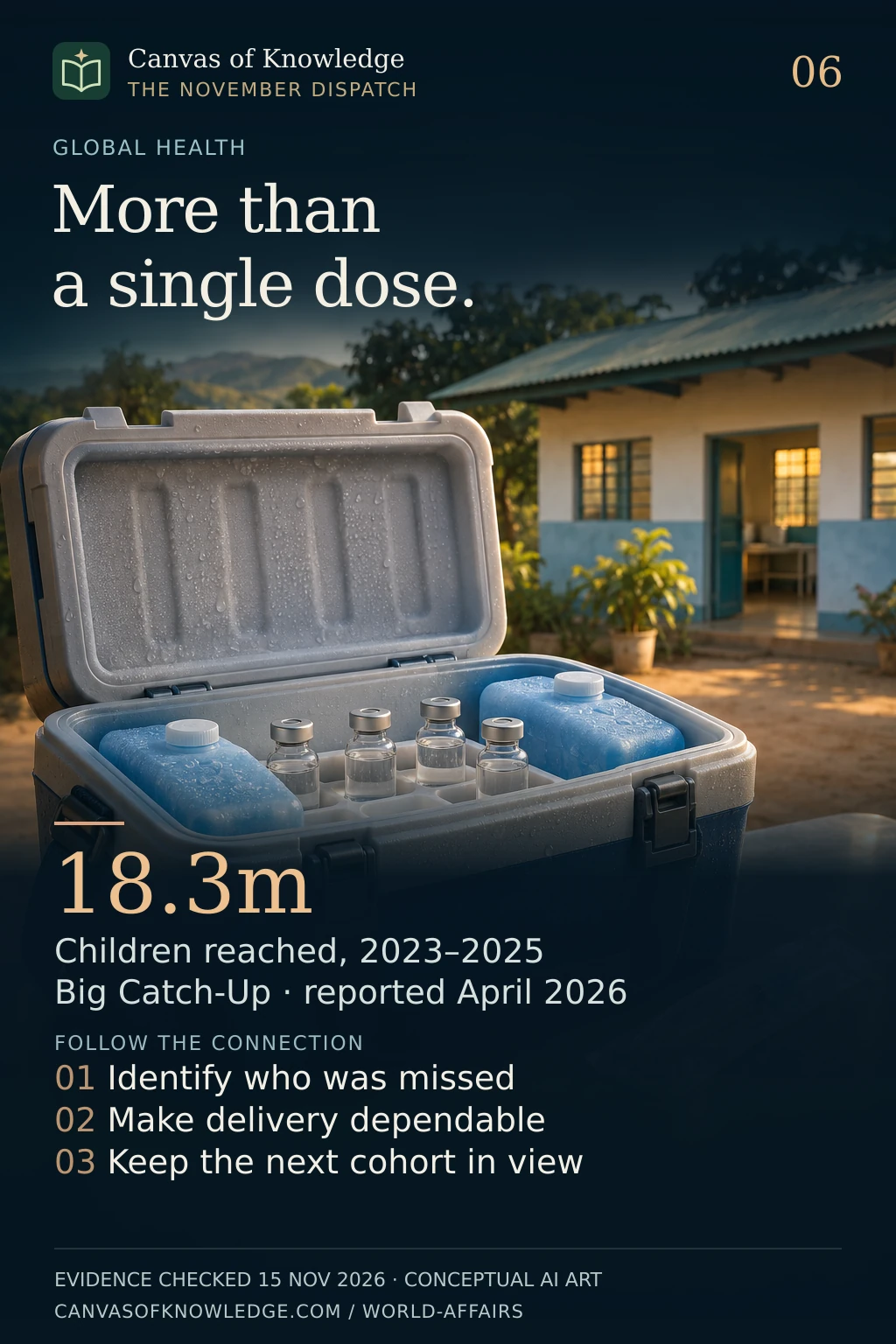
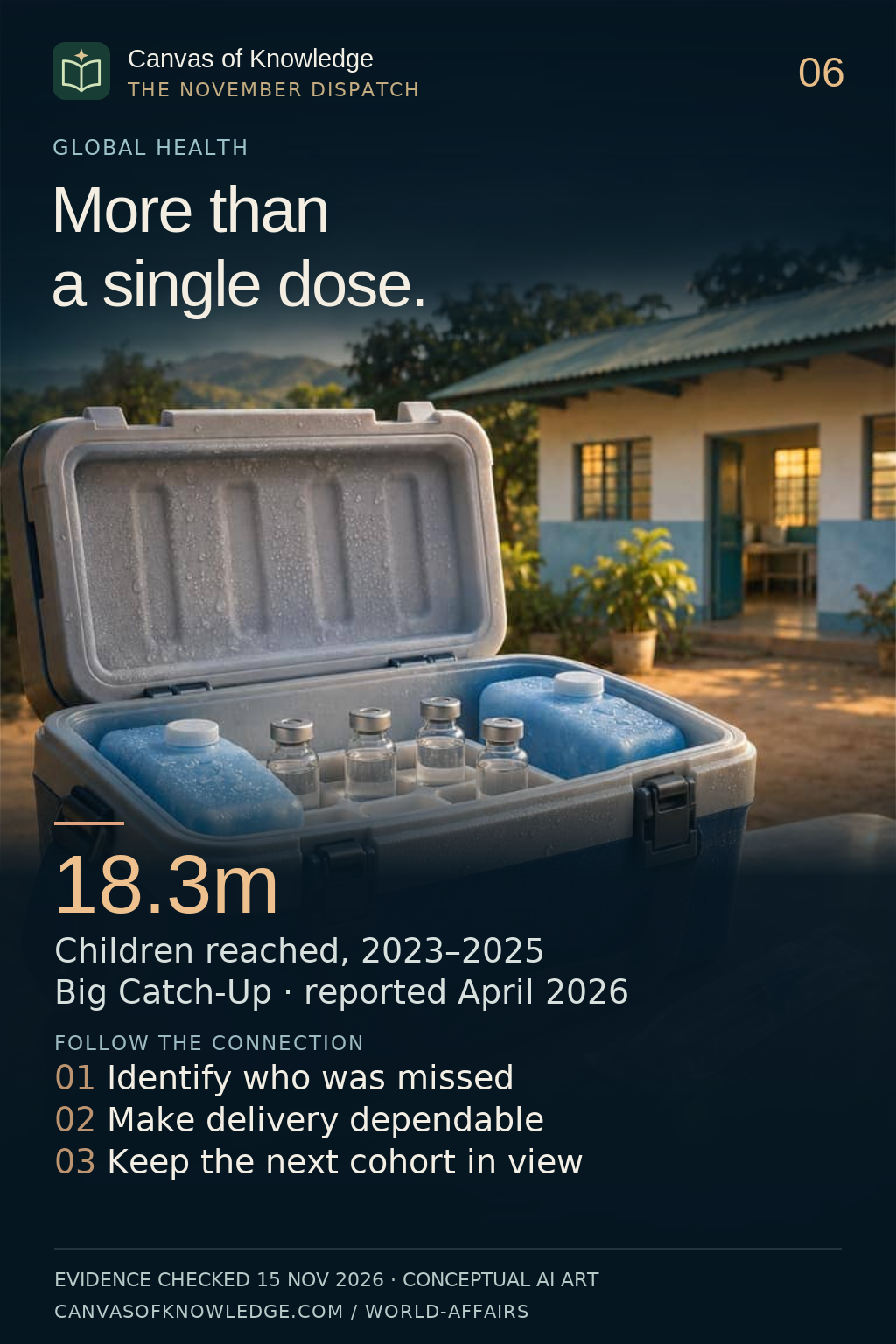
More than
a single dose.
Children reached in the Big Catch-Up's reported 2023–2025 results · estimate released April 2026
Vaccination progress has two clocks: catching up people previously missed, and keeping routine services reliable as new children become eligible.
Latest policy context: WHO 29 October 2026. Routine coverage: 2025. Big Catch-Up results: 2023–2025, reported 24 April 2026.
WHO's 29 October immunisation update describes pressure on programme budgets even as countries work to close protection gaps. Earlier this year, the Big Catch-Up reported reaching an estimated 18.3 million children across 36 countries. The contemporary question is how those gains become lasting access, rather than a one-off effort followed by another backlog.
- 01
Identify who was missed
A catch-up programme must find people who did not receive earlier services. The Big Catch-Up worked with older children as well as the systems usually focused on infancy. Finding a child, checking records and recording a dose are parts of delivery, not peripheral paperwork.
- 02
Make delivery dependable
A vaccine recommendation becomes useful through functioning services. Staffing, supplies, outreach and public confidence have to meet in the same place and time. A scientifically sound policy can still leave a practical gap if the programme cannot reach the people it is meant to serve.
- 03
Keep the next cohort in view
Each year brings new children into routine services. Clearing yesterday's backlog does not automatically cover tomorrow's needs. Programmes must sustain everyday access while retaining the ability to reach people missed earlier, rather than treating the two tasks as interchangeable.
Count people and doses separately
The April UNICEF, WHO and Gavi announcement reported more than 100 million vaccine doses delivered to the estimated 18.3 million children in its 2023–2025 results. Those numbers describe different units: one child may receive several doses. Implementation concluded in March 2026, while final reporting was still being assembled. The initiative's target of at least 21 million children was therefore a target in that announcement, not a confirmed final outcome. We keep the reported result and ambition separate.
An average can conceal a gap
WHO's July coverage release estimates that 85 per cent of infants received the third diphtheria, tetanus and pertussis vaccine dose in 2025. It also reports 84 per cent first-dose measles coverage by the second birthday. These are different indicators, not categories that should be added together. Global percentages describe broad progress while leaving substantial variation between countries and communities. A high national average cannot establish that every district or underserved group has equivalent access.
The lasting achievement is repeatability
The October WHO update connects immunisation with surveillance, evidence review and the resources needed to implement policy. Our interpretation is that the durable success story is not simply a large shipment or a campaign photograph. It is a service that people can use reliably, supported by records that reveal who is still missing. Progress should be judged by continuity as well as scale: can a programme retain staff, maintain outreach and respond to changing needs after a special initiative ends? That turns an exceptional mobilisation into a routine public capability, while keeping local experience visible behind the international total.
Better questions.
A clearer picture.
- Do final catch-up reports distinguish completed results from programme targets?
- Are routine services reaching communities previously missed, not only raising national averages?
- Are staffing, outreach and surveillance funded beyond short campaign cycles?
Sources & dates.
- WHO · Immunisation departmental update, October 2026
Published: 29 October 2026
Evidence period: October 2026 policy and programme assessment - UNICEF, WHO and Gavi · Big Catch-Up results announcement
Published: 24 April 2026
Evidence period: Reported delivery in 2023–2025; implementation concluded 31 March 2026; final data then pending - WHO · Immunization coverage
Published: 15 July 2026
Evidence period: 2025 global coverage estimates
Checked 15 November 2026. Conditions can change after publication. These organisations do not endorse Canvas of Knowledge.