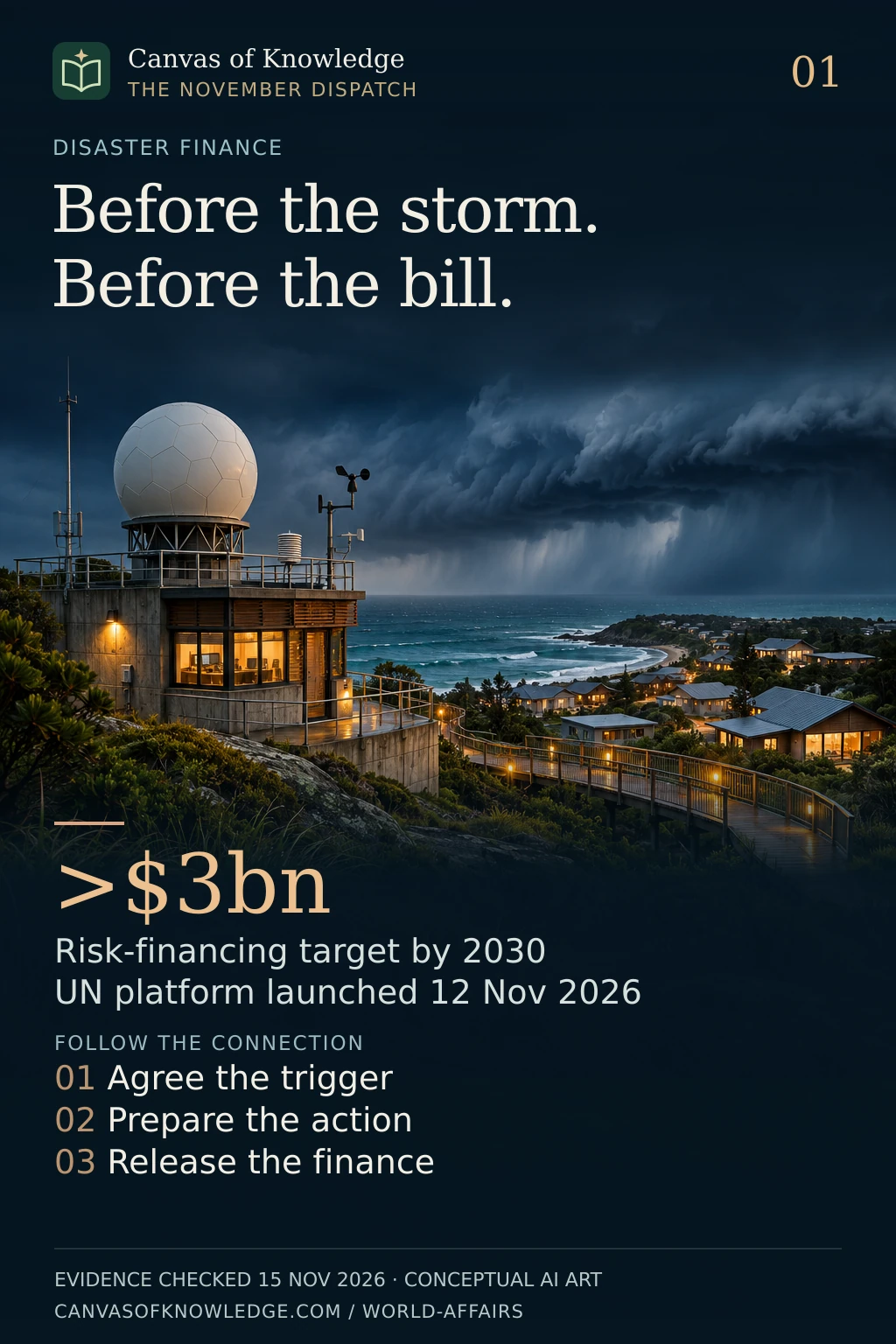
Before the flood. Before the appeal.
A new UN platform asks a practical question: can emergency money arrive while there is still time to prevent harm?
 View full-size infographic
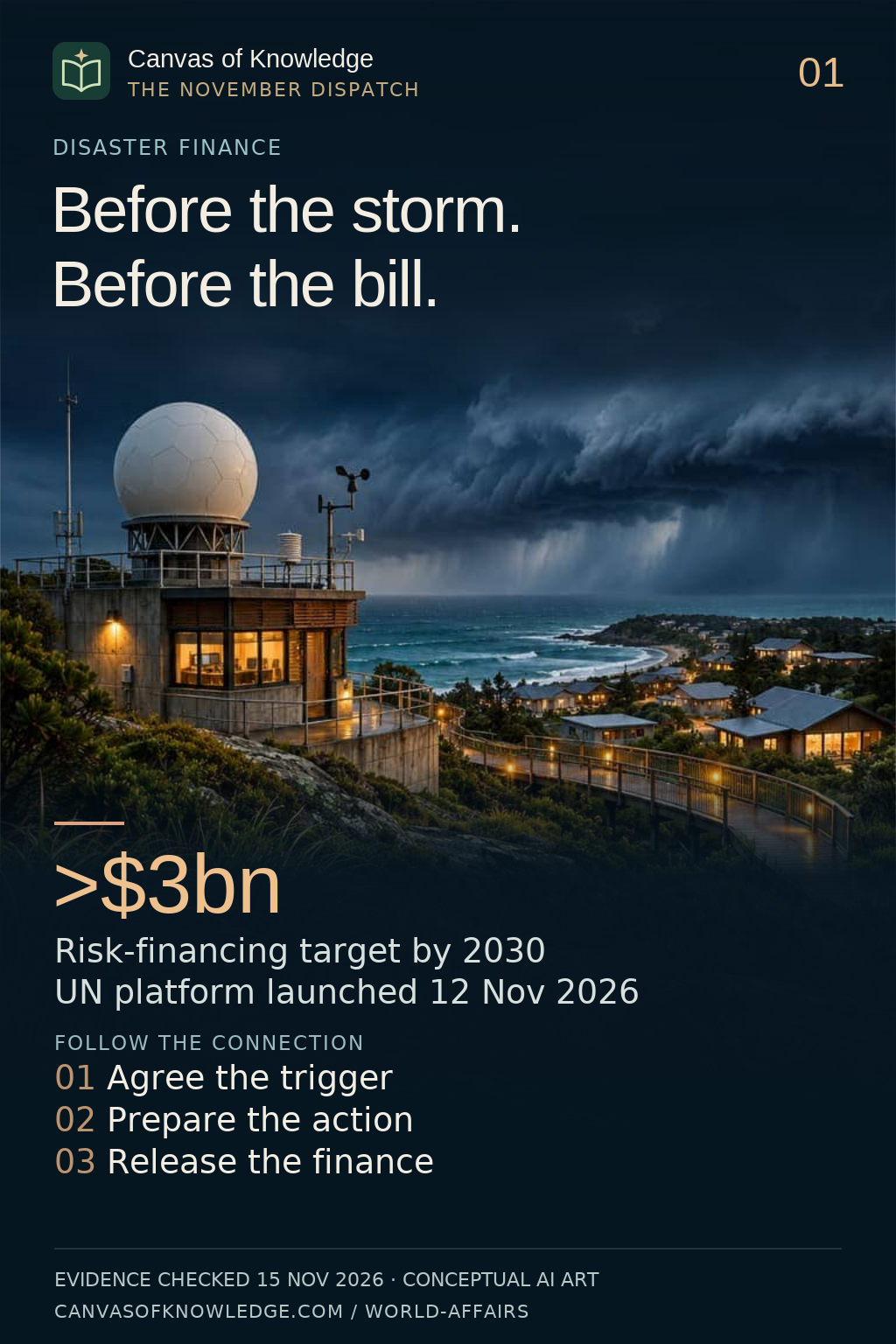
Before the storm.
Before the bill.
Risk-financing access sought by 2030 — a target, not money already disbursed
A forecast becomes protection only when a decision, a funded plan and a delivery system are ready together.
Platform launched 12 November 2026; early-warning capability data to August 2026
On 12 November, six UN agencies launched a Disaster Risk Financing Platform at COP31 in Antalya. Its ambition is access to more than US$3 billion in risk finance to protect 75 million people and their livelihoods by 2030. The important change is timing: arrange resources before a crisis, instead of beginning every response with a fresh appeal.
- 01
Agree the trigger
Decide in advance which forecast or risk threshold will activate a response. OCHA’s framework links a predicted shock to an explicit decision rule. This turns a warning into an operational question: has the agreed condition been met? It does not make the forecast infallible.
- 02
Prepare the action
Identify what can usefully happen in the available lead time, and who will do it. A plan must fit local conditions and the people exposed. An elaborate document that cannot be executed before the hazard arrives offers little practical protection.
- 03
Release the finance
Connect the trigger and action plan to money that has already been arranged. OCHA treats financing, activities and the trigger as a single framework. Speed then depends on operational readiness as well as approval: a transfer still needs a functioning route to its recipient.
Countries reporting some early-warning capability
- March 2025119countries
- August 2026136countries
WMO/UNDRR reporting of multi-hazard early-warning systems. Capabilities vary; these totals do not measure complete population protection. The March baseline is derived from the report’s stated increase of 17 countries.
Evidence period: Platform launched 12 November 2026; early-warning capability data to August 2026 · Source details below
What was launched, and what remains an ambition
The platform brings together FAO, IOM, OCHA, UNICEF, UNHCR and WFP. Agencies will coordinate data, expertise and financing arrangements while retaining operational independence. The launch announcement reports that OCHA and UNICEF had already put insurance policies in place for anticipatory programmes with WFP support. That is an initial arrangement, not evidence that the 2030 financing and protection targets have been achieved. A risk-finance commitment, an insurance limit and a payment to a household describe different things.
The decision is about uncertainty
Imagine a town receiving a serious flood forecast. Waiting for certainty may leave no time to move equipment or prepare safe shelter; acting early may mean spending money on an event that changes course. This illustrative trade-off is why a trigger should be understood and tested before an emergency. A useful evaluation asks whether action was timely and proportionate, what happened to people, and how the system handled a forecast that proved wrong. Counting activations alone cannot answer those questions.
Warnings are expanding; completeness still matters
WMO and UNDRR’s report published on 11 November records 136 countries reporting some multi-hazard early-warning capability by August 2026, up from 119 in March 2025. Yet fewer than half of reporting countries demonstrated capabilities across all four warning-system pillars. The report also stresses planning, community engagement and finance. A national capability indicator therefore cannot tell an individual whether a warning will reach their phone, be understood or lead to a safe, feasible action.
Better questions.
A clearer picture.
- How much finance becomes available under signed arrangements, and how much is actually paid out?
- Can local organisations and exposed communities shape the triggers and action plans?
- Do evaluations measure avoided harm and missed needs, as well as people nominally covered?
Sources & dates.
- UNICEF · UN launches Disaster Risk Financing Platform at COP31
Published: 12 November 2026
Evidence period: Launch arrangements and targets for 2030 - OCHA Centre for Humanitarian Data · Anticipatory Action Framework
Published: Undated technical documentation; checked 15 November 2026
Evidence period: Framework mechanics; historical pilot lists are not used as current coverage - WMO and UNDRR · Global Status of Multi-Hazard Early Warning Systems 2026
Published: 11 November 2026
Evidence period: Reported capability through August 2026 - WMO · Early warning protection expands worldwide
Published: 11 November 2026
Evidence period: March 2025 to August 2026 capability comparison
Checked 15 November 2026. Conditions can change after publication. These organisations do not endorse Canvas of Knowledge.