The ocean has a new rulebook.
The high-seas biodiversity agreement is in force. Its next test is turning shared rules into institutions, evidence and practical protection.
 View full-size infographic
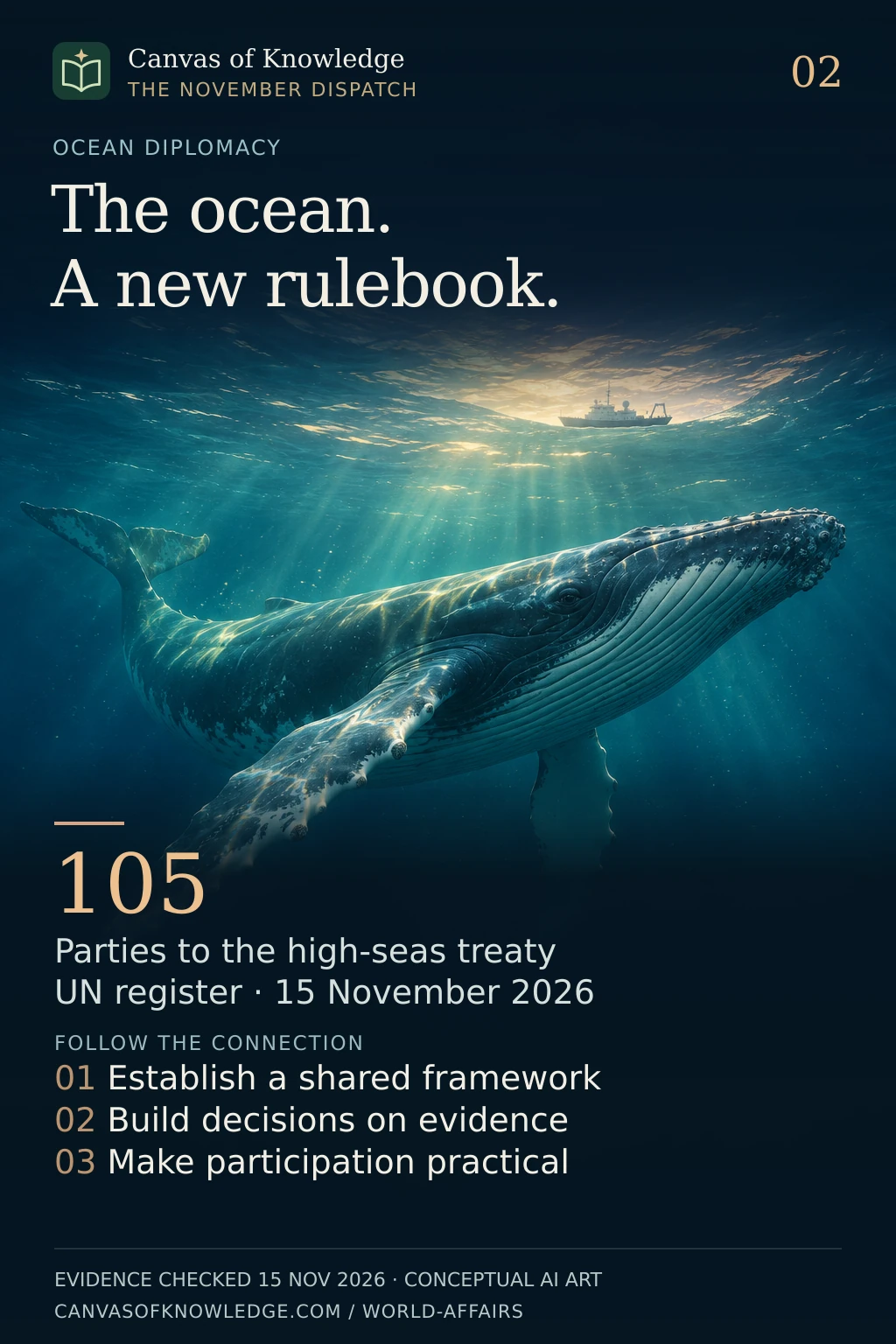
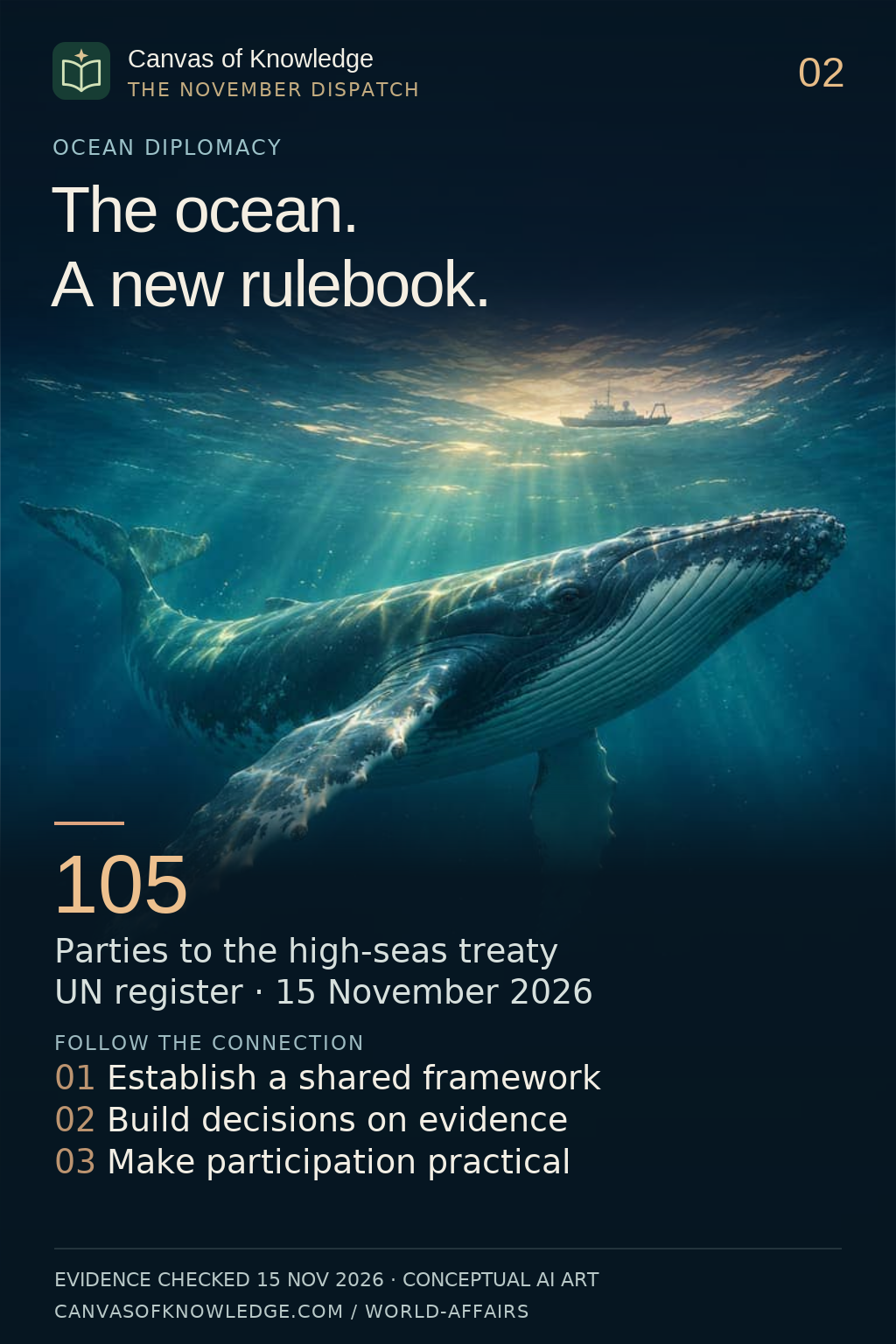
The ocean.
A new rulebook.
Parties listed for the BBNJ Agreement by the UN depositary · 15 November 2026
A treaty creates a framework for collective action. The quality of decisions, scientific capacity and implementation determines what changes in the water.
Treaty status checked 15 November 2026. Entry into force: 17 January 2026. First COP scheduled for 11–22 January 2027.
Preparations are under way for the BBNJ Agreement's first Conference of the Parties, scheduled for January 2027 in New York. The UN has published meeting documents, and non-governmental observer registration opened on 9 November. The story has moved beyond adoption: countries are preparing the machinery through which the agreement will operate.
- 01
Establish a shared framework
The agreement concerns marine biodiversity in areas beyond national jurisdiction. It brings conservation and sustainable use into a common framework under the UN Convention on the Law of the Sea. This does not turn the ocean into a territory owned by a single institution.
- 02
Build decisions on evidence
Measures such as marine protected areas need information about ecosystems, activities and potential impacts. Scientific observations and accessible data help turn a proposed boundary into a defensible conservation choice. Missing knowledge should be identified, rather than concealed by a visually impressive map.
- 03
Make participation practical
A seat in a meeting is not the same as the capacity to collect and interpret ocean data. Training, shared infrastructure and access to marine technology are part of making cooperation effective, especially for countries with limited research resources.
The count needs a definition
The UN Treaty Collection lists 105 parties and 145 signatories in its 15 November status record. These are not two piles to add: a party may also have signed earlier. Nor should parties simply be labelled countries, because the European Union participates too. Entry into force occurred on 17 January 2026. That establishes an important legal milestone; it does not show that every participant has identical domestic capacity or that every intended conservation outcome has already happened.
Four connected tasks
The UN describes four main areas: marine genetic resources and benefit-sharing; area-based management, including protected areas; environmental impact assessment; and capacity-building with marine technology transfer. They address different parts of the same challenge. Protecting a habitat requires knowledge of it, while sharing the benefits of research raises questions about access and participation. The agreement also provides institutions, information-sharing and a financing mechanism. These are enabling arrangements, not a count of ecosystems already restored.
Science is part of the diplomacy
UNESCO's Intergovernmental Oceanographic Commission identifies ocean observations, biodiversity data and training as practical supports for implementation. Our interpretation: the striking change is the connection between a research vessel and a negotiating room. Measurements become evidence; evidence can inform rules; rules need implementation and review. Before declaring success, look for the working links between those stages. January's first COP is still ahead as this briefing is published, so its decisions cannot yet be reported. The useful question is how governments will make a shared framework usable by scientists, administrators and affected communities over time.
Better questions.
A clearer picture.
- What institutional, budget and information-sharing decisions does the first COP actually adopt?
- Can countries with limited ocean-research capacity participate meaningfully?
- How do future protection proposals connect scientific evidence with implementation and review?
Sources & dates.
- UN Treaty Collection · BBNJ Agreement status
Published: Live status record checked 15 November 2026
Evidence period: Status as at 15 November 2026 - United Nations · BBNJ Agreement overview
Published: Continuously updated; checked 15 November 2026
Evidence period: Agreement in force in 2026; first COP preparations for January 2027 - United Nations · First BBNJ Conference of the Parties
Published: Meeting and registration information checked 15 November 2026
Evidence period: Registration opens 9 November 2026; meeting scheduled 11–22 January 2027 - UNESCO IOC · BBNJ treaty enters into force
Published: 16 January 2026; updated 28 September 2026
Evidence period: 2026 ocean-science and implementation framework
Checked 15 November 2026. Conditions can change after publication. These organisations do not endorse Canvas of Knowledge.