The city beyond its streets.
A city’s water security begins upstream and continues through the drains, wetlands and services that rarely make the skyline.
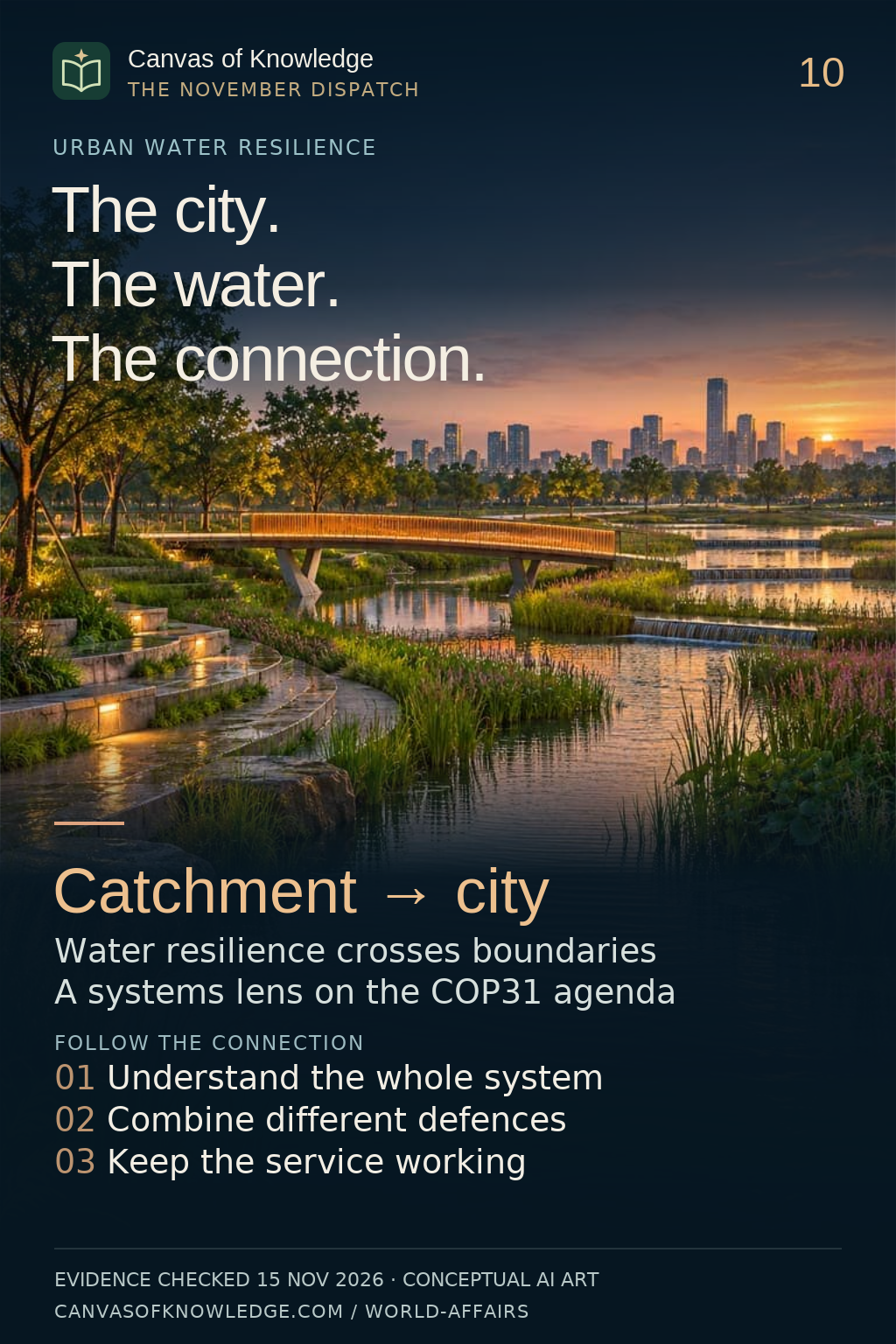 View full-size infographic
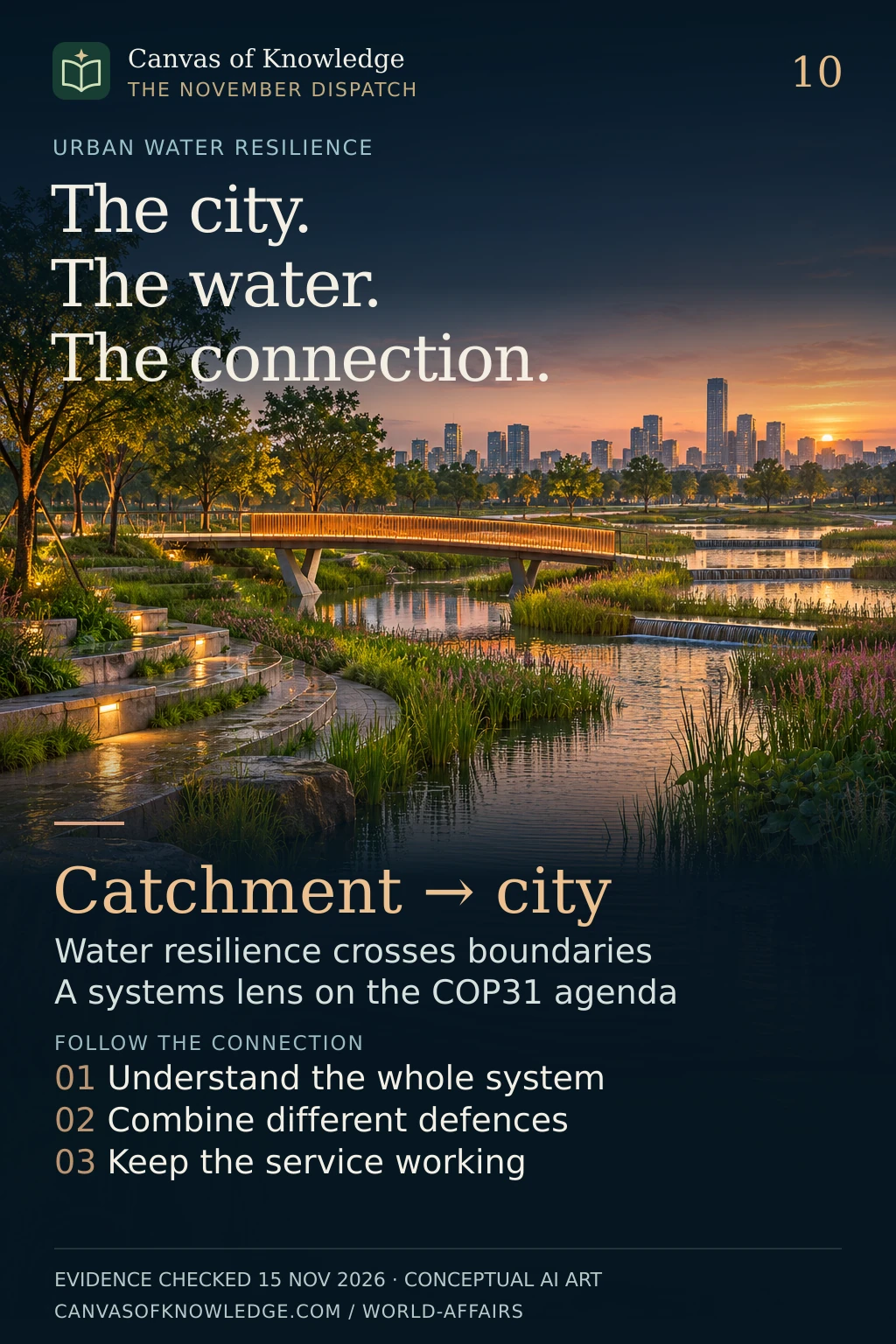
The city.
The water.
The connection.
The scale at which water risks and urban decisions need to meet
Urban resilience depends on connected water systems, sustained maintenance and the people most exposed to failure.
COP31 urban agenda, 11–12 November 2026; supporting case studies retain their original project dates
COP31 has placed cities, infrastructure and water together on its action agenda. UNEP’s programme identifies urban resilience as part of the Leaders Summit on 12 November, alongside a roundtable on moving plans into implementation. The significance is practical: the ability to keep a neighbourhood functioning depends on systems that cross administrative boundaries and continue beneath the surface.
- 01
Understand the whole system
UNDRR’s 2026 urban-water review stresses risk knowledge and coordinated governance. Start with how water reaches, crosses and leaves the city, then connect that picture to exposure. A municipal boundary is a line of responsibility; it is not a barrier that stops a river or a drought.
- 02
Combine different defences
The World Bank describes urban flood projects that combine drainage and engineered structures with wetlands, green corridors and planning measures. These approaches serve different functions. Their value lies in a locally designed combination, rather than in assuming one attractive feature can resolve every kind of flooding.
- 03
Keep the service working
UNDRR highlights sustained investment and community engagement alongside technical solutions. Ask who operates a system after construction, how problems are reported and whether exposed residents can influence decisions. A project is more than its opening day: resilience is tested repeatedly through use and changing conditions.
A conference agenda is the beginning of a delivery test
UNEP’s COP31 programme connects urban implementation with buildings, infrastructure, water, mobility and waste. It describes a process for moving plans towards action, rather than demonstrating that cities are already protected. Our analytical test is to follow the next steps: an identified risk, a prepared intervention, a funded operating plan and observable service improvements. Each step can fail independently. Announcing a facility or convening a dialogue does not establish that money has reached a neighbourhood or that a drainage system is being maintained.
A real example, with its dates left attached
The World Bank’s January 2026 results review reports that the Can Tho Urban Development and Resilience Project in Viet Nam, implemented during 2016–2024, combined flood-defence infrastructure and green corridors. It also installed 60 sensors at flooding hotspots to support real-time monitoring. This is a documented earlier project, not a new COP31 promise. Its relevance is the connection between physical works and information: a city needs to understand changing conditions as well as build assets. Sensors are part of an operating system, not protection by themselves.
Flooding and scarcity belong in the same conversation
UNDRR’s Waves of Change examines cities in Europe and Central Asia dealing with floods, droughts and scarcity. Its approaches include reuse, nature-based measures, monitoring and integrated planning. The lesson is not that every city should copy the same design. Our synthesis is that water management must reconcile multiple objectives: reducing damaging excess, maintaining dependable supply and avoiding decisions that simply transfer risk. A useful public question is therefore not just ‘how much infrastructure?’ but ‘whose service improves, under which conditions, and who remains exposed?’
Better questions.
A clearer picture.
- Do urban plans connect upstream land use, drainage, water supply and vulnerable neighbourhoods?
- Are operating budgets and responsible institutions identified alongside construction finance?
- Are reductions in exposure and service interruptions measured after projects open?
Sources & dates.
- UNEP · From Plans to Delivery: Cities, Infrastructure and Water at COP31
Published: Official event programme, checked 15 November 2026
Evidence period: Scheduled programme for 11–12 November 2026 - UNDRR · Waves of Change: Urban resilience pathways to flood and water scarcity risk
Published: 2026; publication page last checked 30 July 2026
Evidence period: Case studies and approaches in Europe and Central Asia - World Bank · Strengthening Flood Resilience in Rapidly Growing Cities
Published: 26 January 2026
Evidence period: Results from projects including Can Tho, 2016–2024
Checked 15 November 2026. Conditions can change after publication. These organisations do not endorse Canvas of Knowledge.