Trade reroutes. The bill travels.
Why a growing world trade total can coexist with fractured supply chains and sharply unequal outcomes.
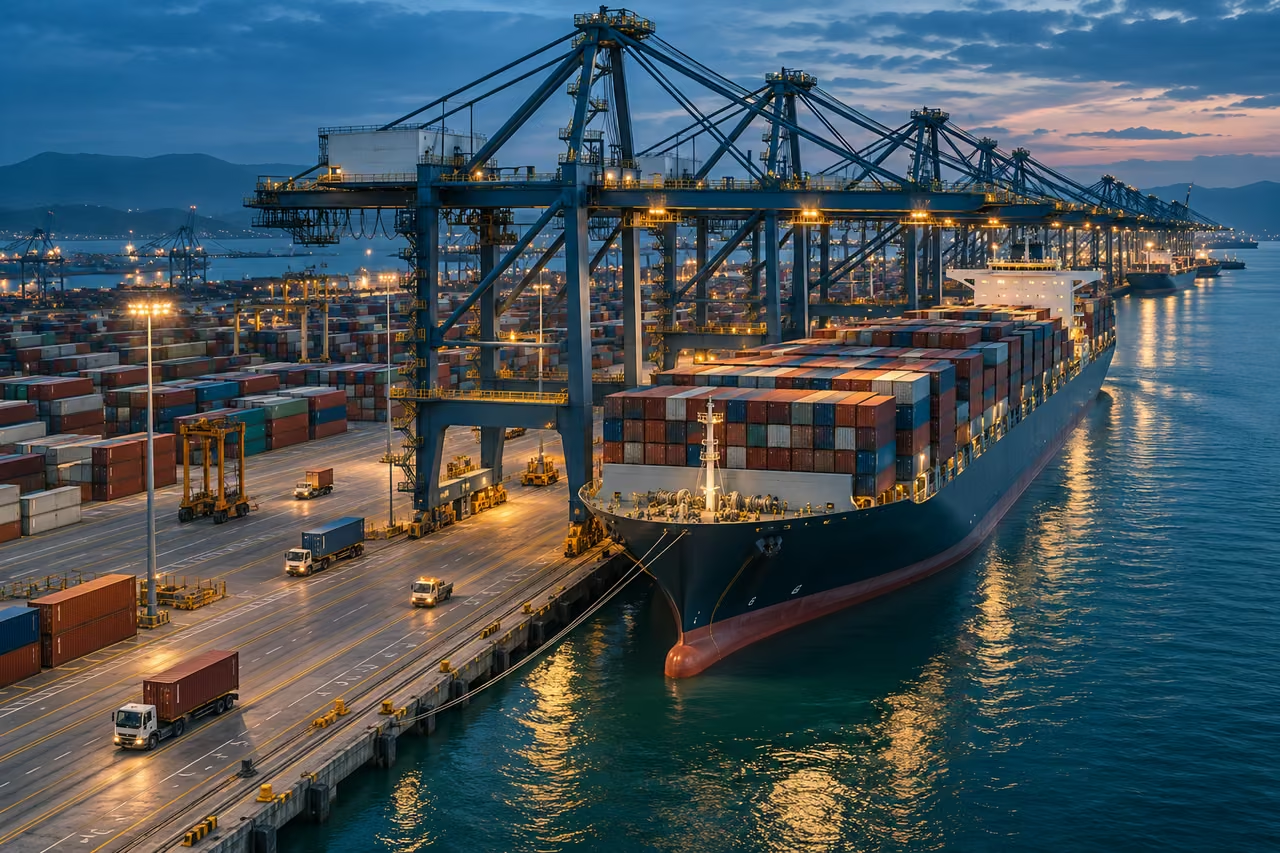
Conceptual AI illustration; not a documentary photograph.
Evidence: WTO forecast published 8 October 2026; IMF outlook published 13 October 2026
The WTO raised its 2026 goods-trade forecast in October while cutting its services outlook. AI-related investment and adaptation are cushioning disruption, but the benefits are uneven. This is an update to expectations, not a completed-year result.
- 01
A barrier changes the calculation
Tariffs, disrupted routes or uncertain rules can alter the delivered cost of a product. A firm must compare suppliers, transport, compliance and reliability together.
- 02
Businesses adapt
Orders can move, shipping can reroute and inventories can absorb delays. Adaptation may preserve deliveries while introducing extra cost, duplication or concentration elsewhere.
- 03
The effects travel
A changed input bill can reach manufacturers, retailers and households. Who absorbs it depends on contracts, competition, exchange rates and the ability to substitute.
Two parts of trade. Different outlooks.
- Merchandise trade3.9% volume growth, 2026 forecast
- Commercial services trade3.3% volume growth, 2026 forecast
WTO October 2026 forecasts. These are growth rates, not shares of world trade. Both are projections.
Evidence period: WTO forecast published 8 October 2026; IMF outlook published 13 October 2026 · Source details below
The aggregate is not the experience
The WTO projects 3.9 per cent merchandise trade volume growth in 2026 and 3.3 per cent commercial services trade growth. Its October assessment identifies AI investment as a support for goods trade and conflict-related disruption as a drag on travel and transport. Rising totals therefore should not be read as evidence that all trade relationships are becoming easier.
Two economies can live inside one headline
The IMF’s October outlook projects global output growth of 3.1 per cent in 2026. It highlights the difficult position of energy importers outside the technology value chain. A country selling equipment into a technology boom faces a different mix of opportunities and costs from one paying more for essential imports without a comparable export boost.
Read resilience as a balance sheet
Our interpretation: resilience is best examined through several questions. Are deliveries arriving, at what cost, and with how much inventory or spare capacity left? A successful diversion today does not prove a permanent solution. Likewise, a tariff headline alone cannot tell you the final consumer price: the economic effect depends on how the whole chain responds.
Better questions.
A clearer picture.
- Do later WTO releases confirm the projected growth, or revise it?
- Are gains spreading beyond AI-related goods and a small group of exporters?
- Are alternative suppliers and routes reducing vulnerability or moving it elsewhere?
Sources & dates.
- WTO · October 2026 trade outlook update
Published: 8 October 2026
Evidence period: 2026 forecast; 2026 first-half observations - IMF · World Economic Outlook, October 2026
Published: 13 October 2026
Evidence period: 2026–2027 projections; information available through 1 October 2026 - WTO · Global Trade Outlook and Statistics, March 2026
Published: March 2026
Evidence period: Earlier forecast vintage; context for tariffs and uncertainty
Checked 15 November 2026. Conditions can change after publication. These organisations do not endorse Canvas of Knowledge.