The universe is in the ingredients.
Hydrogen, oxygen and gold share a periodic table. Their cosmic histories are profoundly different.
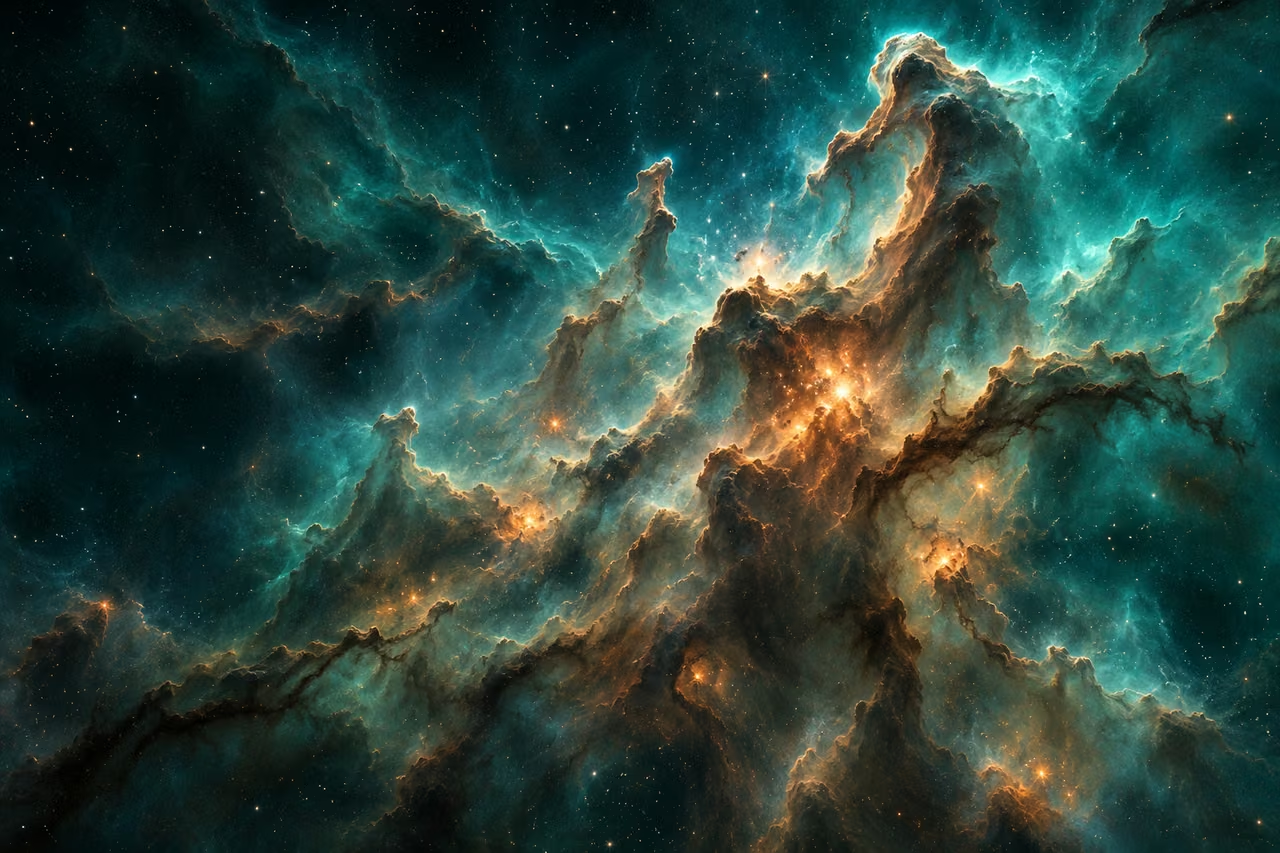
Conceptual AI illustration. Colours and scales are illustrative; not a documentary image or exact scientific model.
A glass of water and a gold ring look unrelated. At the nuclear level, each carries evidence of environments that existed before Earth. Their nuclei have histories.
From mystery
to mechanism.
- 01
Begin with a simpler universe
After early nucleosynthesis, the young universe contained mostly hydrogen and helium. It did not contain the full periodic table we know today.
- 02
Let stars change the mixture
Stellar nuclear reactions create new nuclei. Which ones are produced depends on the star, its stage of evolution and the reactions available.
- 03
Disperse and assemble again
Material expelled from stars and explosive events joins interstellar gas. Later stars and planets can form from this chemically enriched mixture.
Three chapters in the history of matter
Swipe across the mechanism →
Primordial hydrogen and helium establish the starting mixture.
Different environments support different nuclear pathways.
Recycled gas contributes to new stars and planets.
A selective sequence, not a claim that all elements follow one route.
Not every atom is star-made
Much of the universe’s hydrogen predates the first stars. NASA describes those first stars as almost entirely hydrogen and helium; later generations, including the Sun, contain heavier elements inherited from earlier stellar processing. Saying that every atom in a person was forged inside a star therefore erases an important part of the story.
The periodic table has several factories
Fusion in stars is one route to new nuclei. Neutron capture supplies other routes, especially for elements heavier than iron. Do not picture one giant furnace making everything in sequence. Nuclear astrophysics instead connects different stellar environments with different reaction networks, then asks how their products accumulated across a galaxy.
An event leaves a chemical signature
After the 2017 neutron-star merger GW170817, astronomers examined the changing light from its ejecta. A 2019 analysis identified newly formed strontium. This links an observed event to the production of a specific element. It supports neutron-star mergers as sites of heavy-element formation, without proving that every heavy nucleus everywhere came from the same kind of event.
Sources & further reading.
- DOE · Nucleosynthesis
- NASA · What were the first stars like?
- ESO · Strontium identified after a neutron-star merger
Sources checked 15 November 2026. Explanations simplify complex systems and identify their limits. These organisations do not endorse Canvas of Knowledge.