The boundary that light cannot cross back.
A black hole is not a cosmic vacuum cleaner. Its defining feature is a boundary in spacetime.
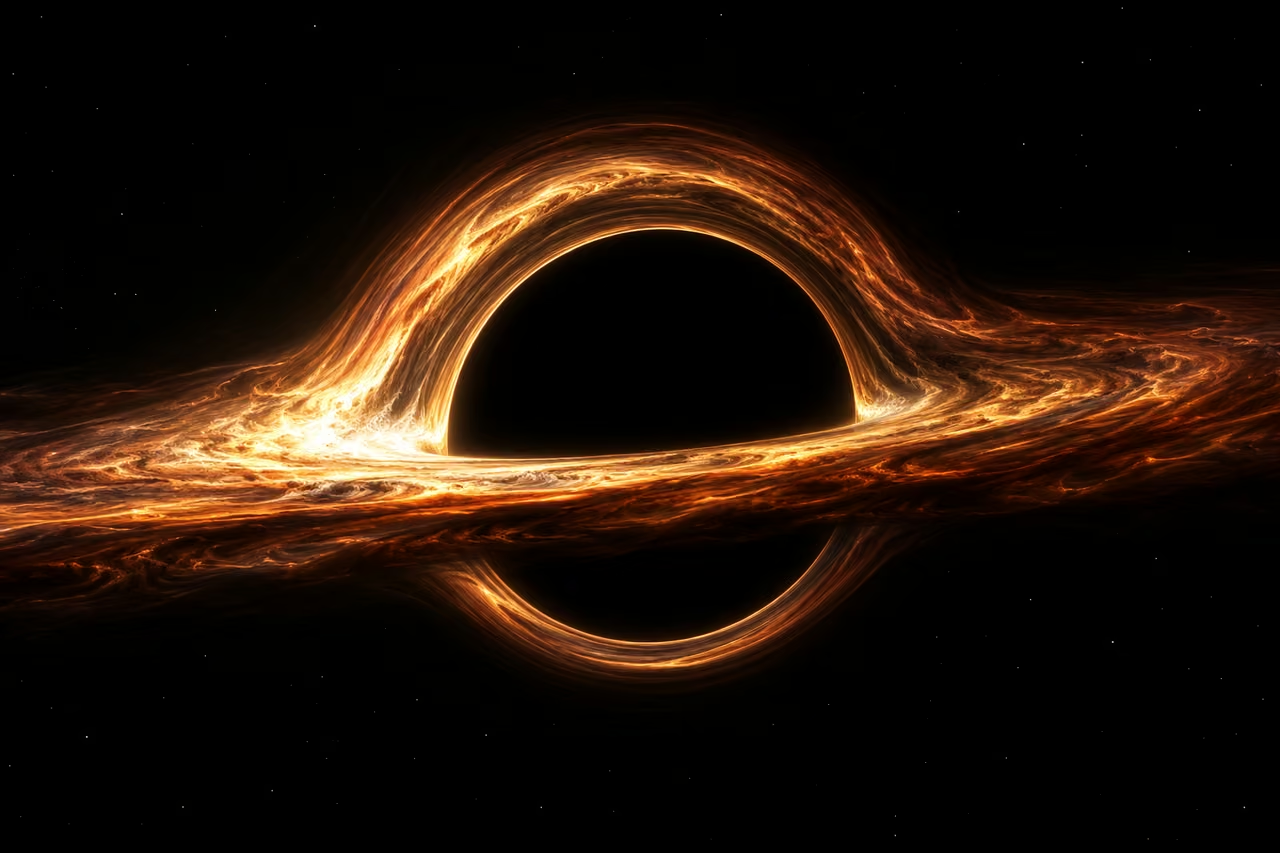
Conceptual AI illustration. Colours and scales are illustrative; not a documentary image or exact scientific model.
Light surrounding darkness is a strange sight. Understanding what each part represents turns a dramatic cosmic portrait into evidence about gravity, matter and the paths light can take.
From mystery
to mechanism.
- 01
Locate the horizon
An event horizon is a causal boundary: signals sent from inside cannot reach the distant exterior. It is not a solid shell.
- 02
Find the source of light
Hot material outside the horizon can emit radiation. Some black holes have luminous accretion flows; isolated ones may have little nearby matter to illuminate.
- 03
Follow the distorted paths
Gravity bends the paths of light around the hole. Emission, lensing and captured light together shape the observed bright structure and central shadow.
Three things the image must not confuse
Swipe across the mechanism →
A possible source of observable radiation.
Produced by light capture and curved light paths.
Not a glowing surface or the visible ring.
Conceptual distinctions. Sizes and shapes are not drawn to scale.
A boundary that grows with mass.
For a non-rotating, uncharged black hole, the Schwarzschild radius is proportional to mass.
Uses 2.95325 km per solar mass. This is radius, not diameter or the apparent shadow size. Rotation changes the geometry; 1 solar mass is a mathematical example, not a claim about an observed stellar-remnant black hole. No image is inferred from this slider. Constants: NASA/JPL astrodynamic parameters.
Strong gravity is not unlimited suction
Imagine replacing the Sun with a black hole of the same mass. Earth’s orbit would remain essentially unchanged, although sunlight would disappear. The Sun cannot actually become such a black hole. NASA’s thought experiment isolates mass from size and exposes the vacuum-cleaner misconception.
A shadow is not a photograph of the interior
The Event Horizon Telescope observes radio emission from plasma around its targets. Its reconstructed images reveal a dark central feature against brighter surrounding material. The shadow is not identical to the physical size of the event horizon. Nor does a bright ring tell us what happens after matter crosses that boundary.
Where the description reaches its limits
General relativity predicts a singularity in idealised black-hole descriptions. Treating that mathematical result as a directly observed object would go too far. NASA notes that it may indicate where a fuller account, including quantum effects, is needed. The unknown interior is a reason for careful questions, not evidence for portals or confirmed travel to another universe.
Sources & further reading.
- NASA · Anatomy of a black hole
- NASA Goddard · Black holes and the vacuum-cleaner misconception
- Event Horizon Telescope · Imaging, light paths and accretion
Sources checked 15 November 2026. Explanations simplify complex systems and identify their limits. These organisations do not endorse Canvas of Knowledge.