One arrival. A pattern of possibilities.
The double-slit experiment makes individual detections accumulate into a pattern that ordinary particles alone cannot explain.
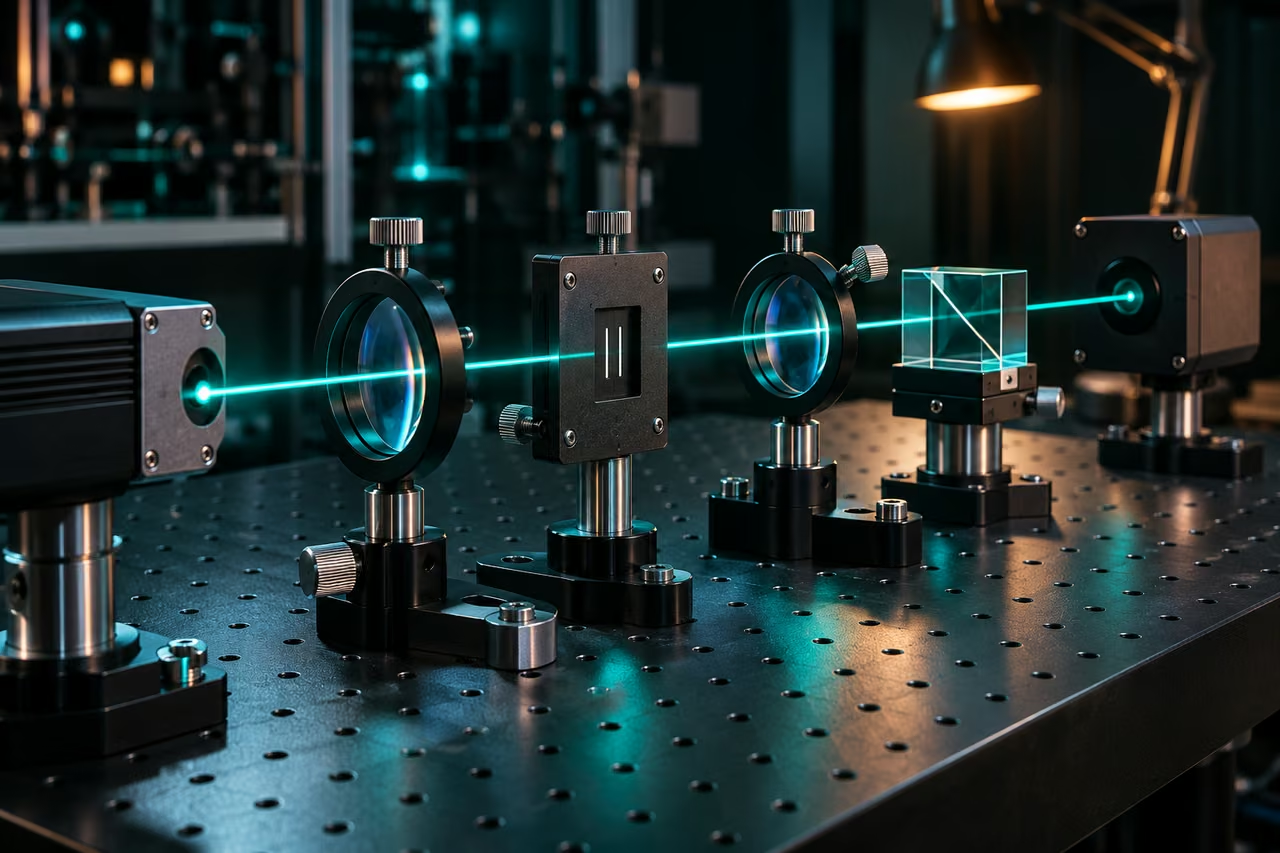
Conceptual AI illustration. Colours and scales are illustrative; not a documentary image or exact scientific model. The visible beam represents an alignment beam, not individual photons.
Imagine keeping the individual arrival marks but gradually revealing their arrangement. Each mark is local. The completed pattern contains alternating regions of high and low detection probability. Both observations belong to the same experiment.
From mystery
to mechanism.
- 01
Prepare coherent alternatives
A controlled source and two possible paths allow amplitudes to retain a definite relationship. Simply drawing two slits does not guarantee usable coherence.
- 02
Accumulate detections
A detector records individual events. Repeating the preparation many times reveals the distribution; one isolated dot cannot display a whole interference fringe.
- 03
Make paths distinguishable
A measurement interaction can correlate the system with a path record. As usable path information increases, interference visibility can decrease.
From individual events to a distribution
The alternatives retain a phase relationship.
Each recorded event has a location.
The accumulated probability pattern becomes visible.
A teaching sequence, not measured data or a literal picture of a photon’s trajectory.
The pattern depends on information.
Indistinguishable alternatives can interfere, producing alternating high- and low-probability regions.
Illustrative Gaussian envelope, with cosine-squared modulation when coherent. Each distribution is normalised to the same total probability over the displayed interval. Position is in arbitrary units; these are not experimental measurements. Recording distinguishable paths removes the interference term in this idealised view. Human consciousness is not required.
The pattern is measured, not imagined
A NIST-listed experiment sent single photons through a double-slit apparatus and recorded the developing interference distribution with single-photon detectors. The experiment distinguishes discrete arrivals from their collective spatial pattern. A wave-like distribution does not require a continuous smear to be deposited on the detector in each trial.
Add amplitudes before probabilities
For coherent alternatives, quantum mechanics combines amplitudes, which carry phase. Squaring the magnitude gives a probability. Contributions can reinforce or cancel, creating fringes. If distinguishable paths are combined without coherence, the cross-term responsible for that pattern is lost. This is why two openings do not simply mean adding two ordinary particle distributions.
Observation is a physical interaction
NIST’s measurement analysis relates lost interference to information gained by an apparatus. A detector or environment can carry that information without someone watching a screen. The phrase “the observer changes reality” is therefore easily misleading: what matters here is the experimental interaction and correlations, not a person deciding to pay attention. Partial path information also permits intermediate visibility, rather than an all-or-nothing cartoon.
Sources & further reading.
- NIST · Measurement-induced decoherence and information in double-slit interference
- NIST · Time-resolved double-slit interference with single photons
- University of Zurich · Self-interference
Sources checked 15 November 2026. Explanations simplify complex systems and identify their limits. These organisations do not endorse Canvas of Knowledge.