From pulling to dropping
Early trebuchets, which appeared in China before the Common Era, were traction machines: teams of people pulled ropes on the short arm to fling stones. In the Mediterranean world in the twelfth century, engineers replaced the pullers with a heavy counterweight, dramatically increasing power and consistency.
How it works
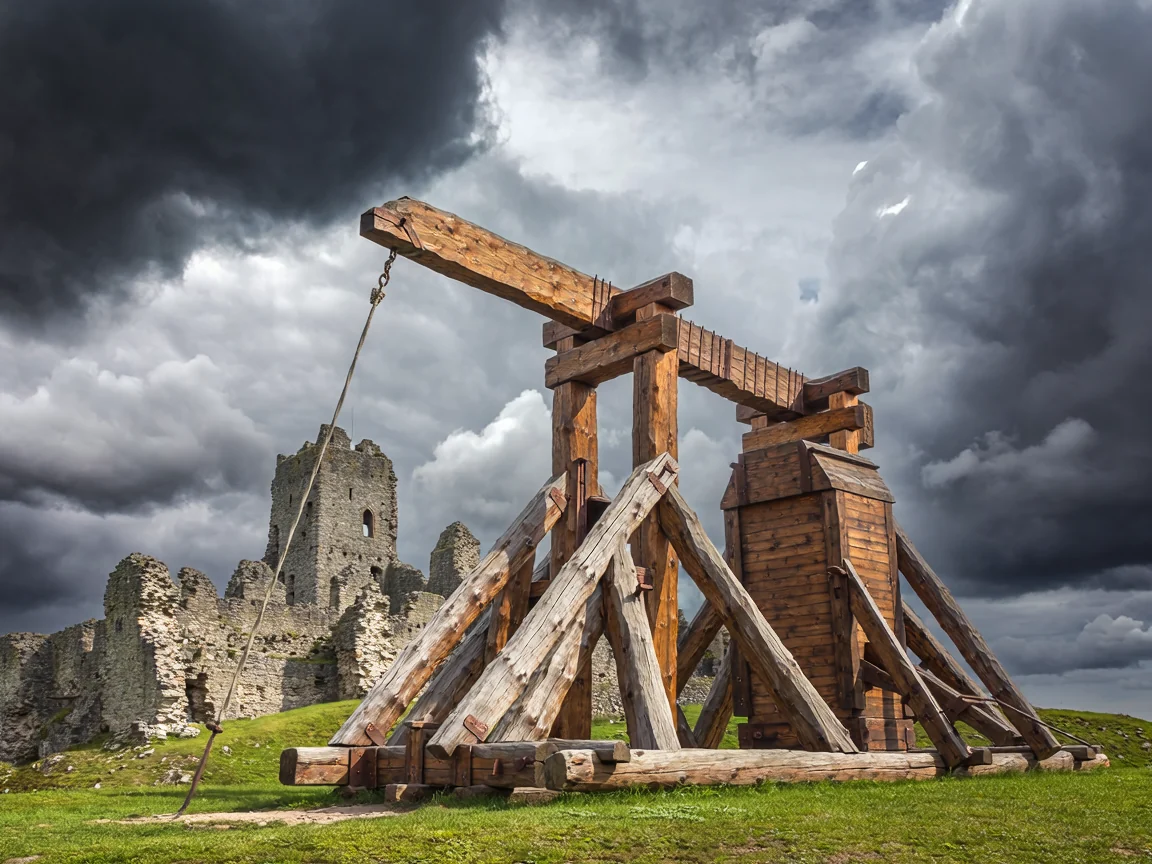
The trebuchet is a lever. A heavy box of earth or stone hangs from the short end of a long beam. When the long end is released, the weight falls and the long arm swings up fast. A sling at its tip lengthens the arm further and releases the projectile at the right moment, like a slingshot attached to a seesaw.
Changing sieges
Counterweight trebuchets could hurl large stones over and into walls, smash defences and throw fire or rotting carcasses into besieged towns. Castle builders responded with thicker, rounder walls and towers. Famous examples include the giant English trebuchet 'Warwolf' used at Stirling Castle in 1304.
Outgunned
From the fourteenth and fifteenth centuries, gunpowder cannon gradually replaced trebuchets. Cannon were more compact and could fire flatter, faster shots at walls. Today reconstructed trebuchets are built by enthusiasts and engineering students as dramatic demonstrations of physics.
Sources & further reading
Performance figures are historical estimates and varied widely. Photograph: original AI-generated illustration (Adobe Firefly). Reference organisations do not endorse this website.