A world waiting for news
By the 1850s, the electric telegraph had transformed communication on land. Wires carried messages between cities in minutes. But the Atlantic Ocean was still a barrier. News between London and New York travelled by ship, taking roughly ten days or more. Merchants, governments and newspapers all wanted faster information about prices, politics and events. The idea of laying a telegraph cable across the ocean floor seemed bold, even fantastical.
Cyrus Field's vision
The driving force behind the project was Cyrus West Field, an American businessman who became convinced that a cable could be laid between Ireland and Newfoundland, the shortest practical route. He raised money in the United States and Britain and formed the Atlantic Telegraph Company in 1856. Engineers and scientists, including the young physicist William Thomson, later Lord Kelvin, worked on the design of the cable and the equipment needed to detect its weak signals.
Failure and success in 1858
The first attempt in 1857 failed when the cable snapped. In 1858, two ships met in the middle of the Atlantic, spliced their cables together and sailed in opposite directions. This time it worked. On 16 August 1858, Queen Victoria sent a message of congratulations to US President James Buchanan. The 98-word message took around 16 hours to transmit because the signals were so weak and slow. Celebrations broke out on both sides of the ocean.
A short-lived triumph
The joy did not last. The cable's signal grew weaker and weaker. An engineer tried to boost it by applying very high voltages, which probably damaged its insulation, and within about three weeks the cable fell silent. Some people even doubted that it had ever really worked. The failure was a blow to investors, but it proved that a transatlantic cable was possible and showed engineers what needed to change.
A better cable
Over the next years, engineers studied what had gone wrong. The new cable was thicker and stronger, with a better copper core, improved insulation made of gutta-percha, a natural latex from Southeast Asian trees, and a tough outer armour of iron wires. Thomson's sensitive mirror galvanometer, which detected tiny currents by moving a beam of light, made it possible to read weak signals reliably without dangerous high voltages.
The Great Eastern
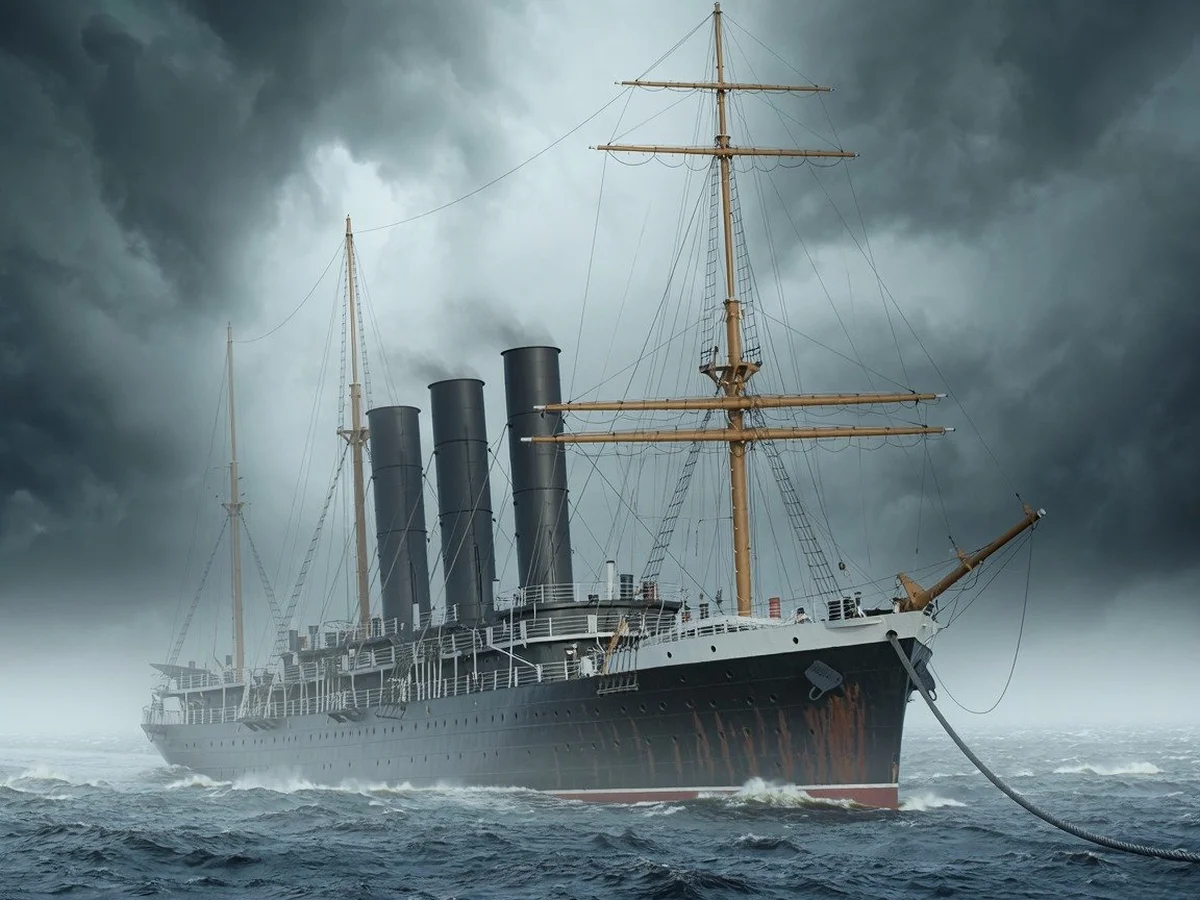
The new cable was so heavy that only one ship in the world could carry it all: the Great Eastern, a giant iron steamship designed by Isambard Kingdom Brunel. In 1865, it began laying cable from Ireland, but the cable broke and was lost in deep water. In 1866, the ship tried again. This time the cable was laid successfully, and the crew even recovered and completed the lost 1865 cable, giving two working lines.
Valentia to Heart's Content
The lasting 1866 link ran from Valentia Island on the west coast of Ireland to Heart's Content in Newfoundland, then on to the rest of North America by land lines and shorter cables. Messages that once took ten days now crossed in minutes. Sending a message was very expensive at first, so it was used mainly by governments, businesses and newspapers, but prices fell as more cables were laid.
Changing the world
Faster communication changed finance, diplomacy and journalism. Stock and commodity prices in London and New York could be compared almost instantly. Governments could send instructions to diplomats abroad quickly. Newspapers carried international news the next day. By the end of the nineteenth century, a web of undersea telegraph cables linked every continent, an early version of the global communication network we now take for granted.
Speed of a message
Early transatlantic telegraph operators could send only a few words per minute, because signals spread out and blurred as they travelled along the long cable. Engineers later developed better instruments and techniques that greatly increased the speed. By the early twentieth century, improved cables and equipment allowed many messages to be sent every hour, making the service faster and cheaper for business and the press.
The legacy today
Today, more than 95% of international data traffic travels through undersea fibre-optic cables, which carry light rather than electrical pulses and can transmit huge amounts of information. Their basic route-laying methods still echo the work of the Great Eastern's crew. The original telegraph stations at Valentia and Heart's Content are now places of history, and Valentia's cable station has been proposed for UNESCO World Heritage status.
Sources & further reading
- Wikipedia · Transatlantic telegraph cable ↗
- Atlantic-Cable.com · History ↗
- Encyclopaedia Britannica · Cyrus Field ↗
Dates and transmission times are as commonly reported by historians. Photograph: original AI-generated illustration (Adobe Firefly). Reference organisations do not endorse this website.