A discovery in a dry field
In March 1974, during a drought, farmers in Lintong, east of the city of Xi’an in Shaanxi province, were digging a well when they struck fragments of fired clay. Among them was a head the size of a real person’s. Archaeologists soon realised the pieces belonged to an enormous buried formation, lying about 1.5 kilometres east of the great burial mound of Qin Shi Huang, the ruler who unified China in 221 BC. Excavation revealed three pits filled with soldiers, horses and chariots, and a fourth left empty. The site, part of the emperor’s mausoleum complex, was listed by UNESCO in 1987 and is now one of China’s most visited museums.
What lies in the pits
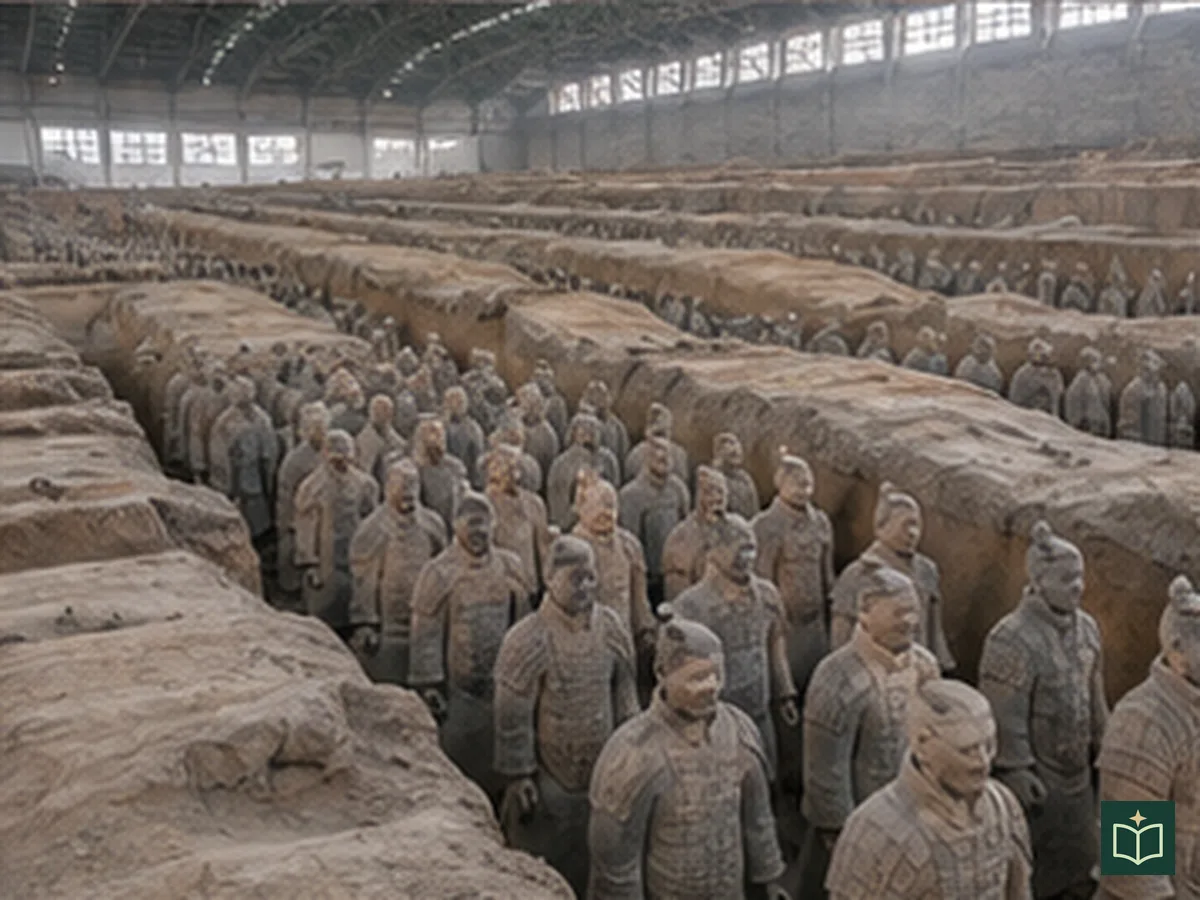
Pit 1, the largest, is about 230 metres long and holds the main infantry, arranged in eleven parallel corridors with archers at the front and on the flanks. Pit 2 mixes cavalry, chariots, archers and infantry in a more complex formation, and the small Pit 3 appears to be a command post with officers and a chariot. In total, archaeologists estimate about 8,000 soldiers, around 130 chariots with 520 horses, and some 150 cavalry horses, although many remain unexcavated. The figures are slightly larger than life, mostly between about 1.75 and 2 metres tall, and they carried real bronze swords, spears, halberds and crossbow mechanisms, tens of thousands of which have been recovered.
How the soldiers were made
The army was produced in workshops using a modular system. Legs were usually solid to bear weight, while torsos were hollow and built up from coils or slabs of clay. Heads, hands and arms were made from a limited set of moulds and then attached. Craftsmen then added clay to shape moustaches, topknots, armour plates and expressions, so that faces vary widely. The figures were fired in kilns at high temperature, coated with lacquer and painted in reds, greens, blues, purples and whites. Many pieces carry stamped or incised names of workshop foremen, which allowed quality to be traced, a system of accountability that also tells historians how the labour was organised.
Why an emperor needed an army
Qin Shi Huang became king of the state of Qin as a boy in 246 BC, and work on his tomb began soon afterwards, continuing after he declared himself First Emperor in 221 BC. He standardised weights, measures, coins and writing across his conquests, and the tomb shows the same administrative reach. The historian Sima Qian, writing about a century later, described hundreds of thousands of labourers working on the mausoleum. The clay army was probably meant to protect the emperor and maintain his power in the afterlife. Earlier rulers had sometimes been buried with real people; here, crafted figures stood in for a living guard, at extraordinary scale.
Colour that fades in minutes
Visitors see grey soldiers, but they were once brightly painted. The problem is that the lacquer layer beneath the paint was preserved by damp soil for two thousand years. When excavated and exposed to dry air, it curls and flakes within minutes, taking the colour with it. This is one reason excavation has proceeded slowly, with conservators working on methods to stabilise paint as it is uncovered. The emperor’s own burial mound has not been opened at all. Sima Qian wrote that it contained rivers of mercury, and soil tests have found unusually high mercury levels, but archaeologists have chosen to wait until techniques can protect what lies inside.
What the army teaches
The Terracotta Army is often presented as a wonder of art, and it is, but it is equally a record of organisation. Producing thousands of standardised yet individual figures, firing them, painting them and equipping them with weapons made to consistent specifications required planning, supply chains and quality control on a scale few societies could manage in the third century BC. The weapons themselves carry inscriptions naming officials responsible for their manufacture. The same state capacity built roads and defensive walls. The empire itself was short-lived, collapsing within a few years of the emperor’s death in 210 BC, but the administrative model it pioneered shaped Chinese government for many centuries afterwards.
Sources & further reading
Figures are rounded and widely published; check the linked organisations for the latest editions. These organisations do not endorse this website.