Who the Neanderthals were
Neanderthals were a group of humans who lived across Europe and western and central Asia from roughly 400,000 to about 40,000 years ago. They take their name from the Neander Valley near Düsseldorf in Germany, where quarry workers found bones in 1856, although earlier finds from Belgium and Gibraltar were later recognised as Neanderthal too. They were short and powerfully built, with wide chests and barrel-shaped bodies suited to cold climates, large noses and prominent brow ridges. Their brains were as large as ours on average, sometimes larger, though shaped differently. They and the ancestors of modern humans descended from a common population that split, according to genetic estimates, more than half a million years ago.
How they lived
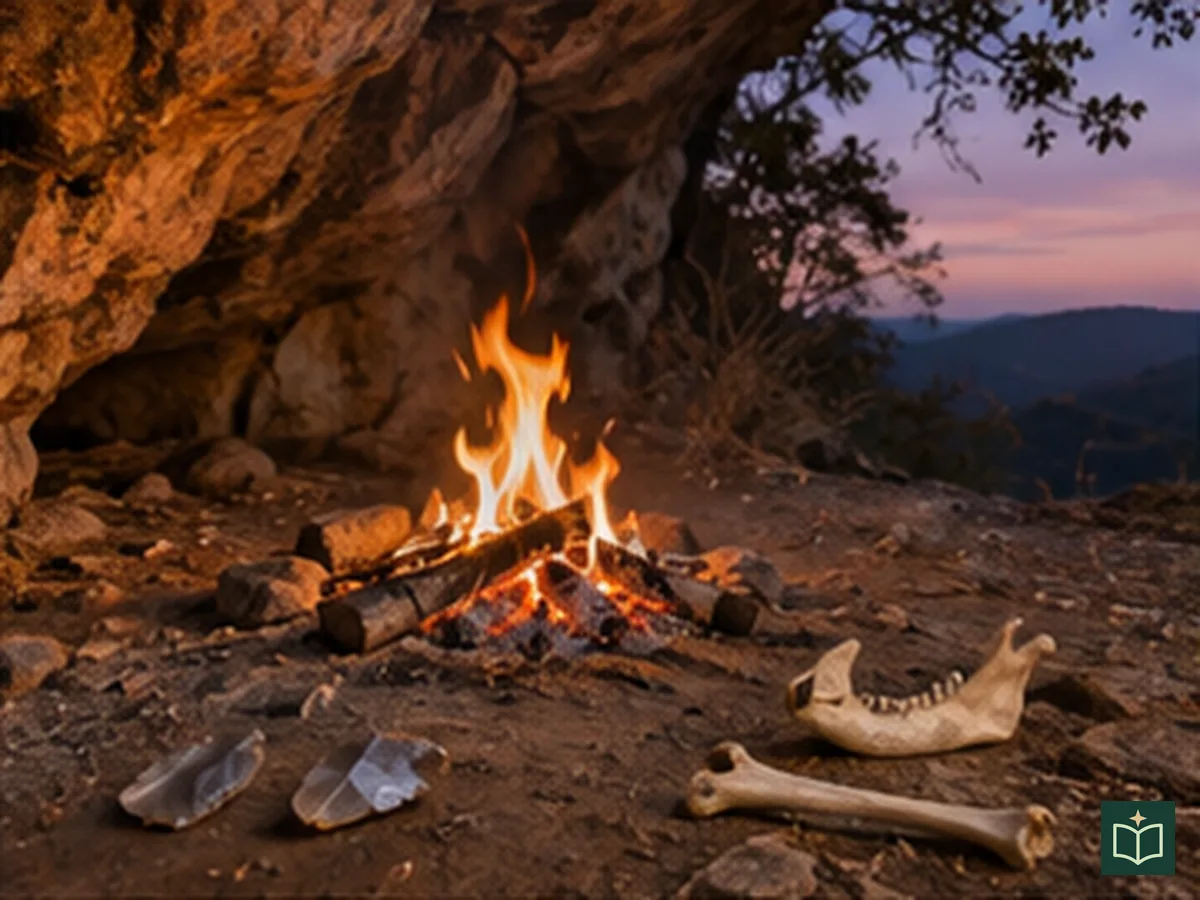
Neanderthals were skilled hunters of large animals such as deer, horses, bison and mammoths, often at close range with thrusting spears. They also ate plants, shellfish and, in some places, birds and rabbits. They made a sophisticated stone tool kit using the prepared-core Levallois technique and controlled fire for warmth and cooking. They produced a glue from birch bark by heating it, which requires careful temperature control. Evidence for symbolic behaviour has grown: eagle talons apparently worn as ornaments, pigments, and markings in Spanish caves dated, though not without debate, to more than 60,000 years ago. Some appear to have cared for injured or disabled members of their groups over long periods.
Reading ancient genomes
The breakthrough came from DNA. Researchers led by Svante Pääbo at the Max Planck Institute for Evolutionary Anthropology in Leipzig spent years developing ways to recover genetic material from ancient bones and to avoid contamination. In 2010 they published a draft Neanderthal genome. Comparing it with modern genomes showed that people outside Africa share more genetic variants with Neanderthals than Africans do, the signature of interbreeding after modern humans left Africa. The same work identified the Denisovans, a previously unknown group known mostly from a finger bone and teeth, whose DNA survives especially in people of Papua New Guinea and Australia. Pääbo received the Nobel Prize in Physiology or Medicine in 2022.
What we inherited
For most people of non-African ancestry, roughly 1 to 2 per cent of the genome comes from Neanderthals. Because different individuals carry different fragments, a much larger share of the Neanderthal genome, perhaps a third or more, survives scattered across living people. Some inherited variants affect the immune system, perhaps helping early migrants cope with unfamiliar diseases in Eurasia. Others influence skin, hair and responses to sunlight. Some carry costs: certain Neanderthal-derived variants are associated with higher risks of particular conditions, including one linked to more severe illness from COVID-19. Large regions of our genome contain almost no Neanderthal DNA, suggesting that some combinations reduced fertility and were weeded out by natural selection.
Why they disappeared
Neanderthals vanish from the fossil and archaeological record around 40,000 years ago, a few thousand years after modern humans arrived in Europe. No single cause is agreed. Possibilities include competition for the same prey and territory, sharp climate swings, and small, scattered populations vulnerable to bad luck and inbreeding; genetic studies show some Neanderthal groups had very low diversity. Absorption also played a part, as some Neanderthals mixed into incoming populations. The two groups did not simply replace one another in a single front; they overlapped in different regions for different lengths of time. Older images of Neanderthals as brutish and slow-witted have been largely abandoned by researchers in light of the accumulating evidence.
A wider human family
The Neanderthal story has changed how scientists picture human evolution. Instead of a single line marching towards modern people, there was a family of related human groups, including Neanderthals, Denisovans and, on islands in Southeast Asia, small-bodied species such as Homo floresiensis. Our species met some of them, sometimes exchanging genes as well as perhaps ideas. Ancient DNA has also shown that interbreeding happened in several directions and at several times. The modern human genome is therefore a record of encounters as much as of descent. For anyone with ancestry from Europe, Asia, the Middle East or the Americas, a little of that ancient meeting is literally carried in every cell.
Sources & further reading
- Smithsonian Human Origins · Homo neanderthalensis ↗
- The Nobel Prize · Physiology or Medicine 2022 ↗
- Max Planck Institute for Evolutionary Anthropology ↗
Figures are rounded and widely published; check the linked organisations for the latest editions. These organisations do not endorse this website.