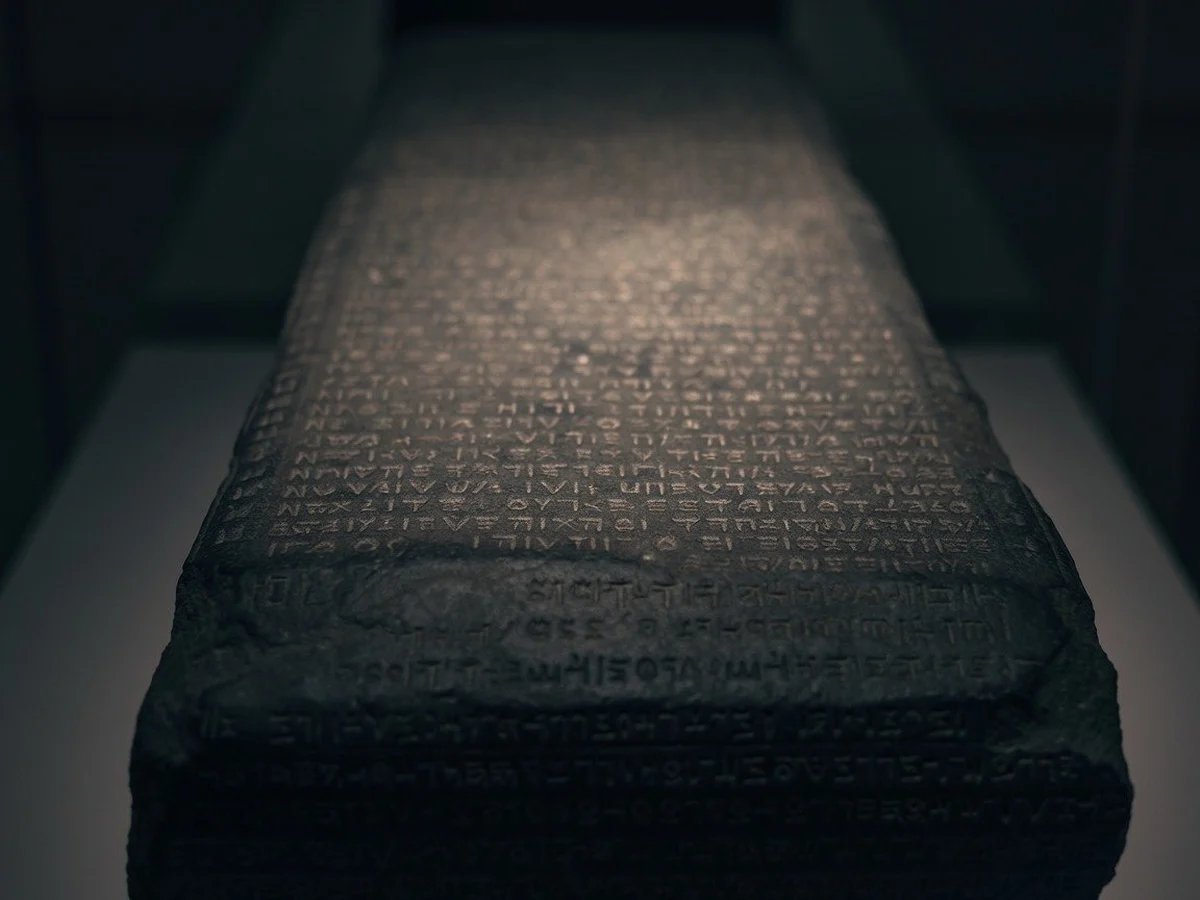
A discovery during war
In July 1799, during Napoleon Bonaparte's campaign in Egypt, French soldiers were rebuilding an old fort near the town of Rashid, known to Europeans as Rosetta, in the Nile Delta. One of them noticed a large stone built into a wall, covered in writing. Officers realised it might be important, and it was sent to scholars in Cairo who had travelled with the army. Copies of its inscriptions were soon made and circulated among researchers in Europe.
What the stone is
The Rosetta Stone is a slab of dark granodiorite about 112 centimetres tall, 76 centimetres wide and weighing roughly 760 kilograms. It is a fragment of a larger stele, a stone slab set up in a temple for public display. Its top and edges are broken, so part of the text is missing. Similar copies of the same decree have since been found elsewhere in Egypt, which helped scholars fill in some gaps.
A decree in three scripts
The text is a decree issued by a council of priests at Memphis in 196 BC, honouring the young king Ptolemy V on the anniversary of his coronation. It was written three times. The top section is in hieroglyphs, the formal script used for religious and monumental inscriptions. The middle is in Demotic, the everyday script of Egypt at the time. The bottom is in ancient Greek, the language of the ruling Ptolemaic dynasty and its government.
Why nobody could read hieroglyphs
Hieroglyphs were used for more than 3,000 years, but their use faded after Egypt came under Roman rule and Christianity spread. The last known hieroglyphic inscription dates from AD 394. Within a few generations, knowledge of how to read them was lost. For centuries, scholars believed the signs were purely symbolic pictures carrying mystical ideas, rather than a writing system that also recorded sounds. That mistaken belief made decipherment almost impossible.
From Cairo to London
After the British and Ottoman forces defeated the French in Egypt, the Treaty of Alexandria in 1801 required the French to hand over antiquities they had collected. The Rosetta Stone was shipped to England and placed in the British Museum in 1802, where it has been on display almost continuously ever since. It is one of the museum's most visited objects. Egypt has asked for its return, and the question of where it belongs continues to be debated.
Young and Champollion
Because the Greek text could be read, scholars compared it with the other two sections. The English scientist Thomas Young made important progress around 1814 to 1819, showing that some hieroglyphs inside oval rings called cartouches spelled out royal names such as Ptolemy. The French scholar Jean-François Champollion went further. Using his knowledge of Coptic, a later form of the Egyptian language, he showed that hieroglyphs combined sound signs with signs for ideas.
The breakthrough of 1822
On 27 September 1822, Champollion presented his findings in a famous letter to the French Academy, often called the Lettre à M. Dacier. According to one story, when he first realised he had cracked the system, he rushed to his brother's office, shouted that he had done it, and fainted. Over the following years he published a full explanation of hieroglyphic grammar and went on to study inscriptions in Egypt itself.
Clues in the cartouches
Royal names were the key that opened the door. Egyptian scribes wrote the names of kings and queens inside cartouches, so they stood out in the text. By matching the cartouche for Ptolemy on the Rosetta Stone with Cleopatra on an obelisk from Philae, scholars could compare shared letters such as P, T, O and L. Each confirmed sound value helped crack the next word.
Why it still matters
Decipherment opened up thousands of years of Egyptian history in the Egyptians' own words: royal records, religious texts, letters, stories and accounts. The phrase a Rosetta Stone is now used for any key that unlocks a hard problem. The stone also reminds us that bilingual and trilingual texts have helped decode other lost scripts. In museums and classrooms around the world, it remains a powerful symbol of how careful comparison and patience can recover lost knowledge.
Sources & further reading
- British Museum · The Rosetta Stone ↗
- Wikipedia · Rosetta Stone ↗
- Wikipedia · Jean-François Champollion ↗
Measurements are approximate; line counts refer to the surviving portions of each text. Photograph: original AI-generated illustration (Adobe Firefly). Reference organisations do not endorse this website.