Power begins after the mine.
Why the ability to refine a mineral can matter as much as the ground that contains it.
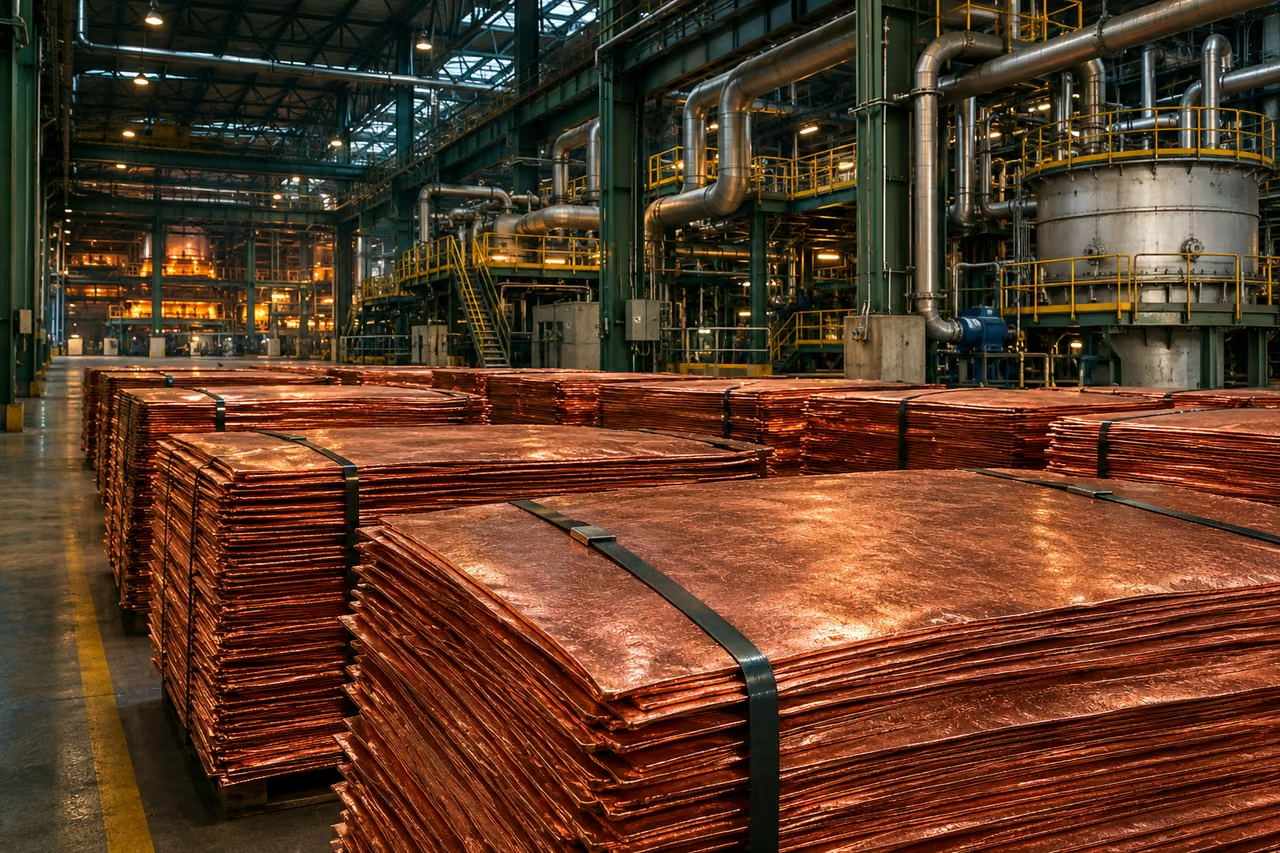
Conceptual AI illustration; not a documentary photograph.
Evidence: 2025 data · IEA report published 16 July 2026
The IEA’s 2026 assessment finds refining concentration still rising across most key minerals. An abundant geological resource is therefore not the same thing as a dependable industrial supply.
- 01
Extract
A deposit becomes ore, then a concentrate. Location matters, but this is only the beginning of an industrial chain.
- 02
Refine
Processing turns material into the purity and chemical form a manufacturer needs. An alternative mine may still depend on the same refining hub.
- 03
Qualify
Material must satisfy a customer’s specifications and reach production reliably. A supplier on a map is not automatically an interchangeable supplier.
Leading-country refining share, on average
- 202370%
- 202572%
IEA comparison of key energy minerals, excluding rare earths. Each mineral has its own leading refining country. Not a combined share of all global mineral output.
Evidence period: 2025 data · IEA report published 16 July 2026 · Source details below
The concentration behind the headline
In the IEA’s 2026 assessment, the average share of the top refining country rose from 70% in 2023 to 72% in 2025 when rare earths are excluded. Indonesia leads nickel refining; China leads the other key energy minerals in this comparison. This is an average across selected markets, not a claim that one country refines 72% of every mineral.
A policy response with several layers
The European Commission describes the Critical Raw Materials Act as a response spanning extraction, processing, recycling and diversification. Its 2030 domestic-capacity benchmarks include processing equivalent to at least 40% of annual EU consumption and recycling equivalent to at least 25%. These are policy benchmarks, not figures already achieved. The distinction matters whenever an announcement is presented as proof that dependency has disappeared.
Read a supply chain, not a flag
A useful test is to trace a component backwards: who makes it, who prepares its inputs, and where the material originates. Then ask which stage has a credible substitute. This is an analytical lens, not a ranking of countries as good or bad partners. Diversification can reduce one exposure while creating different costs, transport requirements or environmental pressures.
Better questions.
A clearer picture.
- Are new processing plants operating, or merely announced?
- Can alternative material meet manufacturers’ specifications?
- Are recycling capacity and collection systems developing together?
Sources & dates.
- IEA · Global Critical Minerals Outlook 2026, executive summary
Published: 16 July 2026
Evidence period: 2023 and 2025 refining shares - European Commission · Critical Raw Materials Act
Published: Official policy overview, checked 15 November 2026
Evidence period: 2030 policy benchmarks
Checked 15 November 2026. Conditions can change after publication. These organisations do not endorse Canvas of Knowledge.