Light before electricity
For most of history, people lit their homes with fire: candles, oil lamps and later gas lamps. These gave dim, flickering light, produced smoke and were a constant fire risk. Gas lighting spread through cities in the nineteenth century, but it was still dirty and dangerous. Scientists knew that electricity could produce light, and many inventors raced to turn that knowledge into a safe, practical lamp for homes and streets.
Early experiments
In the early 1800s, the English chemist Humphry Davy showed that an electric current could create a brilliant arc of light between two carbon rods. Arc lamps were later used for lighthouses and streets but were far too bright and harsh for homes. Inventors then tried heating thin wires, called filaments, until they glowed. The challenge was that the filaments quickly burned out or melted when heated in air.
Swan in England
In England, the physicist and chemist Joseph Swan worked for years on incandescent lamps using carbon filaments inside glass bulbs from which the air had been pumped out. Better vacuum pumps in the 1870s made his lamps more durable. Swan demonstrated his bulb in 1878 and 1879, and his house in Gateshead is often described as the first home lit by electric light bulbs. In 1881, London's Savoy Theatre became the first public building lit entirely by electricity, using Swan's lamps.
Edison in America
In the United States, Thomas Edison and his team at Menlo Park, New Jersey, tested thousands of materials for filaments. In late 1879 they succeeded with a carbonised filament that burned for many hours, and Edison received a US patent in January 1880. His team later found that carbonised bamboo could last more than 1,000 hours. Edison's great strength was building a whole system: generators, wiring, switches, meters and power stations to deliver electricity.
From rivals to partners
Swan and Edison both claimed key rights to the incandescent bulb, and legal disputes followed in Britain. Rather than fight on, they joined forces in 1883 to form the Edison and Swan United Electric Light Company, known as Ediswan. Other inventors, such as Hiram Maxim and Lewis Latimer, also made important contributions; Latimer, an African American inventor and draughtsman, improved the manufacturing of carbon filaments.
Lighting up cities
In 1882, Edison's company opened the Pearl Street Station in New York, one of the first central power stations, supplying electricity to customers in lower Manhattan. Electric lighting spread rapidly over the following decades, changing how people lived and worked. Factories could operate longer hours, streets became safer at night, and homes became brighter and cleaner. The light bulb became a lasting symbol of a bright idea.
Tungsten and beyond
Carbon filaments were fragile and inefficient. In the early twentieth century, inventors developed filaments made of tungsten, a metal with a very high melting point. In 1910, William Coolidge at General Electric found a way to make tungsten into fine, flexible wire, and filling bulbs with inert gas improved them further. Even so, standard incandescent bulbs turned only a small fraction of their energy into light, with the rest lost as heat.
The LED revolution
Fluorescent lamps, including compact fluorescent bulbs, improved efficiency in the late twentieth century. Then came light-emitting diodes, or LEDs. Efficient blue LEDs, invented in the early 1990s, made bright white LED lighting possible; Isamu Akasaki, Hiroshi Amano and Shuji Nakamura won the 2014 Nobel Prize in Physics for this work. Modern LED bulbs typically produce several times more light per watt than incandescent bulbs and can last for many years.
How a filament bulb works
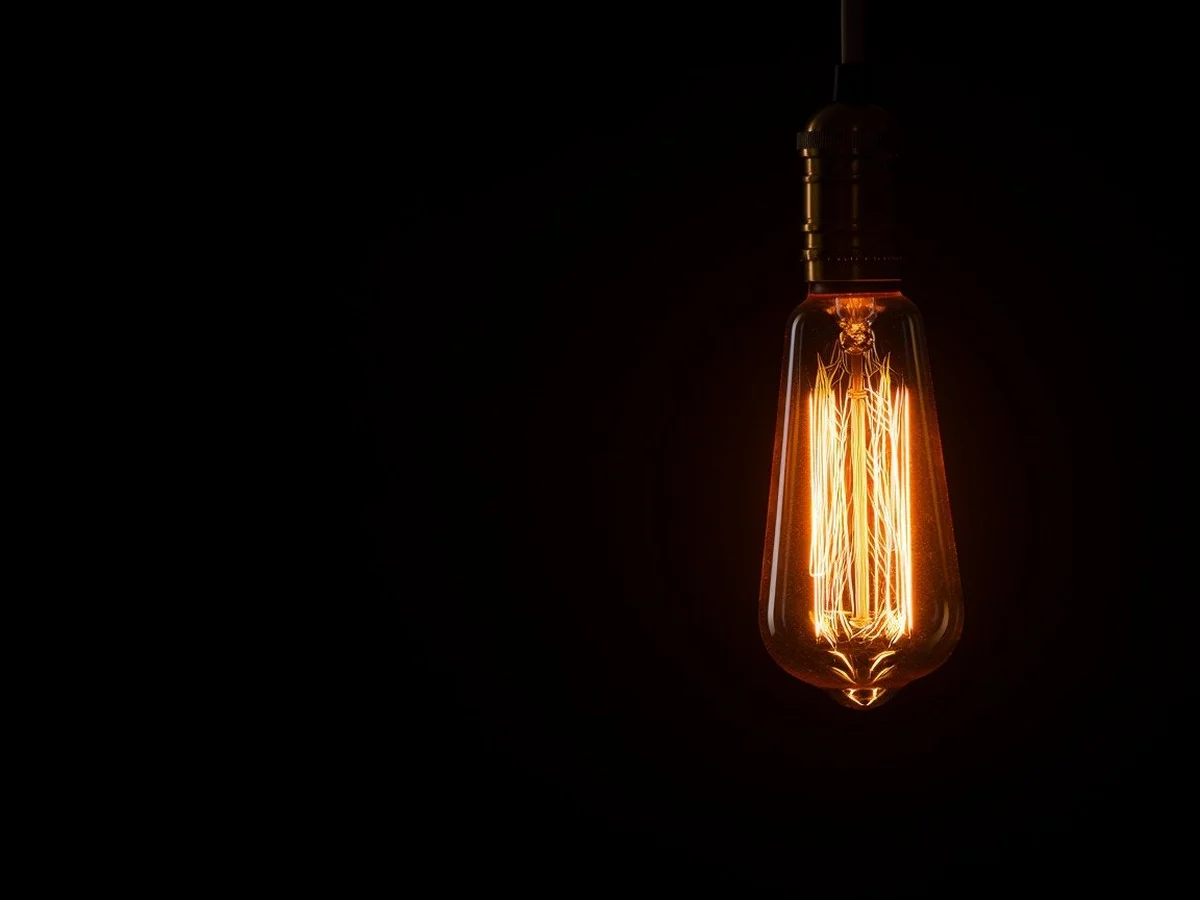
In an incandescent bulb, electricity passes through a very thin filament with high resistance, heating it to more than 2,000 °C so that it glows white hot. The glass bulb keeps out oxygen, which would otherwise make the filament burn up. Because most of the energy comes out as heat rather than visible light, incandescent bulbs feel hot to the touch and waste much of the electricity they use.
A bright legacy
Many countries, including the UAE, have phased out inefficient incandescent bulbs in favour of LEDs to save energy and reduce emissions. The story of the light bulb shows that great inventions are rarely the work of one genius alone. It took scientists, engineers, entrepreneurs and workers across several countries and generations to turn a glowing wire into the cheap, efficient lights we now take for granted.
Sources & further reading
- U.S. Department of Energy · History of the light bulb ↗
- Wikipedia · Incandescent light bulb ↗
- Nobel Prize · Physics 2014 ↗
Dates and efficiency figures are approximate and as commonly cited. Photograph: original AI-generated illustration (Adobe Firefly). Reference organisations do not endorse this website.