A first for the Arab world
The Hope probe, or Al Amal, is the spacecraft of the Emirates Mars Mission, the first interplanetary mission led by an Arab nation. It was launched from Tanegashima in Japan on 20 July 2020 and entered orbit around Mars on 9 February 2021, the year the UAE marked fifty years since its founding. The mission was run by the Mohammed bin Rashid Space Centre in Dubai, which designed and built the spacecraft with partner universities in the United States. Its goals were both scientific and national: to answer open questions about Mars and to build a generation of Emirati engineers and scientists capable of planning and flying deep-space missions.
The question it set out to answer
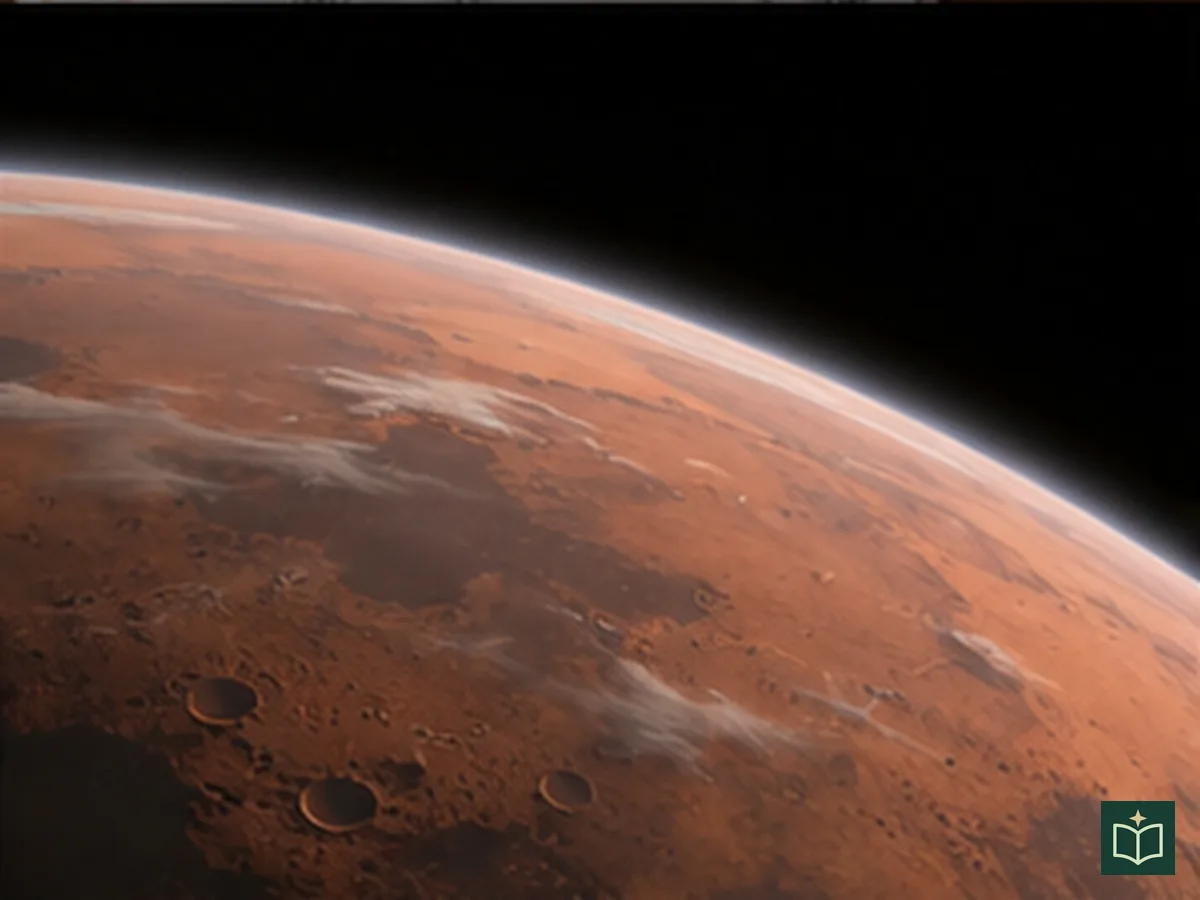
Earlier orbiters mostly studied Mars from low orbits that pass over each location at roughly the same local time every day. That is ideal for mapping the surface but gives a partial view of the weather, which changes from morning to night and season to season. Hope was designed to produce the first complete picture of Martian weather across a full Martian year, about 687 Earth days. Its scientists also wanted to connect conditions in the lower atmosphere, such as dust storms and temperature swings, to the escape of hydrogen and oxygen at the top. That loss over billions of years helps explain how Mars changed from wetter to dry.
An orbit chosen for coverage
The key design choice was the orbit. Hope circles Mars on a tilted ellipse between about 20,000 and 43,000 kilometres up, far higher than most orbiters, and takes about 55 hours per lap. Mars rotates in a little over 24 hours, so as the spacecraft moves slowly along its path, the planet turns beneath it. Over roughly nine days the combination lets Hope view nearly every region at nearly every local time. From that distance it also sees the whole disc at once, which is essential for following weather systems that span the planet. The trade-off is resolution: Hope is built to observe the atmosphere, not to photograph individual rocks.
Three instruments, three layers
Hope carries three instruments, each aimed at a different layer. The Emirates Exploration Imager is a multiband camera that records dust, water-ice clouds and ozone in visible and ultraviolet light. The Emirates Mars Infrared Spectrometer measures the lower and middle atmosphere, tracking temperature, dust, ice and water vapour. The Emirates Mars Ultraviolet Spectrometer studies the thin upper atmosphere and the exosphere, a faint cloud of hydrogen and oxygen extending tens of thousands of kilometres into space. Together they let scientists follow how energy and material move upwards through the atmosphere. The spacecraft weighed about 1,350 kilograms at launch, including fuel, roughly the mass of a small car.
What it has shown
Hope's wide view has produced images and data sets few other missions could. It recorded discrete aurora on the night side of Mars in unusual detail, including long, winding patterns that surprised researchers, since Mars lacks Earth's global magnetic field. It found that oxygen and carbon monoxide in the upper atmosphere are distributed far more unevenly than expected. Its global images followed dust storms from start to finish. In 2023 the spacecraft made close passes of Deimos, the smaller Martian moon, capturing detailed images of its far side. The mission was extended beyond its original two-year science phase, and its data are released openly for researchers worldwide to use.
Why it matters
Understanding Mars's atmosphere matters beyond curiosity. Weather and dust storms affect landers, rovers and any future human visits, while the story of how Mars lost most of its air and water informs scientists studying planets in general, including Earth. For the UAE, Hope was also a deliberate investment in skills. The project was developed in about six years, quicker than many interplanetary missions, by a team that was largely young and included many women. It helped establish the knowledge behind later Emirati space plans, including a mission to the asteroid belt. Its lesson for science is simple: a well-chosen orbit can matter as much as the instruments themselves.
Sources & further reading
Figures are rounded and widely published; check the linked organisations for the latest editions. These organisations do not endorse this website.