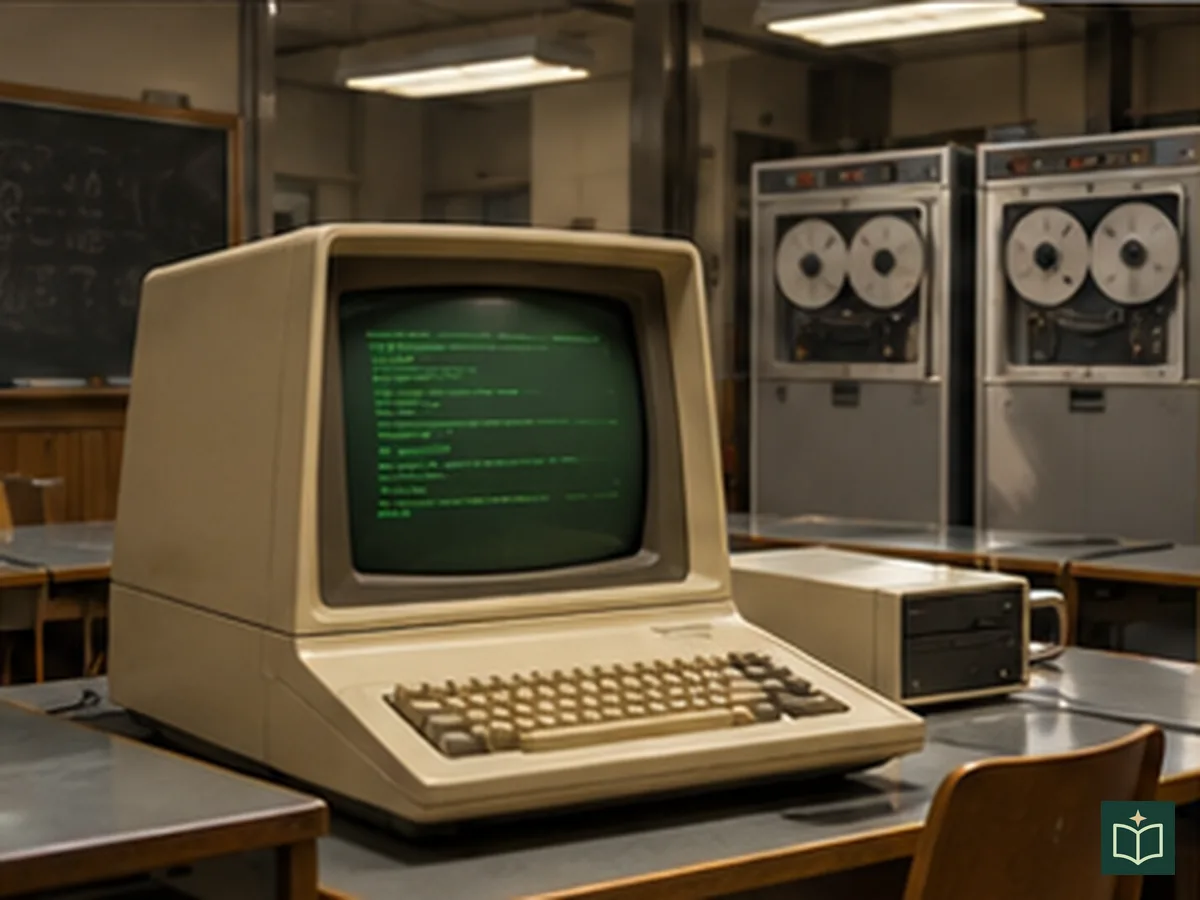
Two letters and a crash
On the evening of 29 October 1969, a student programmer at the University of California, Los Angeles, tried to log in to a computer at the Stanford Research Institute, about 500 kilometres away. He typed L, then O, confirmed by telephone that each had arrived, and then the remote system crashed before the G. So the first message on the ARPANET was 'LO'. An hour or so later the connection worked. By December the network linked four sites: UCLA, Stanford Research Institute, the University of California, Santa Barbara, and the University of Utah. It was funded by the Advanced Research Projects Agency of the United States Department of Defense, which gave it its name.
Why packets, not circuits
Telephone networks of the time connected callers through a dedicated circuit, held open for the whole conversation even during silences. Computer traffic is bursty, with long pauses broken by quick bursts of data, so that approach wasted capacity. ARPANET instead used packet switching, an idea developed independently by Paul Baran in the United States and Donald Davies at Britain's National Physical Laboratory, who coined the word packet. Messages were cut into small blocks, each labelled with its destination and forwarded hop by hop by dedicated machines called Interface Message Processors, built by the firm BBN. Packets could take different routes and be reassembled on arrival, so many users could share the same lines efficiently.
Growth and new uses
The network expanded steadily through the 1970s, reaching dozens and then over a hundred sites, mainly universities and defence laboratories. Its original purpose was to let researchers share expensive computers remotely, but users soon found another use. In 1971 the engineer Ray Tomlinson sent messages between machines and chose the @ sign to separate a user's name from the host computer. Email quickly became the network's most popular application. Meanwhile, other packet networks appeared, using radio links, satellites and different designs. They worked internally but could not talk to each other, rather like towns with railways of different gauges. Connecting them became the next challenge.
The rules that joined everything
In 1974 Vint Cerf and Bob Kahn published a design for interconnecting different packet networks. It became the Transmission Control Protocol and Internet Protocol, known together as TCP/IP. The idea was elegantly modest. IP gives every machine an address and moves packets on a best-effort basis, without caring whether the link beneath is copper, radio or satellite. TCP, running on the computers at each end, numbers the packets, checks that all arrived and asks for missing ones to be resent. Gateways, later called routers, pass traffic between networks. On 1 January 1983 ARPANET switched over to TCP/IP. Any network that spoke these rules could now join the internet.
From research tool to public utility
In the mid-1980s the US National Science Foundation built NSFNET, a faster backbone linking university supercomputing centres, and the system of website names, DNS, was introduced. ARPANET itself became redundant and was shut down in 1990. Restrictions on commercial traffic were lifted in the early 1990s, allowing private companies to sell internet access. The decisive popular step came from CERN in Switzerland, where Tim Berners-Lee proposed the World Wide Web in 1989, a system of linked pages that ran on top of the internet. Once graphical browsers appeared, the network that had served researchers for two decades spread to homes and offices worldwide, reaching the Gulf by the mid-1990s.
Myths and lasting lessons
A popular story says ARPANET was built to survive a nuclear war. Baran's early research did address survivable communications, but ARPANET's own builders have long said its main aim was sharing computing resources. The lasting lesson lies in its design philosophy. By keeping the network simple and putting intelligence at the edges, in the computers, TCP/IP allowed applications nobody had imagined, from video calls to online banking, to be added without changing the core. Its standards were openly published and freely usable, so anyone could build compatible equipment. That openness explains both the internet's explosive growth and some of its enduring problems, since security was not built in from the start.
Sources & further reading
Figures are rounded and widely published; check the linked organisations for the latest editions. These organisations do not endorse this website.