A sand sea
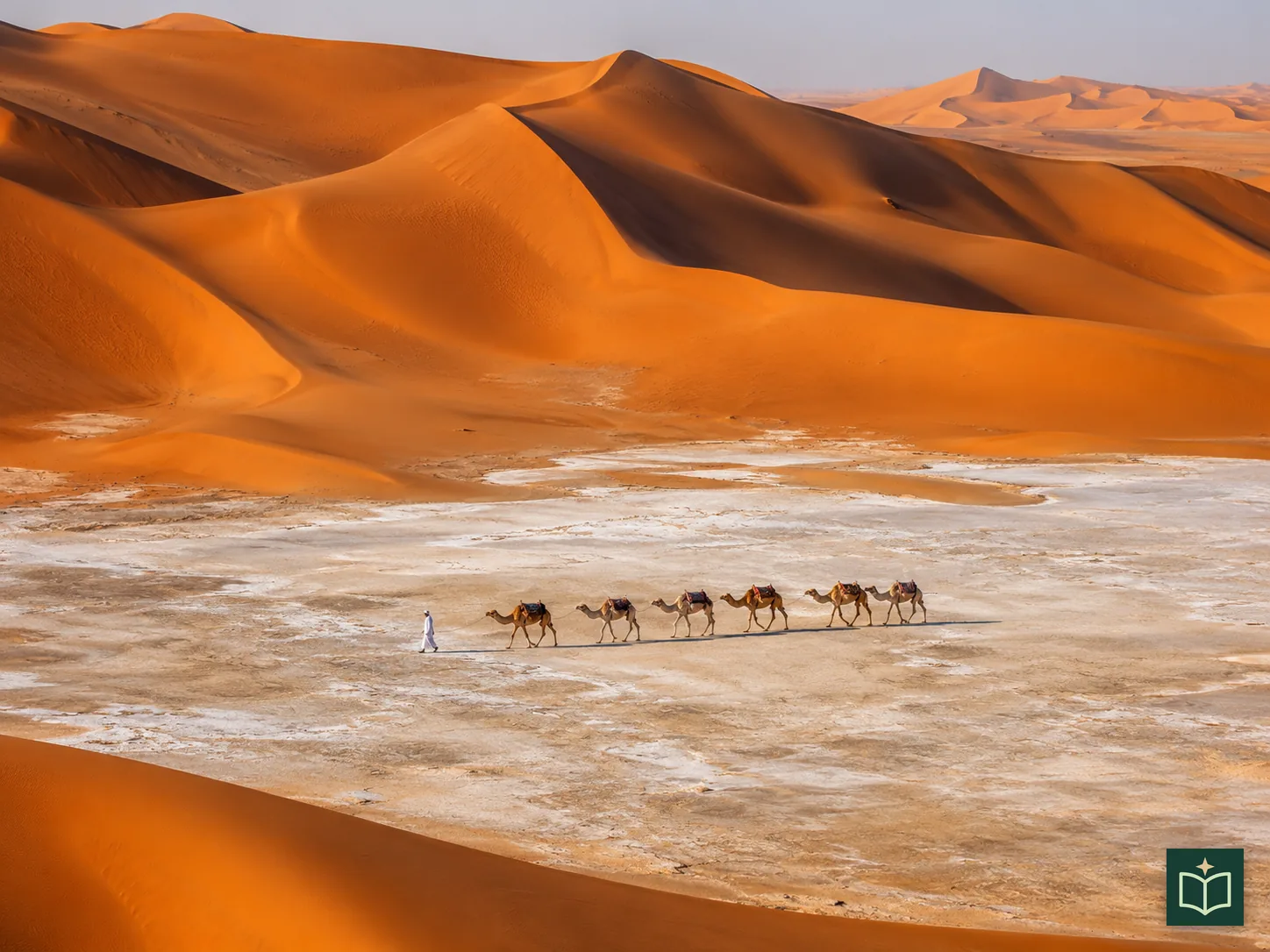
The Rub’ al Khali—the ‘Empty Quarter’—covers much of the southern Arabian Peninsula. It is the largest continuous body of sand, or erg, in the world. Rainfall is very low and summer temperatures often exceed 50°C. Yet the region is not lifeless: oryx, sand gazelles, foxes and hardy plants survive across its edges.
Giant dunes
Persistent winds sculpt different dune forms: crescent barchans, long linear ridges and star dunes where winds shift direction. Near the Liwa Oasis in the UAE, the Moreeb Dune rises well over 100 metres, and some mega-dunes elsewhere in the erg are taller still. Between dunes lie flat, salty plains called sabkhas.
A once-green Arabia
Arabia’s climate has swung between dry and wetter phases. During humid periods, including roughly 9,000 to 6,000 years ago, lakes formed between the dunes. Researchers have found fossils of hippopotamus, water buffalo and other animals, along with stone tools, showing that people and wildlife once lived in what is now hyper-arid desert.
Crossing the quarter
For outsiders, the Empty Quarter was long a blank on maps. Bertram Thomas crossed it in 1931, guided by Bedouin companions, and Wilfred Thesiger made celebrated journeys in the 1940s, writing Arabian Sands. The Bedouin had, of course, known its wells and routes for centuries. Today oilfields such as Shaybah operate in its heart.
Sources & further reading
Figures are rounded and widely published; check the linked organisations for the latest editions. These organisations do not endorse this website.