A merry-go-round world
Imagine throwing a ball across a spinning merry-go-round. To you, riding on it, the ball seems to curve, even though it travels in a straight line. Earth is a giant spinning platform, so winds and currents moving across it appear to bend relative to the ground.
Right in the north, left in the south
In the Northern Hemisphere, moving air is deflected to the right; in the Southern Hemisphere, to the left. The effect is zero at the equator and strongest at the poles. It is named after the French scientist Gaspard-Gustave de Coriolis, who described the mathematics in 1835.
Shaping weather
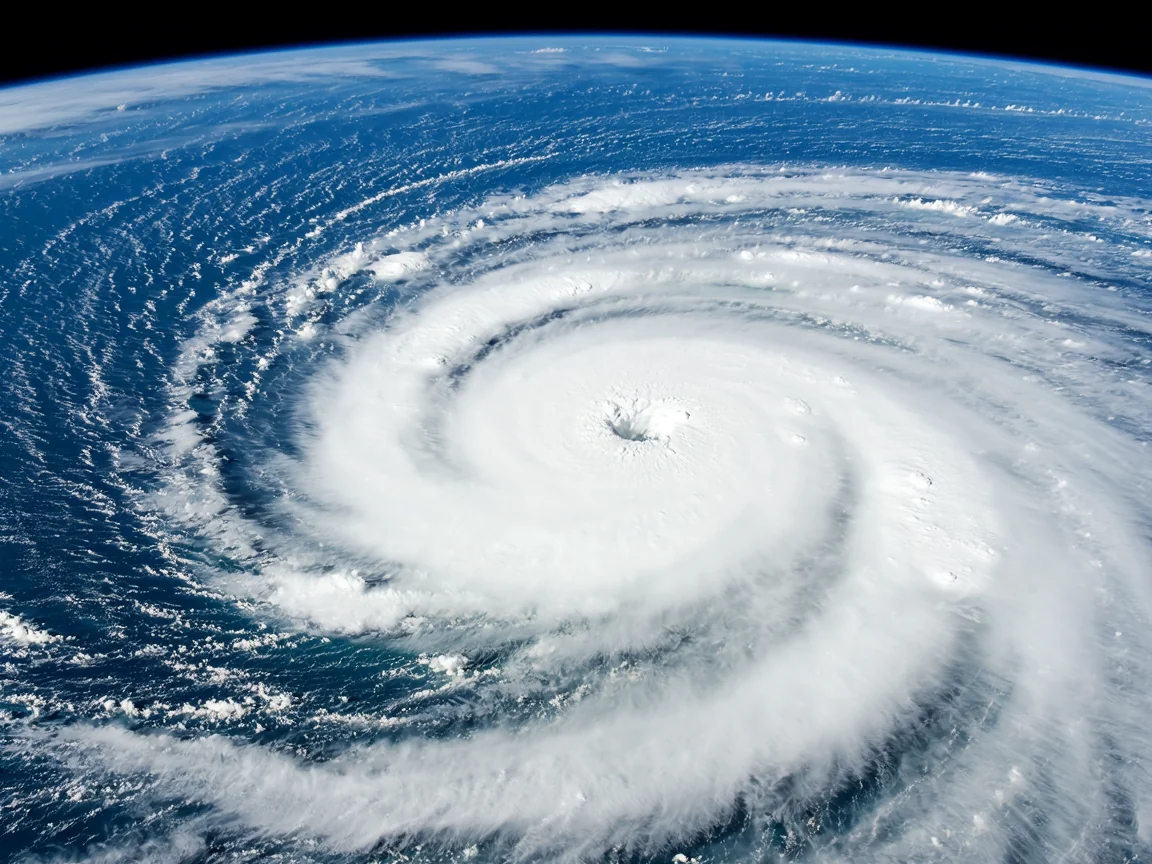
Air rushes towards areas of low pressure, but the Coriolis effect turns it aside, setting up rotation. That is why hurricanes and typhoons spin anticlockwise north of the equator and clockwise south of it, and why they almost never form right on the equator. The trade winds and ocean gyres are curved by the same force.
The sink myth
Water swirling down a basin is not steered by Earth's rotation; the effect is far too weak over such small distances and short times. The shape of the basin and the way it was filled decide the direction. Only in carefully controlled experiments can the Coriolis effect be seen in draining water.
Sources & further reading
Speeds are rounded values for Earth's surface rotation. Photograph: original AI-generated illustration (Adobe Firefly). Reference organisations do not endorse this website.