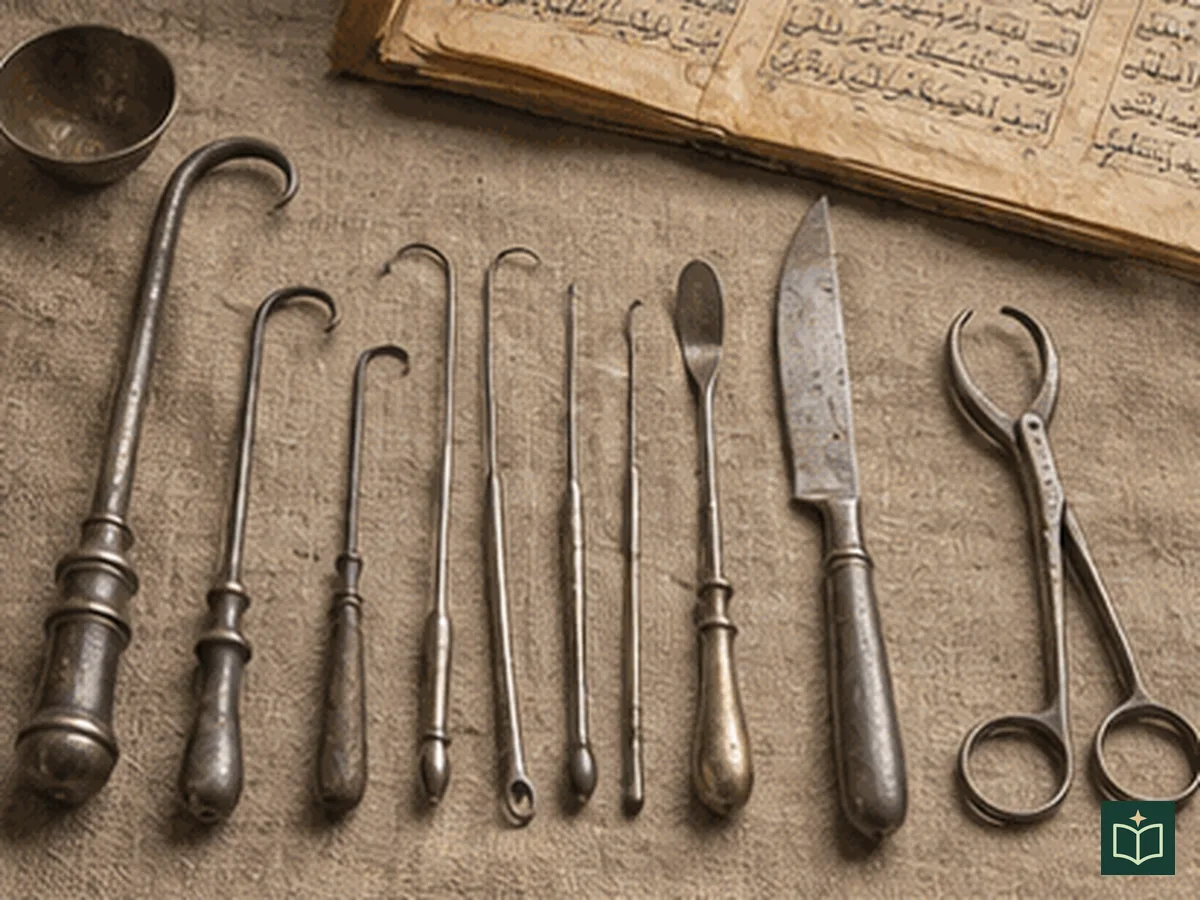
A prodigy from Bukhara
Abu Ali al-Husayn ibn Sina, known in Europe as Avicenna, was born around 980 near Bukhara, in today's Uzbekistan, then ruled by the Persian Samanid dynasty. According to his own account, dictated to a student, he had memorised the Quran by about ten, studied logic, mathematics and philosophy as a teenager, and began practising medicine at around sixteen. After treating the Samanid ruler, he gained access to the royal library. The collapse of the Samanids forced him into a wandering life, serving rulers in Khwarazm, Jurjan, Rayy and Hamadan, sometimes as physician and sometimes as minister. He died in Hamadan, in western Iran, in 1037, having written works on almost every branch of learning.
What the Canon is
Al-Qanun fi al-Tibb, The Canon of Medicine, was completed around 1025. It runs to roughly a million words in five books. The first sets out general principles: the four humours inherited from Greek medicine, anatomy, the causes of illness and how to keep healthy. The second describes around 800 simple drugs from plants, minerals and animals, with their properties. The third covers diseases organ by organ, from head to toe. The fourth deals with conditions affecting the whole body, such as fevers, wounds and poisons. The fifth lists compound medicines and how to prepare them. The structure itself was a teaching tool, letting students find any subject quickly.
Building on many traditions
The Canon did not appear from nowhere. Ibn Sina drew heavily on the Greek physician Galen and on Hippocrates, whose works had been translated into Arabic in Baghdad during the ninth century. He also used Aristotle's philosophy to explain causes, and Persian and Indian medical knowledge. Earlier physicians in the Islamic world, notably al-Razi, had written large clinical collections. What Ibn Sina added was synthesis: he reconciled conflicting authorities, set out reasoned arguments and placed everything in a single framework. Readers valued the book because it gave clear answers. Critics at the time and later complained that it relied too much on theory and not enough on direct observation.
Rules for testing drugs
One frequently cited passage sets out conditions for judging whether a drug truly works. Ibn Sina said the medicine should be pure, tested on a simple rather than a complex disease, and tried on more than one kind of case. Its effect should be consistent across many trials, and its strength should match the strength of the illness. The time of action should be observed, and results in animals might not apply to people. These ideas do not amount to a modern clinical trial, which developed much later with control groups and statistics. But they show an early concern with repeatable evidence rather than authority alone, and historians of medicine often point to them.
The Latin Canon
In the twelfth century Gerard of Cremona, working in Toledo, translated the Canon into Latin. It quickly became a core text in Europe's new universities, including Bologna, Paris and Montpellier. After the invention of printing, it was published in Latin in 1473 and reprinted many times; an Arabic edition was printed in Rome in 1593. In some universities, such as Leuven and Montpellier, parts of it were still set for study in the seventeenth century. In the Islamic world it was taught, summarised and commented on for even longer. Doctors in the Ottoman Empire, Iran and Mughal India used it, and traditional Unani medicine in South Asia still draws on its framework.
What it got wrong and right
Much of the Canon's theory has been overturned. The humours do not exist, and many treatments, such as bloodletting, did more harm than good. Its anatomy depended largely on Galen, who had dissected animals, not people. Yet the book also contains observations that hold up well: careful descriptions of diseases such as meningitis and diabetes, attention to diet, exercise, sleep and clean air, and recognition that some illnesses spread through contact, water or soil. Its value today is historical. Like any old medical text, it is a record of how people reasoned about health, not a guide to treatment, and anyone with health concerns should consult a qualified professional.
Sources & further reading
Figures are rounded and widely published; check the linked organisations for the latest editions. These organisations do not endorse this website.