Tables, hills and towers
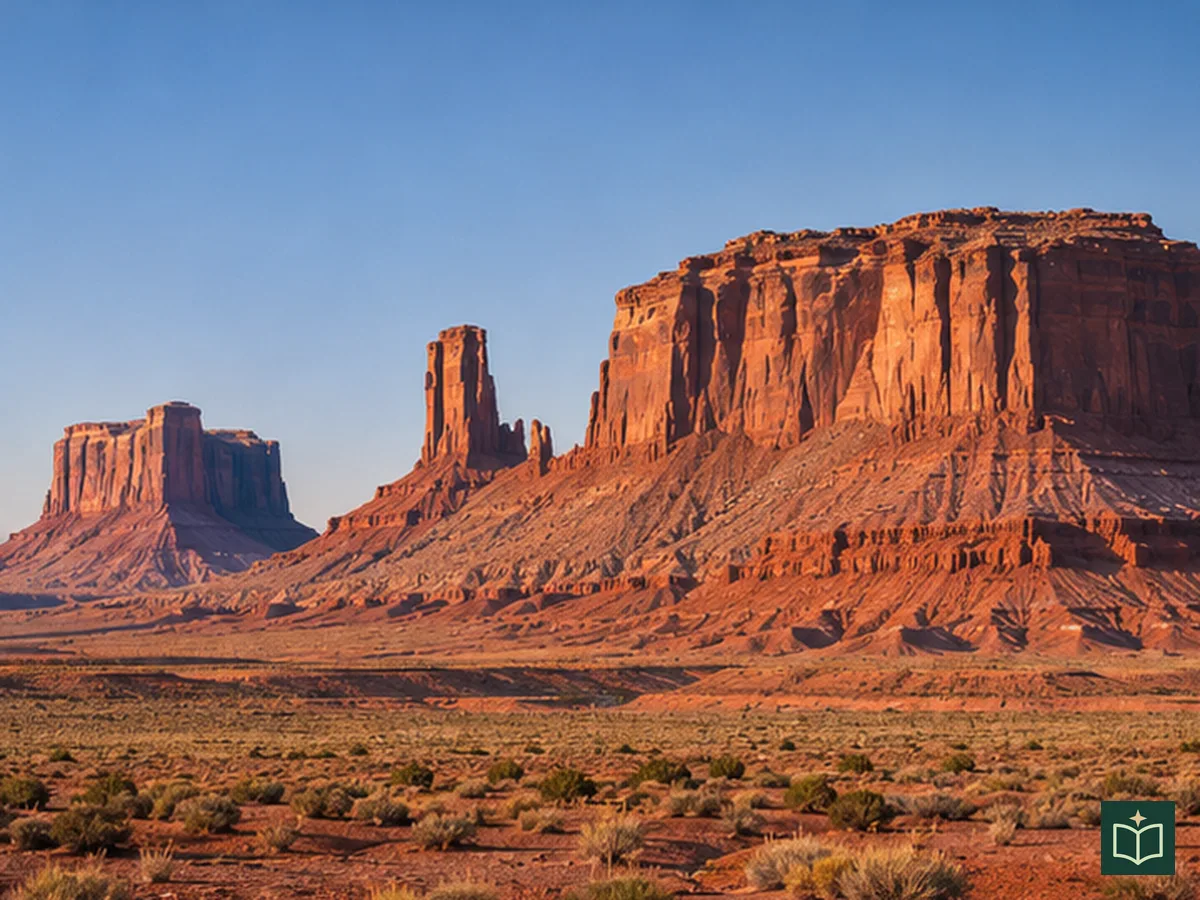
The flat-topped hills of dry landscapes go by a family of names. A plateau is a large, elevated area of fairly level ground, often bounded by steep cliffs. A mesa, from the Spanish word for table, is a smaller isolated block that is wider than it is tall. A butte, from an old French word for a small hill or mound, is narrower, with its height roughly equal to or greater than the width of its top. Erode a butte further and you are left with a pinnacle or spire. These are not separate kinds of feature so much as stages in one long process of wearing down.
The importance of the lid
Every one of these landforms depends on a cap rock: a hard, resistant layer lying on top of softer rock. It might be a well-cemented sandstone, a conglomerate of pebbles, or a sheet of solidified lava. Rain and frost struggle to break the cap, so the top of the land stays flat. But wherever a river or gully cuts through the cap, it exposes the weaker layers underneath. Those soft rocks erode quickly, undermining the edge of the hard layer until blocks break away. As a result, the cliffs retreat sideways, keeping their steep profile, while the flat summit simply shrinks. The land wears back, not down.
From plateau to spire
The sequence is easiest to see on the Colorado Plateau of the south-western United States. Its high tablelands are cut by deep canyons into separate mesas. Over millions of years, those mesas are whittled into buttes. In Monument Valley, on the border of Arizona and Utah, famous buttes of red sandstone rise up to about 300 metres from the desert floor. Each has a protective cap of harder rock, a sheer cliff of massive sandstone, and a sloping apron of softer shale and fallen debris at its base. Smaller spires nearby show the final stage, shortly before the last of the cap rock falls and the column collapses.
Tabletops around the world
Similar landforms appear wherever flat-lying layers of different hardness are exposed to erosion. Table Mountain above Cape Town is capped by tough sandstone. In Venezuela and neighbouring countries, sheer-sided tepuis rise above the rainforest; Mount Roraima, on the borders of Venezuela, Brazil and Guyana, stands about 2,800 metres high. Their isolated summits host plants and animals found nowhere else. Lava-capped mesas are common on volcanic plateaus, from India’s Deccan region to parts of Arabia’s lava fields, or harrat. In the deserts of Jordan and north-western Saudi Arabia, sandstone remnants stand above sandy plains, though wind and weathering have often sculpted them into more irregular shapes.
What climate has to do with it
Mesas and buttes are most striking in dry regions, for a reason. With little vegetation to bind the soil and soften slopes, rain arrives in short, violent bursts that cut sharply into rock. Steep cliffs persist because weathered debris is washed or blown away rather than building up into gentle slopes. In wetter climates, thick soils and plant cover tend to round off edges, and the same rock layers may form softer, wooded hills. Even so, the key ingredient is the contrast between hard and soft layers. Without a resistant cap, a plateau would be lowered more evenly and would not break into such distinct, flat-topped pieces.
Reading the landscape
For geologists, these landforms are a cross-section of time. Each cliff exposes layers laid down in ancient deserts, seas or rivers, often over hundreds of millions of years, and the height of a mesa shows how much rock has been removed around it. The process is extremely slow by human standards; a butte may look unchanged for generations, though rockfalls are frequent. For people, the flat summits have offered defensive sites for settlements, and the sheltered cliffs have housed dwellings and rock art. Today, places such as Monument Valley, managed by the Navajo Nation, draw visitors from around the world to see a landscape shaped by what has disappeared.
Sources & further reading
Figures are rounded and widely published; check the linked organisations for the latest editions. These organisations do not endorse this website.