Iron without a furnace
Iron is the fourth most common element in Earth’s crust, yet metallic iron is almost never found there, because it combines readily with oxygen. Producing it from ore requires smelting: heating iron ore with charcoal at high temperature so carbon strips away the oxygen. That technology spread widely only around 1200 BC, marking the start of the Iron Age in the eastern Mediterranean and Near East. Yet iron objects are known from far earlier. Many of them were made from the one source of ready-made metallic iron on the surface: meteorites, fragments of shattered asteroids that survive their fall through the atmosphere.
The nickel signature
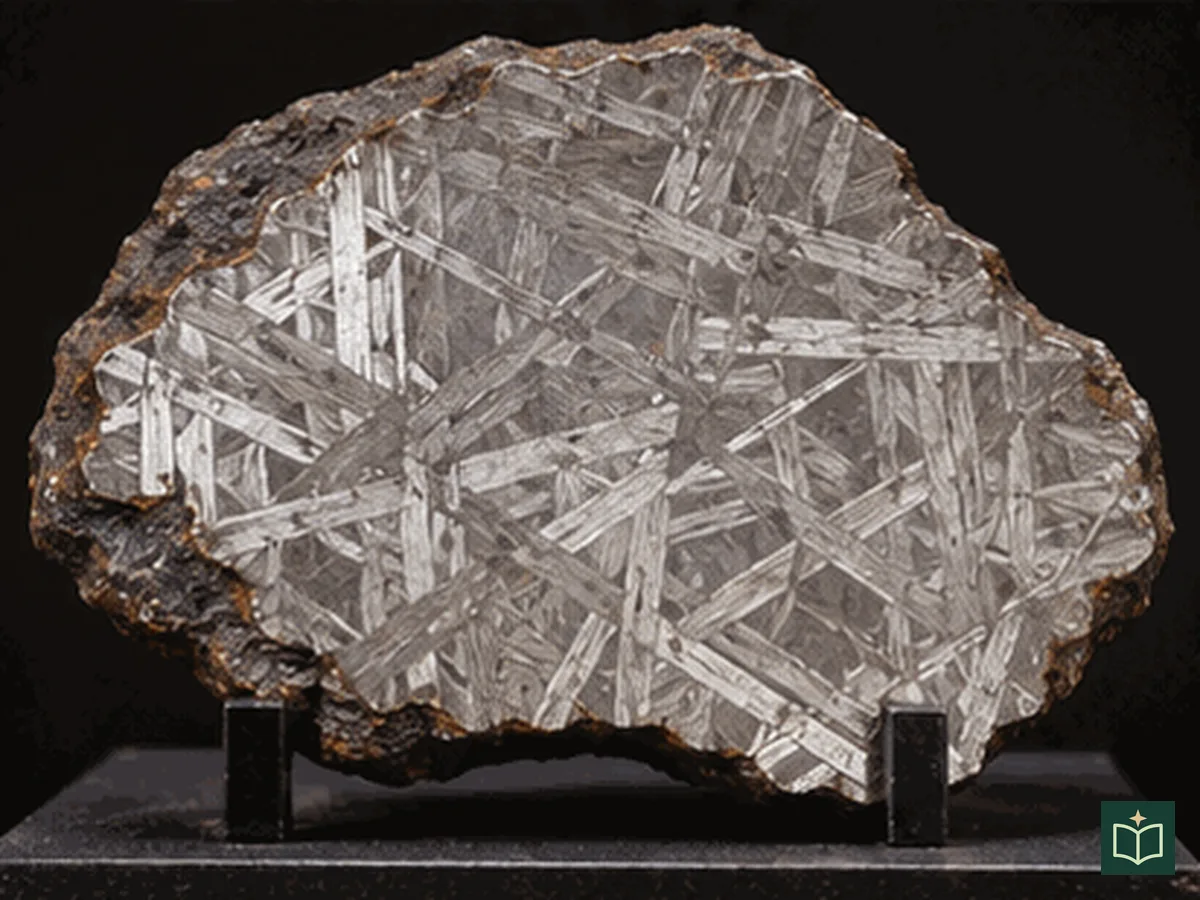
Iron meteorites are almost pure metal, an alloy of iron with roughly 5 to 30% nickel and a little cobalt. Early smelted iron, by contrast, usually contained well under 1% nickel, because little nickel passes from typical ores into the bloom. That difference gives archaeologists a fingerprint. Meteoritic iron also has a distinctive crystal structure: when a cut surface is etched with acid, many show criss-crossing bands called Widmanstätten patterns, formed as the metal cooled extremely slowly inside its parent asteroid. Portable X-ray fluorescence instruments now let scientists measure nickel and cobalt in museum objects without cutting or damaging them, which has transformed this field.
Beads, axes and daggers
Among the oldest worked iron objects are nine small tubular beads from Gerzeh in Egypt, dated to around 3200 BC. A 2013 study showed they were meteoritic iron hammered into thin sheets and rolled into tubes. In 2017 analysis of iron artefacts from the Bronze Age, from sites in Egypt, Syria, Turkey and China, found that the ones tested were consistent with meteoritic iron. Ancient texts hint at the source: a later Egyptian term for iron has been translated as ‘iron of the sky’. Such metal was rare and precious, used for ritual objects and gifts between rulers rather than everyday tools.
Tutankhamun’s dagger
When Howard Carter’s team unwrapped Tutankhamun’s mummy in 1925, they found two daggers, one with a gold blade and one with a blade of rust-free iron, set in a gold hilt. In 2016 Italian and Egyptian researchers measured the iron blade with X-ray fluorescence and found about 10.8% nickel and 0.58% cobalt. The ratio of nickel to cobalt, about 19, sits within the range typical of iron meteorites. A 2022 study suggested the blade was forged at relatively low temperatures and that the hilt’s adhesive may point to a foreign workshop. Letters of the period record iron objects sent as royal gifts from the kingdom of Mitanni.
Star metal in the Arctic
Meteoritic iron was used in much more recent times too. In north-western Greenland, the Cape York meteorite fell thousands of years ago and broke into several large masses. For centuries, Inuit communities chipped flakes from them and set the iron into bone and ivory handles as knife blades and harpoon tips, a rare metal resource in a land without smelting. In 1897 the American explorer Robert Peary shipped the largest piece, a mass of about 31 tonnes known as Ahnighito, to New York, where it is now displayed. Its removal is today viewed critically, as it took a vital resource from the community that used it.
Limits of the evidence
Not every early iron object is meteoritic, and not every meteoritic signal is certain. Corrosion can change the surface chemistry, so analyses of rusted artefacts must be interpreted cautiously, and nickel alone cannot always rule out unusual ores. Some early smelting experiments did take place in Anatolia and elsewhere before 1200 BC, and the shift to the Iron Age was gradual rather than sudden. Meteoritic iron could never support mass production: falls are rare and unpredictable. What it did offer was an introduction to iron’s qualities, a hard, grey metal that ancient smiths learned to work long before they could make it themselves.
Sources & further reading
Figures are rounded and widely published; check the linked organisations for the latest editions. These organisations do not endorse this website.