Aid needs a working route.
Inside the chain that connects a funded shipment to a family: safe passage, fuel, storage and a dependable final journey.
 View full-size infographic
Aid needs
a working route.
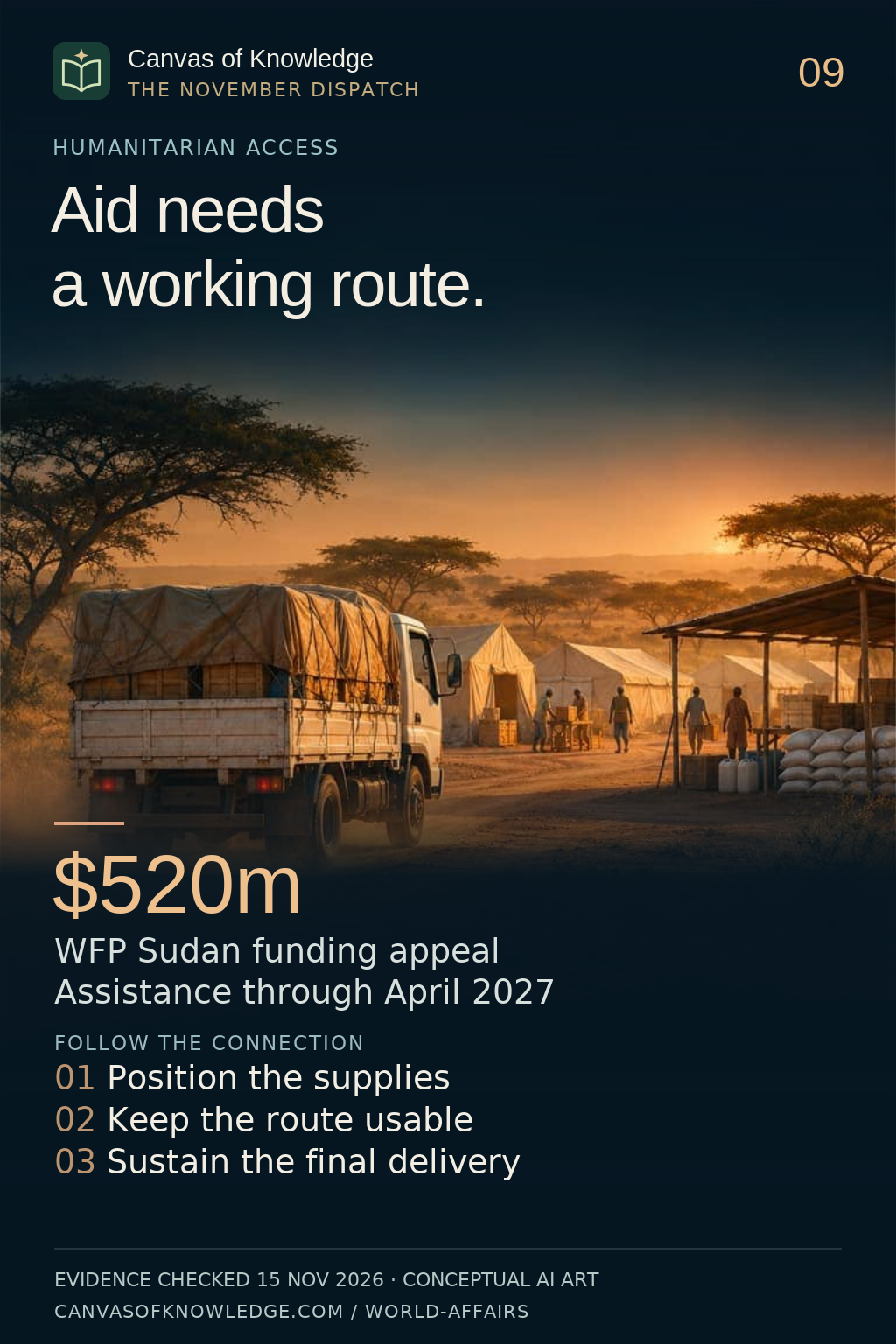
WFP funding sought for Sudan assistance through April 2027, announced 12 November
Humanitarian delivery is a system. More supplies cannot compensate for an unsafe or unusable route.
WFP statement 12 November 2026; operational sources checked 15 November
Following a field mission, WFP warned on 12 November that financing constraints had forced reductions in assistance in Sudan. It sought US$520 million to support 5.4 million people through April 2027. That appeal sits within a second challenge: even financed assistance must pass through an insecure and disrupted delivery system.
- 01
Position the supplies
Shared warehouses allow organisations to place cargo closer to where it may be needed. Sudan’s Logistics Cluster lists seven common-storage hubs, including Port Sudan, Kosti and Tawila. Storage creates options, but a stocked warehouse is an intermediate stage rather than a completed delivery.
- 02
Keep the route usable
The Logistics Cluster coordinates humanitarian road convoys and shares access information. A journey depends on more than a line drawn on a map: physical access, transport availability and changing security conditions must be assessed together. A route that worked last month may need reassessment today.
- 03
Sustain the final delivery
A family needs dependable assistance, not merely the arrival of one shipment somewhere in the country. Planning has to connect transport with distribution and follow-up. In analytical terms, assess the whole chain: a successful upstream movement can coexist with a serious gap at its destination.
A funding appeal measures a need, not a result
WFP reported supporting more than four million people in August, then reducing its caseload from September because of funding constraints. Its 12 November release said an estimated 900,000 people had lost assistance over recent months and that it was reaching just over three million. These are the agency’s dated operational figures. Its new funding request is not money already received, and the proposed 5.4 million people are a planned assistance reach rather than a claim that needs have been met.
The infrastructure behind the humanitarian image
The Logistics Cluster’s Sudan operation combines coordination, information, temporary storage and transport support. Port Sudan has a national coordination role, while Khartoum and eastern Chad support other operations. Shared services help individual organisations work within a larger delivery system. Our practical reading is to ask which constraint is binding at a particular point. An additional warehouse will not remove insecurity; a newly accessible road will not create a financed supply pipeline. Different failures require different responses, and progress at one stage should not be mistaken for progress everywhere.
Protection and delivery cannot be separated
On 31 October, the UN Secretary-General condemned escalating drone attacks in Sudan and their toll on civilians, including attacks affecting critical infrastructure and health facilities. He called for protection of civilians and a cessation of hostilities. This matters to delivery because relief operations depend on the surrounding civilian system. Electricity, water, roads and health facilities are not decorative background to an aid convoy. The broader inference is straightforward: humanitarian logistics can reduce suffering within constraints, while the protection of people and infrastructure addresses conditions that keep recreating those constraints.
Better questions.
A clearer picture.
- Does committed funding become usable support in time to maintain assistance?
- Do access improvements persist across repeated journeys and multiple locations?
- Are civilians, local responders and essential infrastructure protected in practice?
Sources & dates.
- WFP · Executive Director calls for end to fighting in Sudan
Published: 12 November 2026
Evidence period: August–November 2026 assistance; funding requirement through April 2027 - Logistics Cluster · Sudan operation
Published: Live operational overview, checked 15 November 2026
Evidence period: Current listed coordination and logistics services - United Nations in Sudan · Statement on escalating drone attacks
Published: 31 October 2026
Evidence period: Statement on the situation at 31 October 2026
Checked 15 November 2026. Conditions can change after publication. These organisations do not endorse Canvas of Knowledge.