A short cut between oceans
Before the Panama Canal, ships sailing between the Atlantic and Pacific coasts of the Americas had to go around Cape Horn at the tip of South America, a long and dangerous voyage. The narrow Isthmus of Panama offered an obvious short cut, and a railway had crossed it since 1855. The canal, opened on 15 August 1914, cut the sea journey from New York to San Francisco by roughly 13,000 kilometres. It runs about 82 kilometres between the two oceans. Surprisingly, because the isthmus curves, the Pacific entrance lies to the east of the Atlantic entrance, so ships heading from the Atlantic to the Pacific actually travel south-east.
The French failure
The first serious attempt was French. Ferdinand de Lesseps, celebrated for building the Suez Canal, began work in 1881, planning a sea-level canal like Suez, with no locks. Panama was very different from Egypt’s flat desert. Engineers faced mountains, landslides, the flood-prone Chagres River and heavy rains. Above all, yellow fever and malaria killed workers in huge numbers; estimates suggest around 22,000 deaths. At the time, people did not know that mosquitoes carried both diseases. The French company went bankrupt in 1889, and the collapse caused a major financial and political scandal in France. The work they did, however, including excavation in the mountains, was later partly reused.
How the locks work
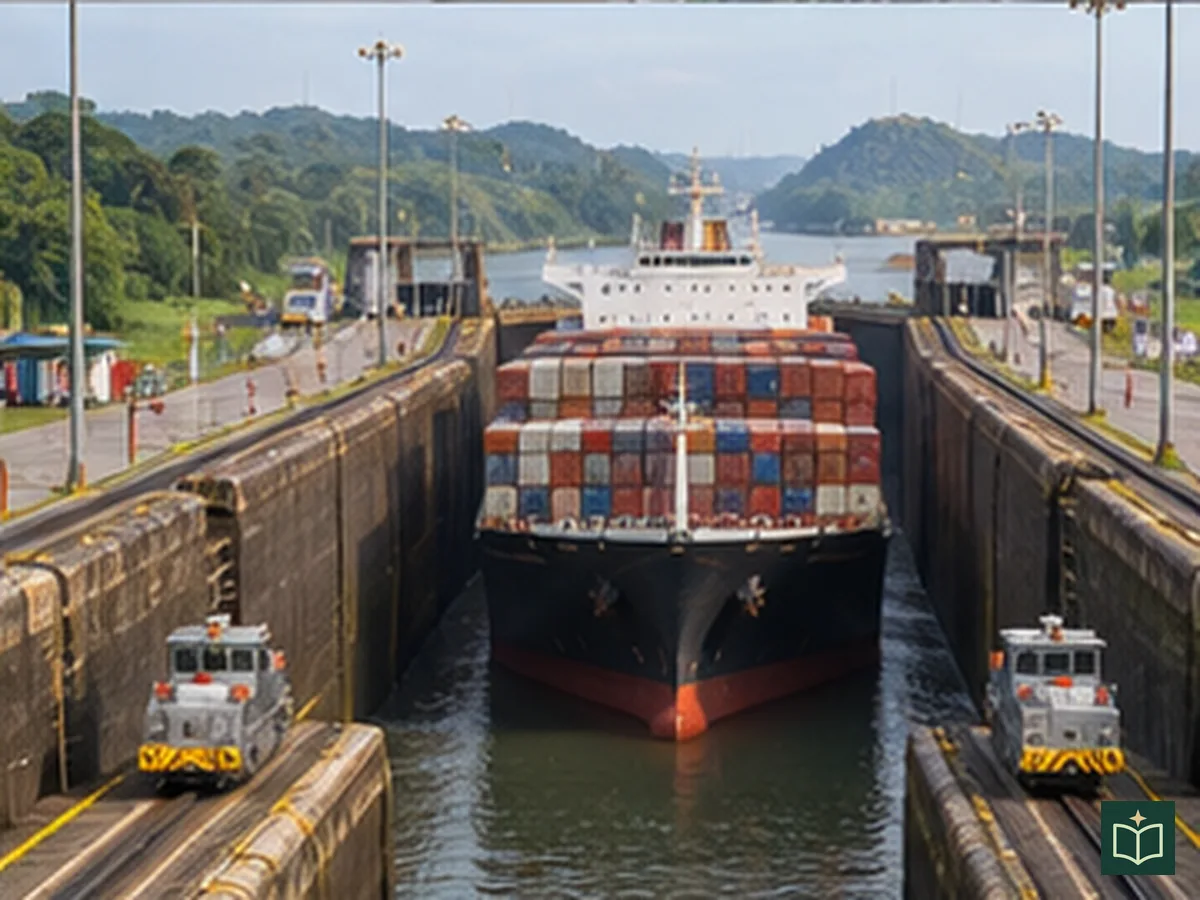
The United States took over the project in 1904, after Panama separated from Colombia with American support. Its engineers abandoned the sea-level plan. Instead, they dammed the Chagres River at Gatun to create a large artificial lake and built locks to lift ships up to it. A lock is a concrete chamber with gates at each end. When a ship enters, the gates close and water flows in through culverts from higher up, purely by gravity, raising the vessel. The upper gates then open and it moves on. Gatun Locks lift ships in three steps on the Atlantic side; Pedro Miguel and Miraflores locks lower them on the Pacific side.
Lakes, cuts and mosquitoes
Between the locks, ships cross Gatun Lake, once the largest artificial lake in the world, and pass through the Culebra Cut, a channel carved through the continental divide, where landslides repeatedly undid months of digging. The work required enormous steam shovels, railways to haul away rock and soil, and tens of thousands of workers, many from the Caribbean. Success also depended on public health. Under the army doctor William Gorgas, teams drained standing water, fumigated buildings and installed screens, which sharply reduced yellow fever and malaria. Even so, about 5,600 workers died during the American construction period. The Chief Engineer, George Goethals, oversaw the canal’s completion ahead of schedule.
Water: the hidden constraint
Every ship that passes through the original locks uses fresh water from Gatun Lake, which flows out to the sea. A single transit releases about 197 million litres, roughly 52 million US gallons. The lake is fed by rainfall, so drought can limit how many ships may pass and how deeply loaded they may be, as happened in 2023 and 2024, when the authority restricted transits. In 2016 a major expansion opened larger locks that can handle much bigger ships than the original chambers, which are 33.5 metres wide and about 305 metres long. The new locks recycle much of their water through side basins, saving roughly 60 per cent per transit.
Ownership and importance
For most of the twentieth century the United States controlled the canal and a surrounding strip of land, the Canal Zone, a source of long-running tension with Panama. Under the Torrijos–Carter Treaties signed in 1977, control passed gradually to Panama, which took full ownership on 31 December 1999. The Panama Canal Authority now runs it, and tolls are a major source of national revenue. The canal remains vital for trade between Asia and the east coast of the Americas, including grain, containers and energy shipments. Unlike the Suez Canal, which is at sea level, Panama relies on lake water, which makes climate and rainfall central to its future.
Sources & further reading
Figures are rounded and widely published; check the linked organisations for the latest editions. These organisations do not endorse this website.