Not stars at all
A shooting star has nothing to do with stars. It is a meteor, a streak of light created when a small piece of space debris enters Earth’s atmosphere at high speed. Before it reaches the atmosphere, the particle is called a meteoroid. Most are tiny, from dust grains to pebbles, and many are fragments shed by comets or chipped off asteroids. If a piece survives the journey and lands on the ground, it is called a meteorite. On any clear, dark night, an observer far from city lights can typically see a few random meteors per hour, known as sporadic meteors, even when no shower is under way.
Why they glow
Meteoroids enter the atmosphere at speeds between about 11 and 72 kilometres per second, depending on whether they meet Earth head-on or catch up from behind. At such speeds, the air in front of the particle is violently compressed and heated, and the particle’s surface vaporises. The glow comes mainly from the surrounding air and vaporised material being excited and emitting light, rather than from the solid grain itself burning like a match. Most meteors appear about 80 to 120 kilometres above the ground and vanish within a second or two. Colours can hint at composition and speed, with green, orange and blue tints sometimes visible.
Showers from comet trails
Meteor showers occur when Earth passes through a stream of debris left along the orbit of a comet or, occasionally, an asteroid. Because Earth crosses each stream at the same point in its orbit, showers recur on roughly the same dates each year. The meteors seem to radiate from one point in the sky, an effect of perspective, like parallel railway lines appearing to converge. Showers are named after the constellation containing that radiant. The Perseids, peaking around 12 August, come from Comet Swift–Tuttle. The Geminids, peaking around 13 to 14 December, come from an object called 3200 Phaethon and are often the richest shower of the year.
Watching from the desert
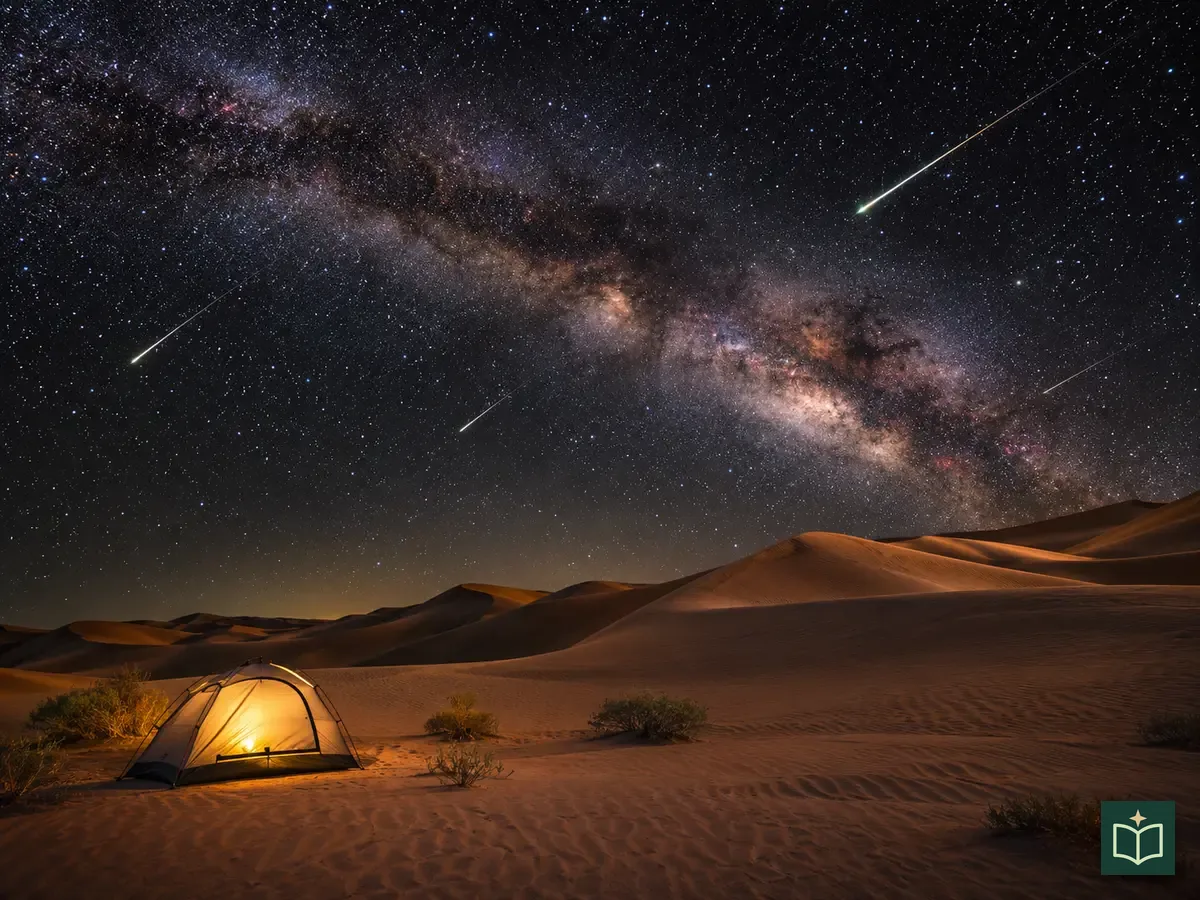
The best way to see a meteor shower is to escape artificial light, let your eyes adapt to the dark for 20 to 30 minutes and look at a broad area of sky rather than straight at the radiant. No telescope is needed; binoculars actually narrow the field too much. Moonlight can wash out fainter meteors, so showers near new moon are best. In the UAE, desert areas away from city lighting are popular for viewing major showers, and astronomy groups often organise public observing nights for the Perseids and Geminids. In winter, the cooler nights make the Geminids especially comfortable to watch, while summer Perseid nights remain hot.
Fireballs and meteorites
Occasionally, a larger meteoroid produces a fireball, a meteor brighter than the planet Venus, sometimes lighting the landscape and breaking apart with visible fragments. Most meteoroids burn up entirely, but tougher rocky or iron-rich fragments sometimes reach the ground. By the time they land, they have usually slowed to the speed of a falling stone, and many are cool to the touch rather than glowing hot, a common misconception. Deserts are excellent places to find meteorites, because dark stones stand out against pale sand and dry conditions slow weathering. Significant collections have been recovered from the deserts of North Africa, Oman and Antarctica.
Why they matter
Meteors are more than a pretty sight. Every day, Earth sweeps up a large amount of material from space, mostly as fine dust, although estimates vary widely. Studying meteoroids helps scientists understand the composition of comets and asteroids, some of which preserve material from the early solar system. Meteorites provide samples of other worlds, including rare fragments from Mars and the Moon, and some contain organic molecules. Tracking networks of cameras record fireballs to calculate their orbits and locate fallen fragments. Space agencies also monitor larger near-Earth objects, which are far rarer but potentially hazardous, as part of planetary defence efforts such as NASA’s DART mission, which successfully altered an asteroid’s orbit in 2022.
Sources & further reading
Figures are rounded and widely published; check the linked organisations for the latest editions. These organisations do not endorse this website.