Differential weathering
Rock never wears away evenly. Some layers are harder or better cemented than others, and cracks let water reach deep into one part of a cliff but not another. Over thousands of years, this uneven attack, called differential weathering, carves the landscape into shapes that look deliberately sculpted. The main tools are water, frost and gravity. When water freezes in a crack it expands by about 9%, wedging the crack wider. Rain dissolves the natural cement holding sand grains together. Gravity then removes the loosened pieces. The result can be arches, towering pillars or rock mushrooms, depending on the rock and the climate.
How an arch forms
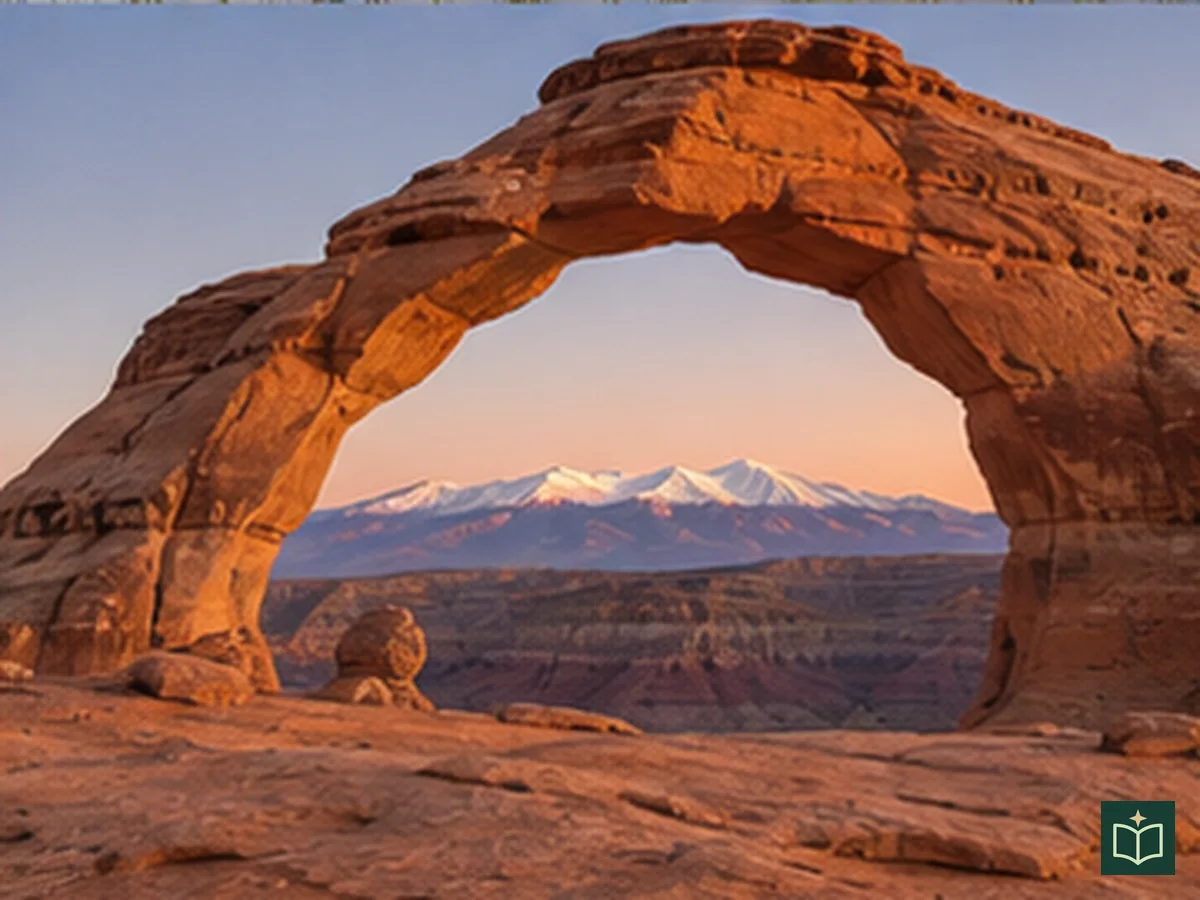
Arches National Park in Utah has more than 2,000 documented arches, the greatest concentration anywhere. Beneath its sandstone lies an ancient layer of salt, which flowed and swelled, bending the rock above and cracking it into long parallel joints. Water widened the joints until thin walls of rock, called fins, stood between them. Where water seeps into a fin, frost and dissolving cement break grains away, and flakes fall from the underside. A small hole grows into a window and then an arch. Landscape Arch, among the longest in the world, spans about 88 metres, and pieces have fallen from it within recent decades.
Hoodoos of Bryce Canyon
Hoodoos are tall, thin spires of rock, often topped by a harder cap. Bryce Canyon in Utah has the largest collection on Earth. They are carved from layers of limestone, siltstone and mudstone that vary in strength. According to the US National Park Service, temperatures at Bryce cross freezing on more than 200 days a year, so frost wedging runs almost nonstop, breaking walls into fins and then into pillars. Rain, which is slightly acidic, rounds and dissolves the softer layers. The varying hardness gives hoodoos their bulging, totem-like profiles, and iron and manganese minerals colour them orange, pink and cream.
Fairy chimneys of Cappadocia
In central Türkiye, the fairy chimneys of Cappadocia formed in volcanic rock rather than sandstone. Millions of years ago, eruptions blanketed the region in thick layers of ash that hardened into soft tuff, sometimes topped by harder lava or welded ash. Rain and meltwater cut the plateau into valleys, and where a hard cap protected the soft tuff beneath, cone-shaped pillars remained. The tuff was soft enough to carve by hand, so people hollowed out homes, churches and storerooms, and even underground cities. The Göreme valley and its rock sites were listed by UNESCO as a World Heritage site in 1985.
Not mainly the wind
It is natural to assume wind carved these shapes, especially in a desert, but in most cases water, frost and gravity do the heavy work. Wind can sandblast rock, but blown sand travels mostly within a metre or two of the ground, so it mainly undercuts the bases of rocks, helping to produce mushroom shapes. Arches in particular are formed largely by water seeping through rock. In Arabia, the sandstone outcrops around AlUla in Saudi Arabia, including the famous Elephant Rock, show the same mixture of processes: cracks, rare rain, salt crystals growing in pores, and a little help from the wind.
Here today, gone tomorrow
Arches and hoodoos are temporary. The forces that create them keep working until they collapse. Wall Arch in Arches National Park fell in 2008, and rockfalls regularly change familiar viewpoints. Hoodoos topple as their bases narrow and their caps fall off, while new ones are cut from retreating cliffs behind them. Park managers record changes and sometimes close trails beneath unstable rock. Rangers also ask visitors not to climb on arches or carve into soft rock, which can speed up natural decay. Each formation is a snapshot in a long process, and its eventual fall is part of the same story.
Sources & further reading
- US National Park Service · Arches National Park ↗
- US National Park Service · Bryce Canyon National Park ↗
- UNESCO · Göreme National Park and the Rock Sites of Cappadocia ↗
Figures are rounded and widely published; check the linked organisations for the latest editions. These organisations do not endorse this website.