A hill in Upper Mesopotamia
Göbekli Tepe, meaning potbelly hill in Turkish, lies on a limestone ridge near the city of Şanlıurfa in south-eastern Türkiye, at the northern edge of the Fertile Crescent. Surveys in the 1960s noted broken stone slabs but misidentified their importance. From 1995, excavations led by the archaeologist Klaus Schmidt of the German Archaeological Institute revealed monumental structures of extraordinary age. Radiocarbon dating places their construction and use from around 9600 to 8200 BCE, more than 11,000 years ago. That is several thousand years before Stonehenge and the Egyptian pyramids, and before people in the region made pottery. It reshaped debates about prehistory.
What was built
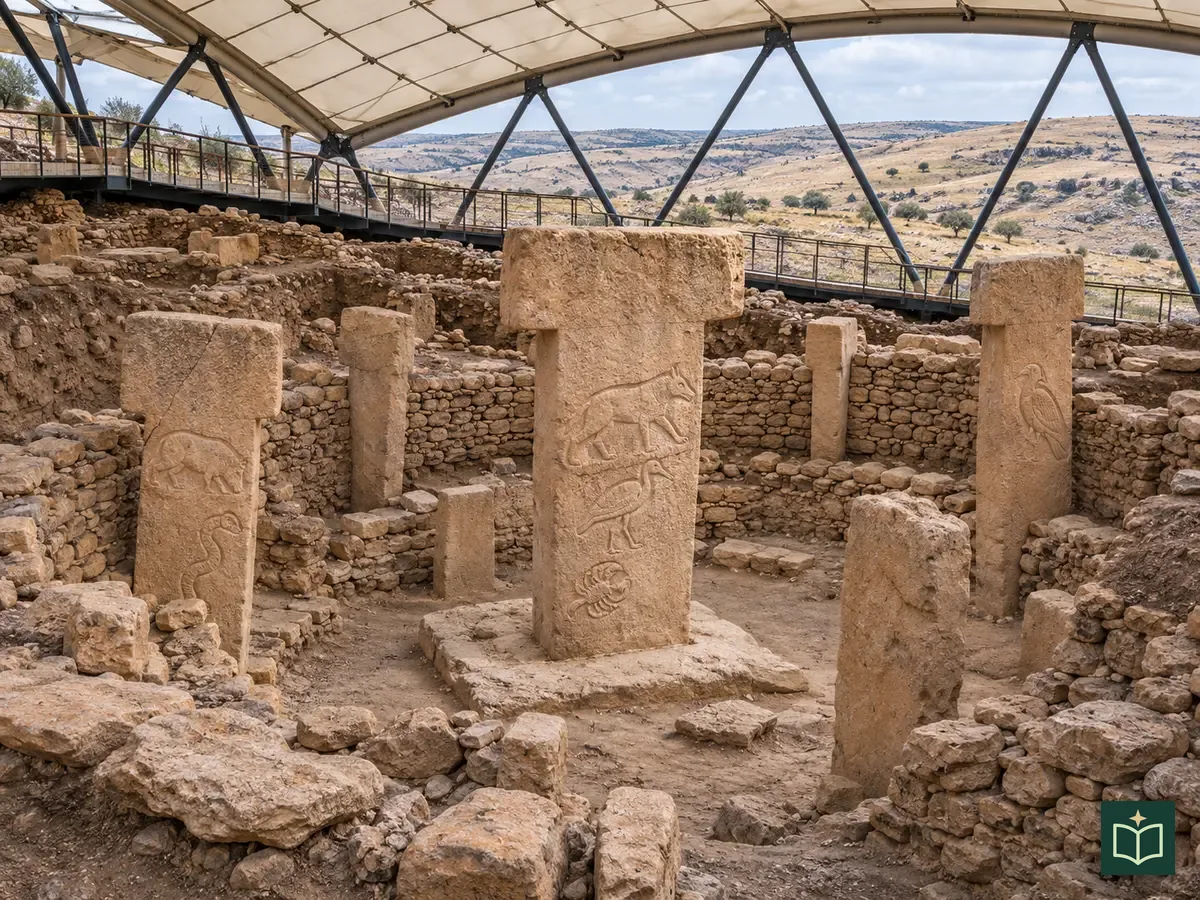
The most famous structures are large circular or oval enclosures, defined by stone walls and benches, with T-shaped limestone pillars set into them. Two especially large pillars typically stand in the centre of each enclosure, some reaching around five metres in height and weighing several tonnes. Many pillars appear to be stylised human figures: carved arms and hands wrap around their sides, and some wear belts and loincloths. The surfaces are decorated with reliefs of animals, including foxes, wild boars, snakes, cranes, scorpions and vultures. The quarries where pillars were cut have been found on the surrounding plateau. The craftsmanship is striking.
Who built it
Göbekli Tepe was built by people of the Pre-Pottery Neolithic period. When construction began, the region’s people were largely hunter-gatherers who exploited wild cereals, gazelles and other game, though this was also the period when the first steps towards plant and animal domestication were happening nearby. Building such structures required many people to quarry, move and carve heavy stones, and it required food to feed them. Large quantities of animal bones and evidence of grain processing suggest that feasts were held there. Organising such efforts implies social cooperation on a scale previously thought to need farming communities. That assumption has been revised.
Temple or settlement?
Klaus Schmidt interpreted Göbekli Tepe as a ritual centre, sometimes described as the world’s first temple, where scattered groups met for ceremonies but did not live permanently. Later research has refined this picture. Excavations since his death in 2014 have found evidence of domestic buildings, water cisterns and daily activities, suggesting that people did live at or near the site for long periods. Many archaeologists now see it as a settlement with monumental communal buildings, rather than a purely sacred site. The carvings clearly had symbolic meaning, but we cannot read them like a text, so interpretations of beliefs remain cautious.
Rethinking the story
A traditional account of the Neolithic held that farming came first, producing food surpluses that then allowed people to settle, build monuments and develop religion. Göbekli Tepe suggests a more complicated relationship. Here, monumental building and communal ritual were already happening while people were only beginning to cultivate plants. Some researchers argue that the need to feed large gatherings may even have encouraged the cultivation of cereals. Genetic studies indicate that one of the earliest domesticated forms of einkorn wheat originated in this broad region. The site does not overturn everything, but it shows that cultural and economic changes evolved together.
Protection and wider context
UNESCO inscribed Göbekli Tepe as a World Heritage Site in 2018, and protective roofs now shelter the main enclosures. It is no longer seen as unique. Nearby sites in the same region, such as Karahan Tepe and Nevalı Çori, have revealed similar pillars and enclosures, part of a wider landscape of early Neolithic sites sometimes called the Taş Tepeler, or stone hills. Ongoing excavations continue to add detail. Beware of popular claims linking Göbekli Tepe to lost advanced civilisations or ancient catastrophes; these lack support from the archaeological evidence. The real story, of hunter-gatherers raising monuments, is remarkable enough. Visitors can see the enclosures from walkways.
Sources & further reading
Figures are rounded and widely published; check the linked organisations for the latest editions. These organisations do not endorse this website.