Before the alphabet
The earliest writing systems, Mesopotamian cuneiform and Egyptian hieroglyphs, used hundreds of signs. Some stood for whole words, others for syllables or sounds, and learning them took years of training, so literacy was largely confined to professional scribes. Around the early second millennium BCE, workers and soldiers who spoke a Semitic language and had contact with Egypt developed a simpler idea. Inscriptions found at Serabit el-Khadim in Sinai and Wadi el-Hol in Egypt use a small number of signs based on Egyptian pictures, each representing a single consonant. Scholars call this Proto-Sinaitic or Proto-Canaanite script, the earliest known alphabet. It was a quiet revolution.
How the letters got their sounds
The early alphabet worked on the acrostic principle: a picture stood for the first sound of the word it depicted. A sign showing an ox head, alp in early Semitic, stood for the glottal sound at the start of that word; a sign for a house, bayt, stood for b. Over time, the pictures became simpler and more abstract. These names survive in the Hebrew letters aleph and bet, the Greek alpha and beta, and, through Greek, the word alphabet itself. The letter A, turned on its side, still faintly suggests the horns of an ox if you look closely.
The Phoenician standard
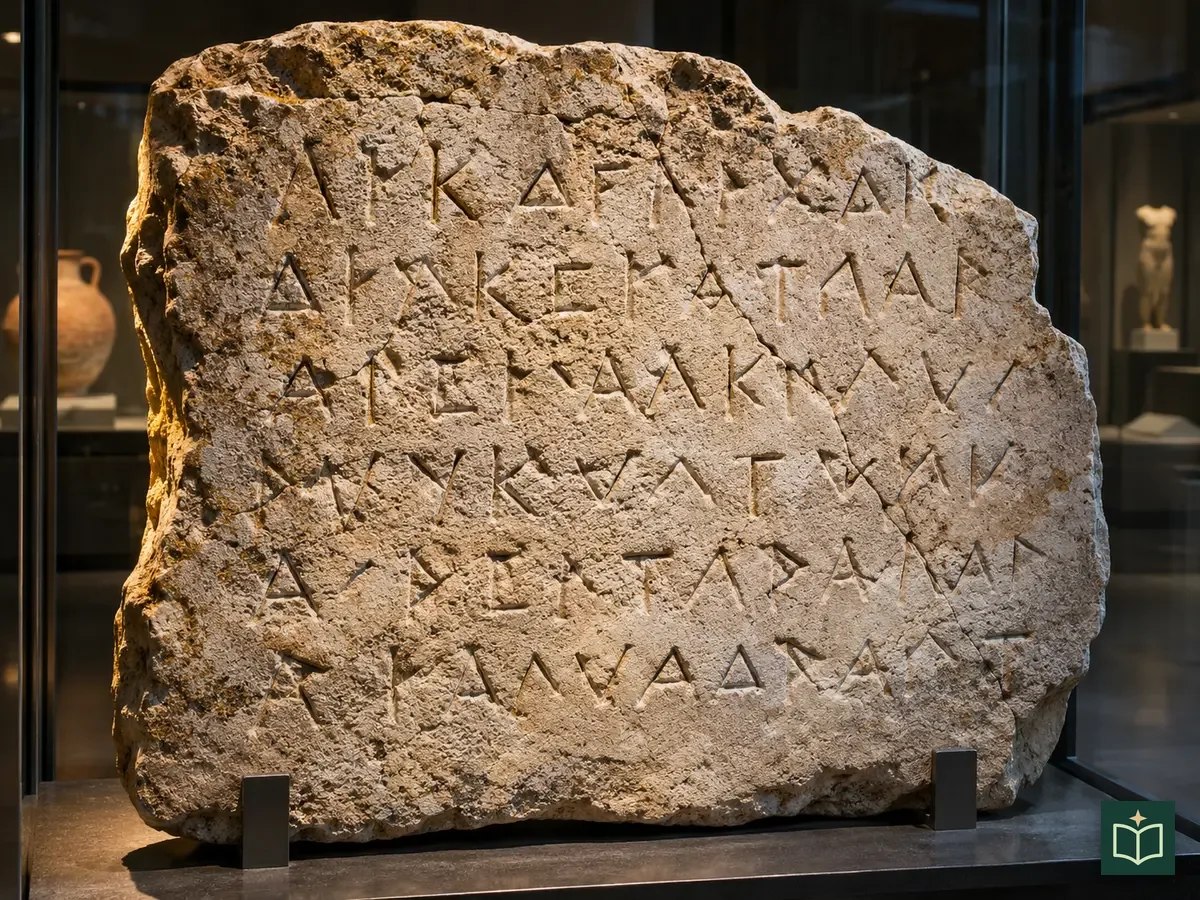
By around 1050 BCE, the Phoenicians, who lived in city states such as Tyre, Sidon and Byblos on the coast of today’s Lebanon, used a settled alphabet of 22 letters, all consonants, written from right to left. One of the earliest long inscriptions in this script is on the sarcophagus of King Ahiram of Byblos, from around 1000 BCE. Phoenician traders sailed across the Mediterranean, founding colonies such as Carthage in North Africa and trading posts as far as Spain. Their compact, practical script travelled with them, used for contracts, inventories and inscriptions, and was easy for others to learn and adapt.
Greek vowels and the Latin line
Around the eighth century BCE, Greeks adopted the Phoenician letters. Greek needed vowels to be written clearly, so they repurposed some Phoenician consonant letters for sounds Greek did not use, turning aleph into alpha as a vowel, for example. This created the first full alphabet with separate vowel letters. Greek writing later settled into left-to-right direction. The Etruscans in Italy borrowed a Greek alphabet, and the Romans adapted it into the Latin alphabet. Through the expansion of Rome, the spread of Christianity and later European colonisation and printing, Latin letters became the most widely used script in the world. The journey took many centuries.
The Aramaic branch and Arabic
Another major branch passed through Aramaic, the language of Aramaean states and later a common language of the Persian Empire. The Aramaic alphabet gave rise to many scripts, including the square Hebrew script used today, Syriac and several scripts of Central and South Asia. The Nabataeans, whose capital was Petra, developed a cursive form of Aramaic. Over several centuries, Nabataean writing evolved into the Arabic script, with early examples in inscriptions from the region around the fourth to sixth centuries CE. Arabic retains the consonantal character of its ancestors, with vowels often shown only by optional marks. The family resemblance is still visible.
Was it the first?
It is often said that the Phoenicians invented the alphabet. More precisely, they inherited an idea developed by earlier Semitic speakers and standardised it into the form that spread most widely. Ugarit, a city in Syria, even used an alphabet of cuneiform wedge signs around the fourteenth century BCE. The Phoenician contribution was to establish a stable, compact system and carry it across the Mediterranean through trade. Today, scripts descended from it, including Latin, Greek, Cyrillic, Hebrew and Arabic, are used by a large majority of the world’s population, a striking legacy of a small group of seafaring city states.
Sources & further reading
Figures are rounded and widely published; check the linked organisations for the latest editions. These organisations do not endorse this website.