The power shift reaches the rooftop.
The next renewable-energy story is about who receives usable electricity, as well as how much equipment gets installed.
 View full-size infographic
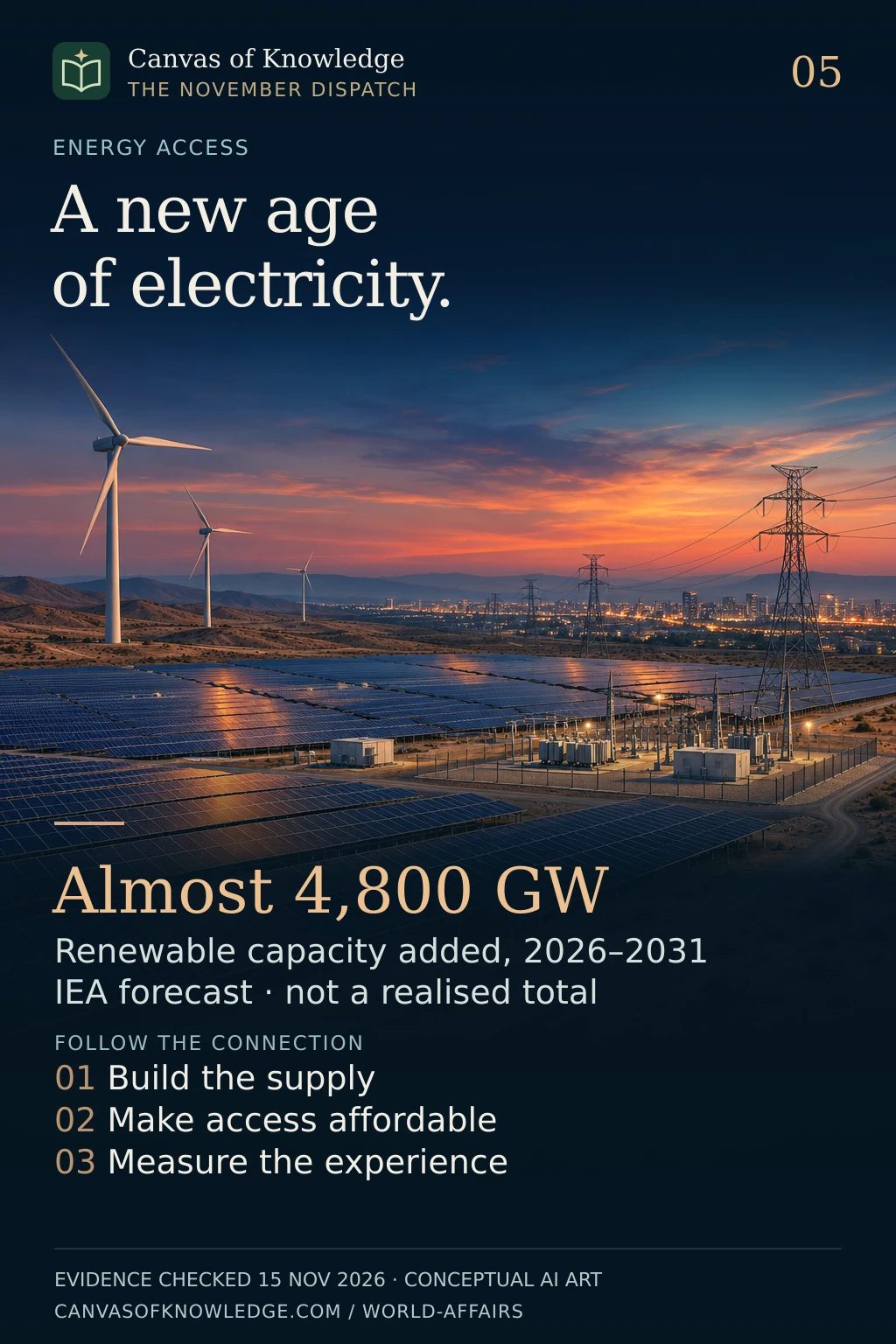
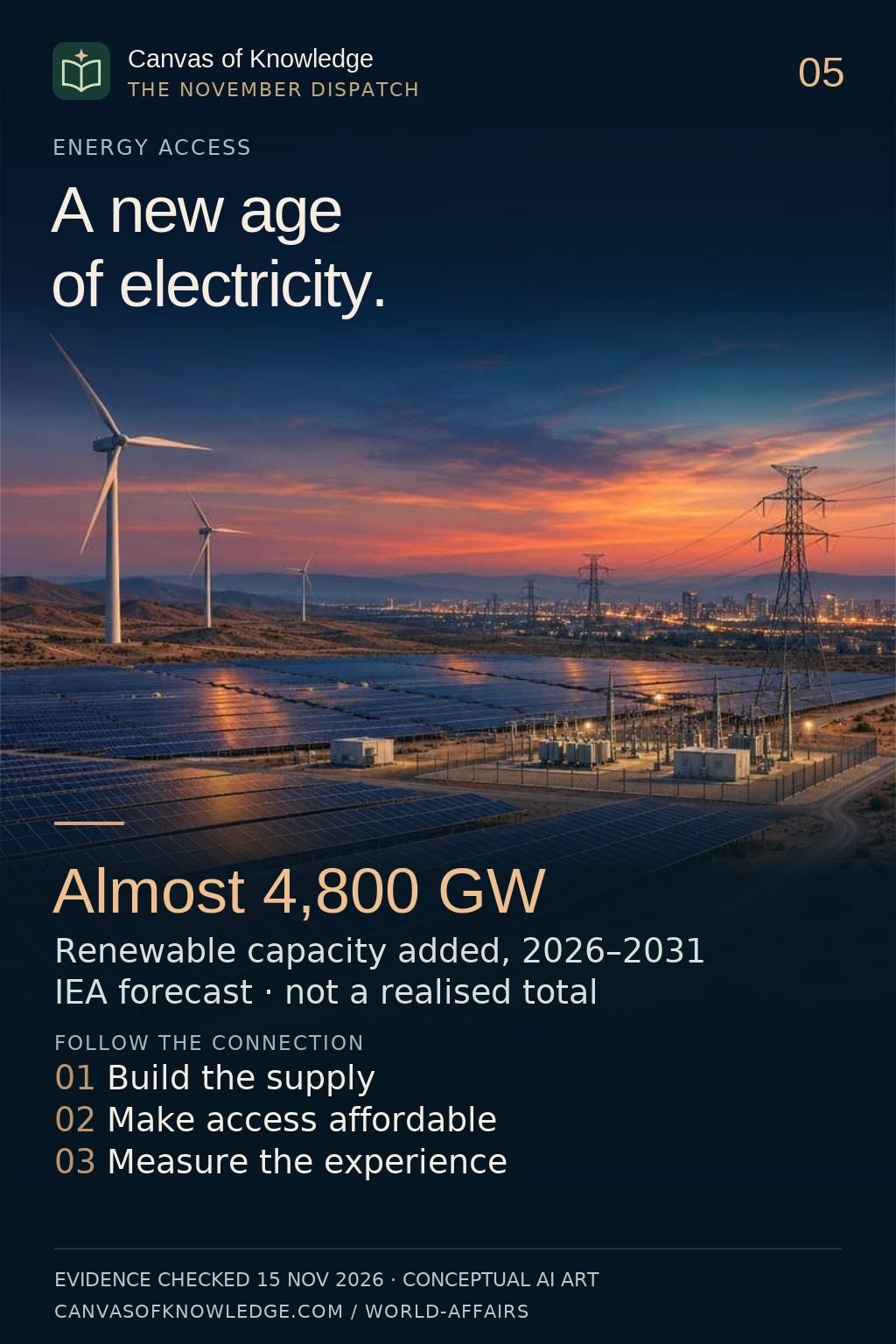
A new age
of electricity.
Renewable power capacity additions forecast by the IEA for 2026–2031
Generating capacity, a connection and dependable energy service are three different measures of progress.
IEA forecast published 6 November 2026; energy-access baseline refers to 2024
The IEA’s Renewables 2026 report, released on 6 November, forecasts almost 4,800 GW of additional renewable capacity during 2026–2031. Its outlook highlights growing deployment beyond the established largest markets. The question for households is more immediate than a global capacity total: will electricity be available, reliable and affordable when they need it?
- 01
Build the supply
A power source must be matched to the demand it is intended to serve. The World Bank’s SDG 7 assessment includes distributed solutions such as off-grid solar and mini-grids among electricity-access options. Their usefulness depends on local circumstances rather than the novelty of the equipment.
- 02
Make access affordable
A nearby line is not sufficient if a household cannot afford a connection, internal wiring or regular service. The 2026 SDG 7 release identifies these barriers explicitly. Counting infrastructure therefore needs a companion question: who can actually become a customer and keep using the service?
- 03
Measure the experience
ESMAP’s Multi-Tier Framework treats access as a range of service levels. It examines constraints including capacity, reliability and affordability. The aim is to identify what prevents useful consumption, instead of allowing a simple connected-or-unconnected label to conceal an unreliable or inadequate supply.
Read the forecast in its own units
The IEA expects renewable electricity capacity to increase by almost 85% between 2025 and 2031, with solar PV providing more than three-quarters of the expansion. It also estimates that additional rooftop solar has improved electricity access and services for at least 70 million households since 2022. The wording matters: improved service includes existing users, and households are not a count of newly connected people. A forecast describes an assessed future pathway, not equipment already commissioned.
The access gap has an older measurement date
Tracking SDG 7, released in June 2026, estimates that 655 million people lacked electricity access in 2024, including more than 560 million in Sub-Saharan Africa. These are historical estimates published with a lag, not a live November counter. The same release emphasises affordability and tailored electrification solutions. It follows that adding capacity in a well-served market cannot be counted as closing a service gap somewhere else: geography, delivery and household economics all matter.
The result should be measured at the socket
ESMAP’s approach makes a useful analytical shift: start with what a person or enterprise can do. Consider a hypothetical small workshop. A nominal connection may exist, but if power is unavailable during working hours, the connection alone cannot support dependable production. Conversely, a modest system can deliver valuable services when well matched to demand. Comparing these situations requires explicit questions about the user, the service and the hours of availability. A compelling installation photograph tells us what was built; a service assessment tells us what changed after it was built.
Better questions.
A clearer picture.
- Do new projects improve electricity service in places with the largest unmet needs?
- Are connection costs, ongoing bills and maintenance addressed together?
- Do reported results distinguish capacity, new access and better service for existing users?
Sources & dates.
- IEA · Renewables 2026, executive summary
Published: 6 November 2026
Evidence period: 2026–2031 forecasts and rooftop-solar estimates since 2022 - World Bank and SDG 7 custodian agencies · Accelerating universal energy access
Published: 24 June 2026 (page publication date)
Evidence period: Electricity-access estimates for 2024 - ESMAP · Multi-Tier Framework for Energy Access
Published: Undated programme overview; checked 15 November 2026
Evidence period: Methodology launched in 2015; service-quality framework
Checked 15 November 2026. Conditions can change after publication. These organisations do not endorse Canvas of Knowledge.