A matter of centimetres
A railway’s gauge is the distance between the inner faces of its two rails. Wheels are fixed to axles at matching widths, so a train built for one gauge cannot run on another. The most widespread is standard gauge, 1,435 millimetres, or four feet eight and a half inches, used across most of Europe, North America, China, the Middle East and on many high-speed lines. Broad gauges are wider and narrow gauges are narrower. Each has advantages: broader track can carry heavier, more stable trains, while narrower track is cheaper to build and fits tighter curves in mountains. The trouble begins where different networks meet.
Why standard gauge won
Standard gauge traces back to the colliery wagonways of north-east England. George Stephenson used a similar width on his early railways, and as his lines spread, so did the gauge. A popular story links it to the axles of Roman chariots, but that is a simplification at best. Not everyone agreed with Stephenson. Isambard Kingdom Brunel built the Great Western Railway to a broad gauge of just over seven feet, arguing it was faster and smoother. The resulting gauge war ended with an act of Parliament in 1846 favouring the narrower width for new lines. The Great Western finally completed its conversion in 1892.
A world of different widths
Other gauges spread with empires and engineering fashions. Russia adopted a broad gauge of five feet in the nineteenth century, later redefined as 1,520 millimetres, and it remains standard across the former Soviet Union, with Finland using the almost identical 1,524 millimetres. India, Pakistan, Bangladesh, Argentina and Chile use a 1,676-millimetre broad gauge. Spain and Portugal built their conventional networks at about 1,668 millimetres, while Ireland uses 1,600 millimetres. Narrow gauges of 1,067 millimetres are common in Japan, southern Africa, Indonesia and New Zealand, and metre gauge is still found in parts of South-East Asia, East Africa and South America.
Breaks at the border
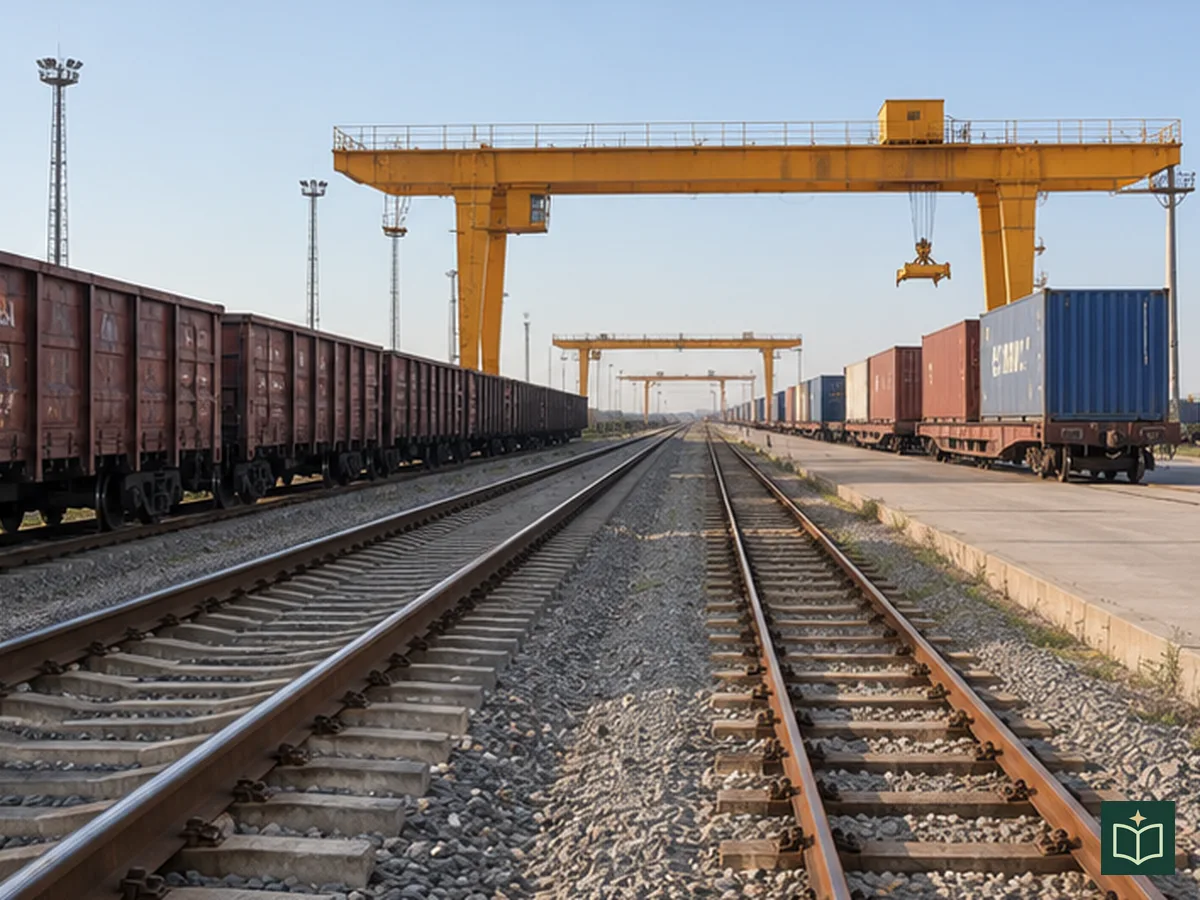
Where gauges meet, trains must stop. At Brest, on the border between Belarus and Poland, freight is transferred between wagons or wagons are lifted so their wheelsets can be changed. On the China–Europe rail routes, containers are swapped between trains at the borders of Kazakhstan and Mongolia, and again entering Poland, adding hours or days. Spain developed variable-gauge axles that adjust as trains pass slowly through special equipment, allowing through services onto lines of a different width. Australia once had the most notorious break of all: until 1962, passengers between Sydney and Melbourne had to change trains at Albury, because the two states had chosen different gauges.
Standard gauge in the Gulf
New networks usually avoid the problem by choosing a gauge compatible with their neighbours. Saudi Arabia’s railways use standard gauge, and the UAE’s national network, built by Etihad Rail, uses 1,435 millimetres too. That allows freight and passenger lines to connect with future cross-border links proposed between Gulf countries. Standard gauge also gives access to a wide market of locomotives, wagons and high-speed trains. Elsewhere, countries have spent heavily to unify their networks. India has converted large parts of its metre-gauge system to broad gauge, and Spain built its high-speed lines to standard gauge so that they could connect with France and the rest of Europe.
Why gauges are hard to change
If different gauges cause so many problems, why not simply convert? The answer is cost and disruption. Re-gauging means moving or replacing every rail, adjusting sleepers, rebuilding switches and refitting or replacing every locomotive and wagon, often while the line must remain open. Some networks lay a third rail so trains of two gauges can share the same track. Military considerations once played a role too: a different gauge could slow an invading army’s supply lines. Today, the economic case for continuity usually wins. The result is a world map of railways still shaped by decisions made by engineers nearly two centuries ago.
Sources & further reading
Figures are rounded and widely published; check the linked organisations for the latest editions. These organisations do not endorse this website.