The locks we rely on
Every secure website, banking app and messaging service relies on public-key cryptography, which lets two strangers agree on a secret key over an open network and lets software prove it is genuine with digital signatures. The most widely used methods, RSA and elliptic-curve cryptography, depend on mathematical problems that ordinary computers cannot solve in any practical time: factoring very large numbers and a related problem on elliptic curves. Breaking a well-chosen key by brute force would take longer than the age of the universe. These systems work well today. The concern is a type of machine that does not yet exist at the necessary scale: a large, reliable quantum computer.
What a quantum computer would break
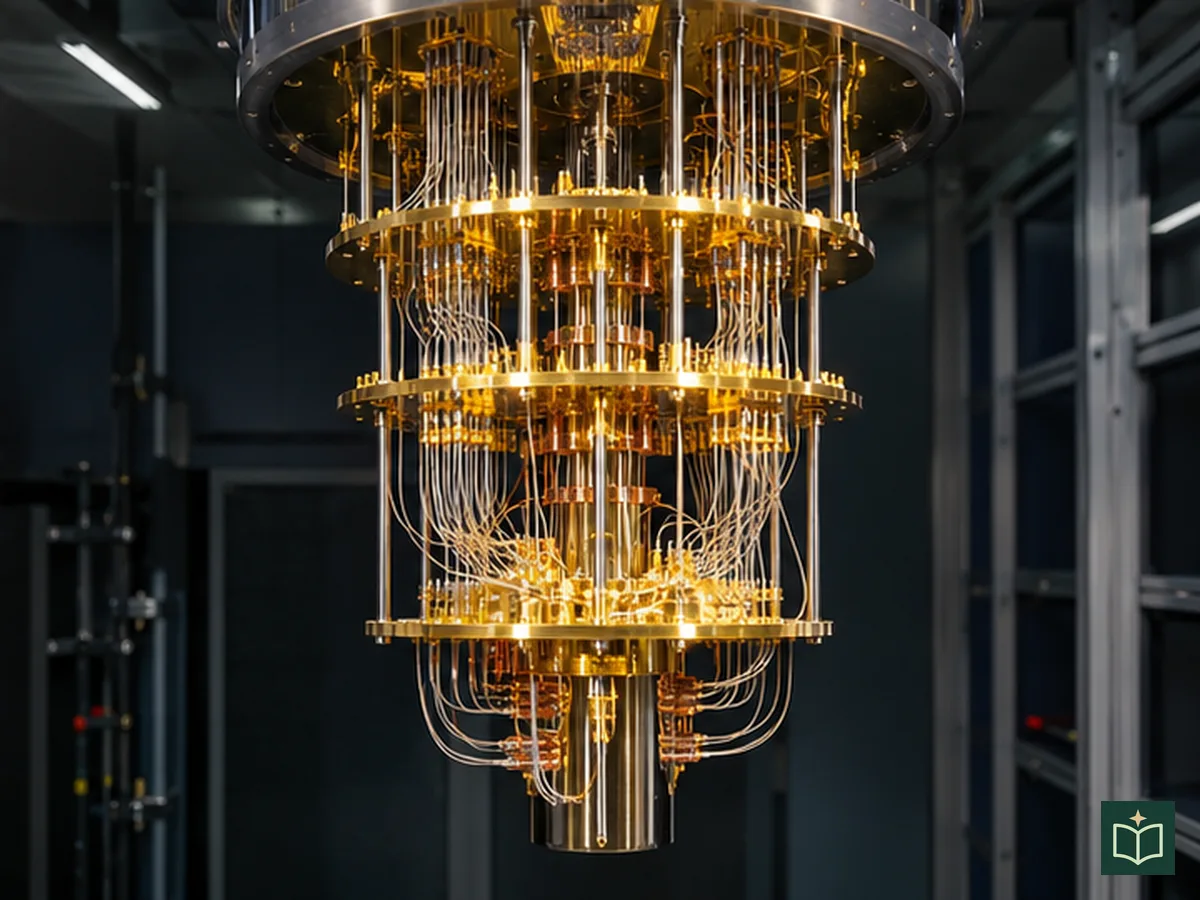
In 1994 the mathematician Peter Shor showed that a quantum computer could factor large numbers and solve the elliptic-curve problem efficiently, using quantum interference to find hidden patterns. A sufficiently large machine running Shor’s algorithm would therefore break RSA and elliptic-curve cryptography outright. Today’s quantum computers are far too small and error-prone to do this, and estimates of when, or whether, a capable machine will be built vary widely. Symmetric encryption, such as AES, which scrambles the bulk of data once keys are agreed, is affected much less. A different quantum method, Grover’s algorithm, roughly halves its effective strength, which is countered simply by using longer keys such as 256 bits.
Harvest now, decrypt later
If the threat is years away, why act now? Because encrypted data can be recorded today and stored until a quantum computer exists to unlock it. This strategy, known as harvest now, decrypt later, matters for information that must stay secret for a long time: medical records, state secrets, commercial plans and personal communications. Replacing cryptography across the internet also takes many years. Software must be rewritten and tested, hardware such as smart cards and car systems must be replaced, and standards must be agreed. Security agencies therefore argue that the migration should begin well before any quantum computer capable of breaking today’s encryption appears.
The new algorithms
In 2016 NIST launched an open international competition for quantum-resistant algorithms, and cryptographers spent years attacking the submissions; several were broken along the way. In August 2024 NIST published its first three standards. ML-KEM, derived from an algorithm called CRYSTALS-Kyber, is for agreeing keys. ML-DSA and SLH-DSA are for digital signatures. The first two rely on hard problems involving lattices, vast grids of points in many dimensions, while SLH-DSA relies on the well-studied security of hash functions. They run on ordinary computers but use larger keys: an ML-KEM-768 public key is 1,184 bytes, 37 times the 32 bytes of a widely used elliptic-curve key.
Migration is already under way
Much of the switch is happening quietly. Major web browsers and content delivery networks have begun using hybrid key exchange, combining a traditional elliptic-curve method with ML-KEM, so a connection stays safe unless both are broken. Messaging services, including Signal in 2023 and Apple’s iMessage in 2024, have added post-quantum protection. Governments are setting deadlines: NIST has proposed phasing out quantum-vulnerable algorithms in federal systems by around 2030 to 2035. Banks, telecom operators and governments in the Gulf and elsewhere are cataloguing where they use cryptography, a necessary first step, because many organisations do not fully know which systems rely on which algorithms.
What to watch and what not to fear
For individuals, there is little to do beyond keeping devices and apps updated, because post-quantum protection arrives through ordinary software updates. Claims that a quantum computer has already broken modern encryption should be treated sceptically; demonstrations so far involve very small numbers. Nor does post-quantum cryptography require quantum hardware, which is a common confusion with quantum key distribution, a separate technique using physics to share keys. The new algorithms are younger than RSA and still face scrutiny, which is why hybrid approaches and backup algorithms, such as one called HQC selected by NIST in 2025, are being kept in reserve should a weakness emerge.
Sources & further reading
- NIST CSRC · Post-quantum cryptography ↗
- NIST · First three finalised post-quantum encryption standards (2024) ↗
Figures are rounded and widely published; check the linked organisations for the latest editions. These organisations do not endorse this website.