What nodules are
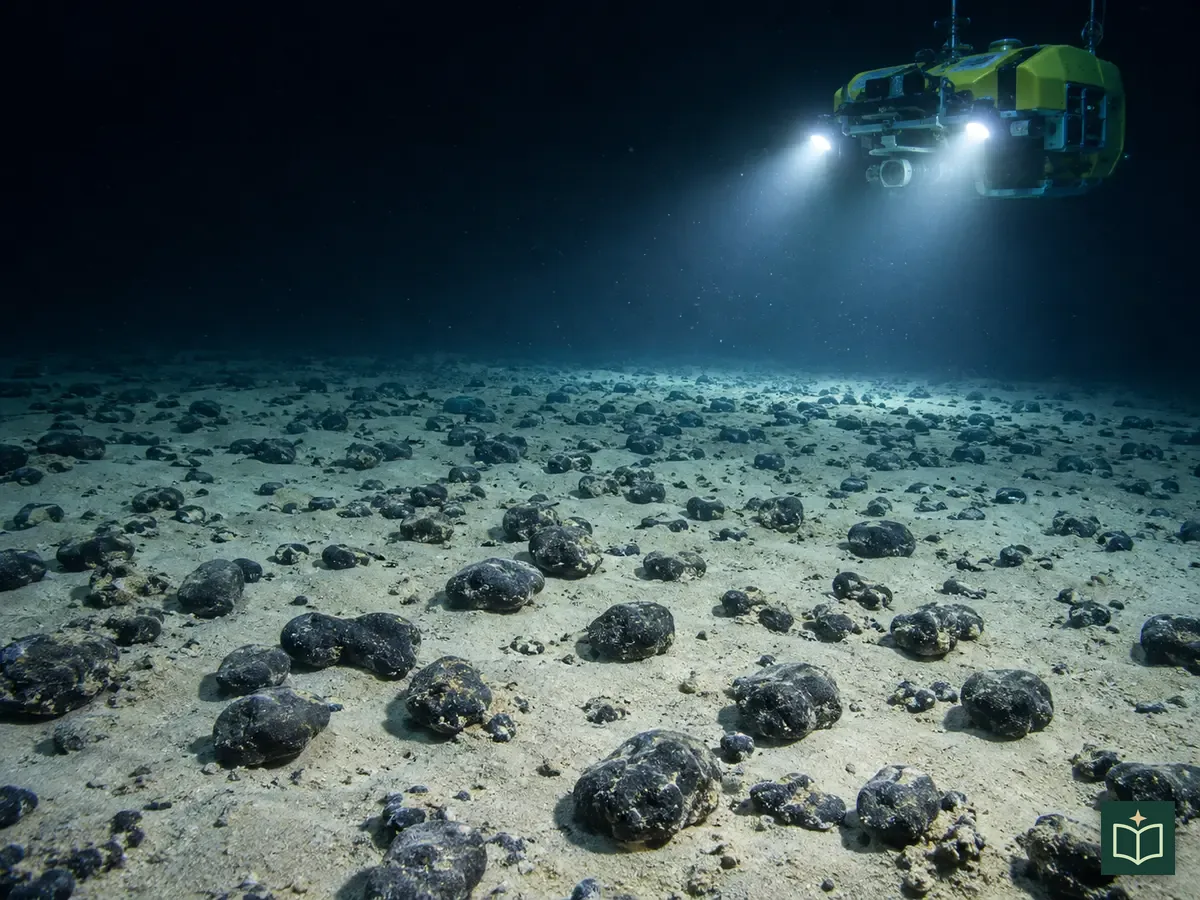
Polymetallic nodules are lumps of mineral, typically the size of a potato, scattered across vast areas of the deep-sea floor. Cut one open and it shows concentric layers, like the rings of an onion, built around a small core such as a fragment of shell, rock or a shark’s tooth. The layers consist mainly of manganese and iron oxides, but they also contain nickel, copper and cobalt, together with smaller amounts of other metals including rare earth elements. They were first collected scientifically during the British Challenger expedition of the 1870s, one of the founding voyages of oceanography. Commercial interest has risen and fallen several times since the 1960s.
Growing over millions of years
Nodules grow extraordinarily slowly, by precipitating metals from seawater and from water in the sediment beneath them, often at rates of only a few millimetres per million years. A single nodule may therefore be millions of years old. They lie on abyssal plains, mostly at depths of about four to six kilometres, where sedimentation is very slow, allowing them to remain on the surface instead of being buried. The best-known field is the Clarion-Clipperton Zone in the Pacific Ocean, between Hawaii and Mexico, an area of several million square kilometres. Other significant deposits occur in the central Indian Ocean and the Peru Basin.
Who regulates the seabed
Most nodule fields lie in international waters, beyond any country’s national jurisdiction. Under the UN Convention on the Law of the Sea, the seabed and its mineral resources in this region, known as the Area, are the common heritage of mankind. The International Seabed Authority, based in Kingston, Jamaica, and operating since 1994, regulates mineral activities there. It has granted many exploration contracts to state agencies and companies sponsored by member states. Rules for commercial exploitation, often called the mining code, have been under negotiation for years. Some governments have called for a moratorium or precautionary pause, while others support moving forward under agreed regulations.
The case made for mining
Supporters argue that nodules could provide nickel, cobalt, copper and manganese for batteries and electrification without the deforestation, displacement of communities and large waste rock piles associated with some land-based mines. Nodules sit loose on the seabed, so no blasting or deep excavation would be needed, and a single field contains large quantities of several metals at once. Proposed systems would use a tracked collector vehicle on the seabed, a riser pipe to lift nodules to a ship, and processing plants on land. Test collections have been carried out, but no commercial-scale mining of polymetallic nodules has yet taken place in international waters.
The case for caution
Many scientists urge caution because the deep sea remains poorly understood. Surveys in the Clarion-Clipperton Zone have found large numbers of species new to science, and many organisms live on or depend on the nodules themselves, which would not regrow for millions of years. Collectors would disturb the seabed and generate sediment plumes that could spread and settle over wider areas, while noise and discharges from ships could affect life in the water column. Disturbance experiments from decades ago show that tracks remain visible and some communities have not fully recovered. Researchers stress the need for baseline data and monitoring before decisions are made.
What to watch
The future of nodule mining depends on several unresolved questions: whether the International Seabed Authority finalises exploitation rules, how countries and companies act on the legal framework, how metal markets develop and whether battery chemistries reduce demand for some nodule metals. Some governments and companies have explored alternative legal routes, which others dispute. Scientific research is expanding rapidly, adding to knowledge of deep-sea ecosystems. This explainer presents the positions neutrally and is not investment advice. The central dilemma is clear: the deep sea holds metals the world wants, in places that are among the least explored and slowest to recover on the planet.
Sources & further reading
Figures are rounded and widely published; check the linked organisations for the latest editions. These organisations do not endorse this website.