Two kinds of flat land
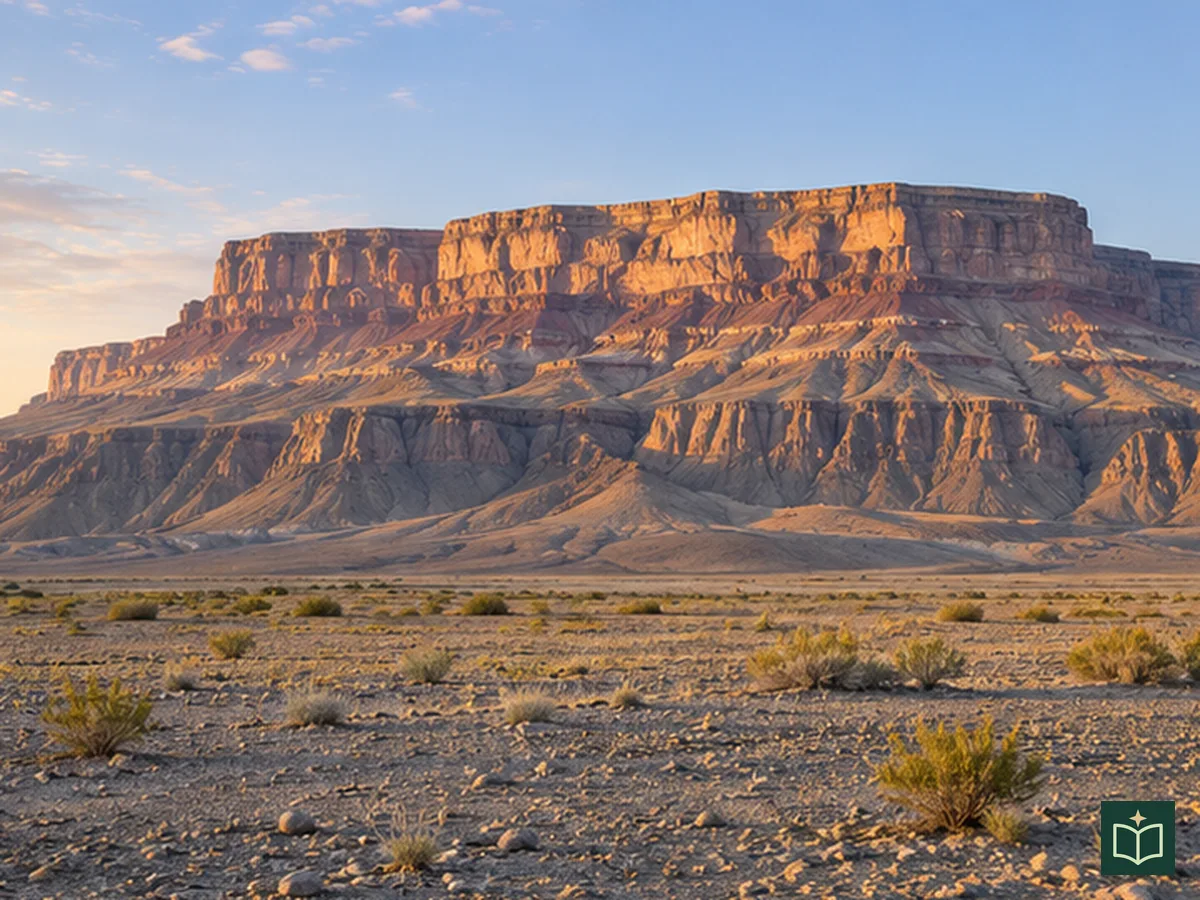
Plateaus and plains are both broad areas of fairly level ground, which is why they are easily confused. The difference lies in their setting. A plateau, sometimes called a tableland, is raised well above the land around it, with at least one steep side such as an escarpment, cliff or deep canyon edge. A plain is extensive flat or gently rolling land with no such abrupt rise; it blends gradually into its surroundings. Plains cover a large share of the world's land and hold many of its farms and cities. Plateaus also cover vast areas, from the highlands of East Africa to the interior of Arabia.
How plateaus are built
Plateaus form in several ways. Some are pushed up by colliding tectonic plates: the Tibetan Plateau rose as the Indian plate drove into Asia, lifting a region of about 2.5 million square kilometres to an average height of around 4,500 metres. Others are built by volcanic outpourings. The Deccan Plateau of India is partly covered by the Deccan Traps, layer upon layer of basalt lava that flooded the region about 66 million years ago. Still others are left behind by erosion, when rivers cut down around a resistant block of rock. The Colorado Plateau in the United States, slowly uplifted and sliced by rivers, shows this in the Grand Canyon.
How plains are made
Most plains are built by deposition, the slow laying down of sediment. Rivers spill over their banks and spread silt across floodplains and deltas, creating some of the most fertile land on Earth, such as the plains of Mesopotamia between the Tigris and Euphrates, and the Indo-Gangetic Plain of South Asia. Ice sheets left flat sheets of clay and gravel across northern Europe and North America. Coastal plains form where sea level has fallen or sediments have built out from the shore. Other plains result from long erosion that wears uplands down almost level. The UAE's coastal strip, with its sabkhas and gravel plains, combines several of these processes.
When a plain is higher than a plateau
Height alone does not decide the label. The Great Plains of North America slope gently upwards towards the Rocky Mountains and, at their western edge, reach more than 1,500 metres above sea level, yet they are plains because they rise gradually over hundreds of kilometres without an abrupt edge. Much of the Deccan Plateau, by contrast, lies between roughly 300 and 900 metres. It is a plateau because it is bounded by steep escarpments, the Western and Eastern Ghats. In Arabia, the Najd plateau of central Saudi Arabia rises in a series of escarpments above lower plains, another case where shape and edges set the category.
Life on the high and the low
The two landforms shape very different human stories. Plains, with deep soils, easy travel and rivers for irrigation, cradled many early civilisations and today support dense farming and large cities. Plateaus are often harder places to live. High plateaus have thin air, cold nights and short growing seasons, though they may be rich in minerals or grazing. Their steep edges can make roads and railways difficult and costly. Yet plateaus can be refuges too. The Ethiopian Highlands, a vast plateau, enjoy cooler temperatures and more rain than the surrounding lowlands, which helped them support farming communities and kingdoms for thousands of years.
Common misconceptions
The first misconception is that plateaus must be high and plains must be low. Both can exist at almost any elevation; what matters is their relationship to nearby land. The second is that plains are perfectly flat. Many are gently undulating, crossed by low ridges and shallow valleys. A third is that a mesa and a plateau are the same; a mesa is a small, isolated flat-topped hill, often a remnant of an eroded plateau, and a still smaller one is called a butte. When reading a map, look for contour lines bunched tightly around the edge of a flat area: that pattern is the signature of a plateau.
Sources & further reading
- National Geographic Education · Plateau ↗
- National Geographic Education · Plain ↗
- Britannica · Plateau ↗
Figures are rounded and widely published; check the linked organisations for the latest editions. These organisations do not endorse this website.