Cousins, not the same animal
Dolphins and porpoises are both toothed whales, members of a group called odontocetes that also includes sperm whales and belugas. They share streamlined bodies, blowholes and the ability to find prey by echolocation, sending out clicks and listening for echoes. But they belong to different families, which split from a common ancestor millions of years ago. Oceanic dolphins form the family Delphinidae, with several dozen species, including the bottlenose dolphin and the orca, or killer whale, which is the largest dolphin. Porpoises form the much smaller family Phocoenidae, with seven species. River dolphins belong to further families of their own, so dolphin is a loose label.
Teeth tell the story
The most reliable difference is one you rarely see: the teeth. Dolphins have cone-shaped, pointed teeth, well suited to gripping slippery fish and squid. Porpoises have flattened, spade-shaped teeth, more like small chisels. Scientists studying stranded animals or skulls use this feature to identify species with confidence. The skulls differ in other ways too, but teeth are the textbook test. Because the teeth are hidden inside the mouth, people watching from boats rely on other clues: the shape of the head, the dorsal fin, body size and how the animals behave at the surface. With practice, these external features make most sightings easy to classify.
Snouts, fins and bodies
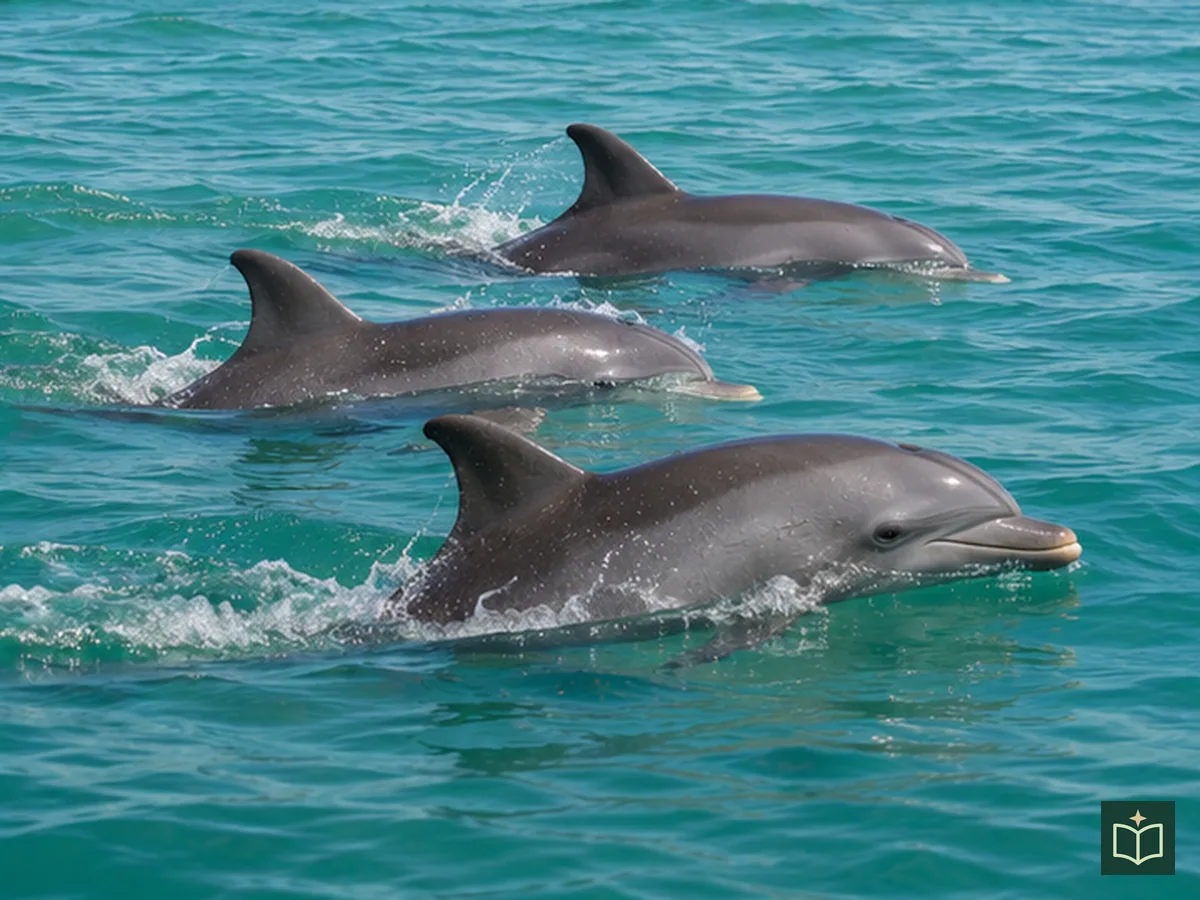
Most dolphins have a distinct, elongated beak, a snout that stands out from the rounded forehead, or melon. Porpoises have a short, blunt face with no obvious beak. Dolphins typically have a tall, curved dorsal fin, shaped like a wave or a hook. Porpoises usually have a smaller, triangular fin, and some species have none at all. In size, porpoises are generally small and stocky, most no more than about two metres long. Many dolphins are longer and leaner; bottlenose dolphins can reach around four metres, and orcas far more. There are exceptions, since some dolphins lack prominent beaks, so combining several clues works best.
Gulf dolphins and the finless porpoise
The waters of the Gulf and the Gulf of Oman host both groups. The Indo-Pacific bottlenose dolphin is regularly seen off the UAE coast, often in small groups near islands and shallow banks. The Indian Ocean humpback dolphin, recognised by the hump beneath its dorsal fin and its pale colouring with age, favours shallow coastal waters, lagoons and mangroves. Other dolphins, such as spinner dolphins and common dolphins, appear in deeper waters, especially off Oman. The region's porpoise is the Indo-Pacific finless porpoise, a small grey animal with no dorsal fin at all, just a low ridge along its back. It is shy and easily overlooked.
Behaviour at the surface
Dolphins are known for their sociability. Many species live in groups called pods, sometimes numbering in the hundreds offshore, and they leap, bow-ride on the waves made by boats and communicate with whistles. Porpoises are generally quieter companions. They tend to live alone or in small groups, rarely leap clear of the water and often avoid boats, surfacing briefly with a quick roll before disappearing. Porpoises produce high-frequency clicks but are not known for the signature whistles that bottlenose dolphins use to identify one another. These habits explain why dolphins feature in tourism and popular culture while porpoises are seen far less often.
Pressures on both
Both groups face similar threats: accidental capture in fishing nets, coastal development, pollution, underwater noise and declining fish stocks. Porpoises are especially vulnerable to entanglement because they live close to shore. The most extreme case is the vaquita, a tiny porpoise found only in the northern Gulf of California, Mexico, where recent surveys have counted only around ten individuals or fewer, making it the world's most endangered marine mammal. In the Gulf, conservation groups and environmental agencies monitor dolphin and porpoise populations, and the region's shallow, busy waters make careful management important. Knowing which animal you are watching is the first step to recording sightings that help scientists.
Sources & further reading
Figures are rounded and widely published; check the linked organisations for the latest editions. These organisations do not endorse this website.