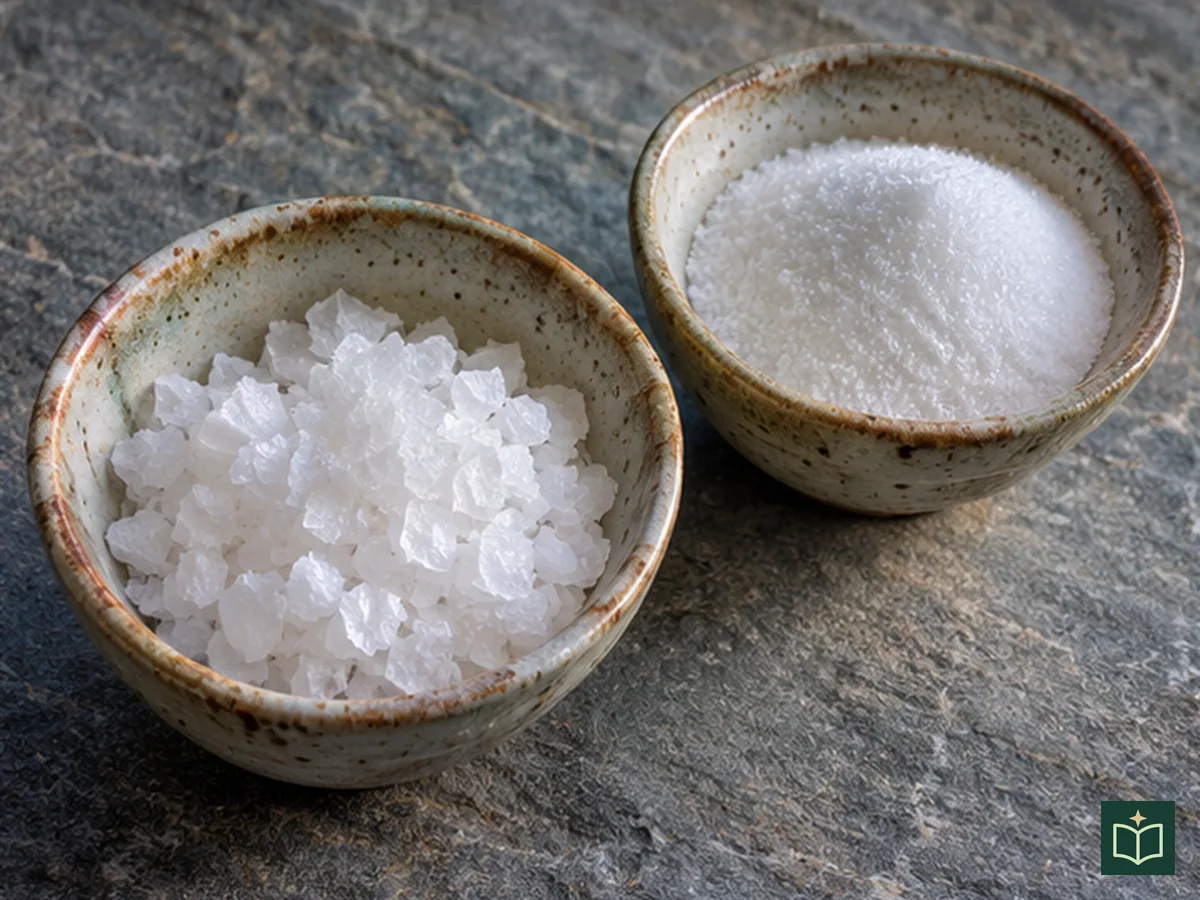
Two routes to the shaker
All salt starts in the sea, but it reaches the kitchen by two routes. Sea salt is made by evaporating seawater, either in shallow pans warmed by sun and wind or by boiling brine. The crystals are collected with little processing, so they can be coarse, flaky or slightly grey. Table salt usually comes from rock salt, ancient seabeds buried underground, which is mined directly or dissolved with water and pumped up as brine. The brine is purified and evaporated under controlled conditions, producing small, uniform cubes. Anti-caking agents are often added to keep it flowing freely, which is why it pours easily even in humid climates.
What is actually inside
Chemically, the two are far more alike than their prices suggest. Both are mostly sodium chloride. Refined table salt is typically more than 97% sodium chloride, and many sea salts are well over 90%. The difference is a small fraction of other minerals left from seawater, such as magnesium, calcium and potassium, along with traces of others. These give some sea salts a slightly different flavour or colour. In nutritional terms, however, the quantities are tiny. You would need to eat a dangerous amount of salt to gain a meaningful dose of magnesium or potassium; fruit, vegetables, nuts and pulses provide far more.
Sodium, gram for gram
Sodium makes up about 40% of sodium chloride by weight, so a gram of either salt delivers roughly 0.4 grams of sodium. Sea salt is sometimes said to contain less sodium, but that is mainly a matter of crystal size. Large, flaky crystals pack loosely, so a teaspoon of coarse sea salt weighs less, and therefore holds less sodium, than a teaspoon of fine table salt. Weight for weight, the difference is minimal. The World Health Organization advises adults to eat less than 5 grams of salt a day, about one teaspoon, to help lower blood pressure. Most people worldwide eat considerably more, much of it hidden in bread, cheese and processed foods.
The iodine advantage
The most important health difference between the salts is something added, not something natural. Many table salts are iodised. Iodine is essential for thyroid hormones, and deficiency during pregnancy and childhood can impair brain development and cause goitre, a swollen thyroid gland. Adding iodine to salt is cheap and effective. Switzerland and the United States began iodising salt in the 1920s, and the WHO and UNICEF promote universal salt iodisation, which has sharply reduced iodine deficiency worldwide. Most sea salts contain very little natural iodine unless it has been added. People who use only non-iodised salt should make sure their diet includes other iodine sources such as dairy, eggs or seafood.
Gourmet salts and claims
Specialty salts, from flaky crystals harvested on European coasts to pink rock salt from the Himalayan foothills, are sold with claims of extra minerals and purity. Their real advantages are texture and appearance. Large crystals add crunch and bursts of flavour when sprinkled on finished dishes, and some chefs prefer coarse salt for seasoning by hand. Claims that they balance the body or detoxify are not supported by evidence. Researchers have also found tiny plastic particles in some sea salts, reflecting plastic pollution in the oceans, though the health significance at such levels is unclear. Whatever the type, it is still salt, and the same daily limit applies.
Choosing in the kitchen
In practice, the choice comes down to cooking and taste. Fine table salt dissolves quickly and measures accurately, which suits baking and recipes that need precise amounts. Coarse sea salt and kosher-style salts are easier to pinch and scatter, so many cooks prefer them for finishing. Iodised salt remains the simplest way to secure enough iodine. For health, the evidence points less to which salt you buy than to how much you eat in total. People with high blood pressure or kidney problems should seek medical advice about their sodium intake, and anyone cutting back can lean on herbs, spices, lemon and garlic to keep food flavourful.
Sources & further reading
Figures are rounded and widely published; check the linked organisations for the latest editions. These organisations do not endorse this website.