Why start from nothing?
Most capitals grew where trade, conquest or history happened to concentrate power. A few were chosen deliberately on largely empty land. Governments have built new capitals for several reasons: to avoid favouring one powerful city over its rival, to draw people and investment into a neglected interior, to escape congestion or vulnerability in an existing city, or to symbolise a fresh national start. Because they are designed before they are built, planned capitals reveal the ideas of their time about how a city should work, from grand ceremonial axes to neighbourhood units, green belts and generous roads intended for the motor car.
Brasília: a plan shaped like a bird
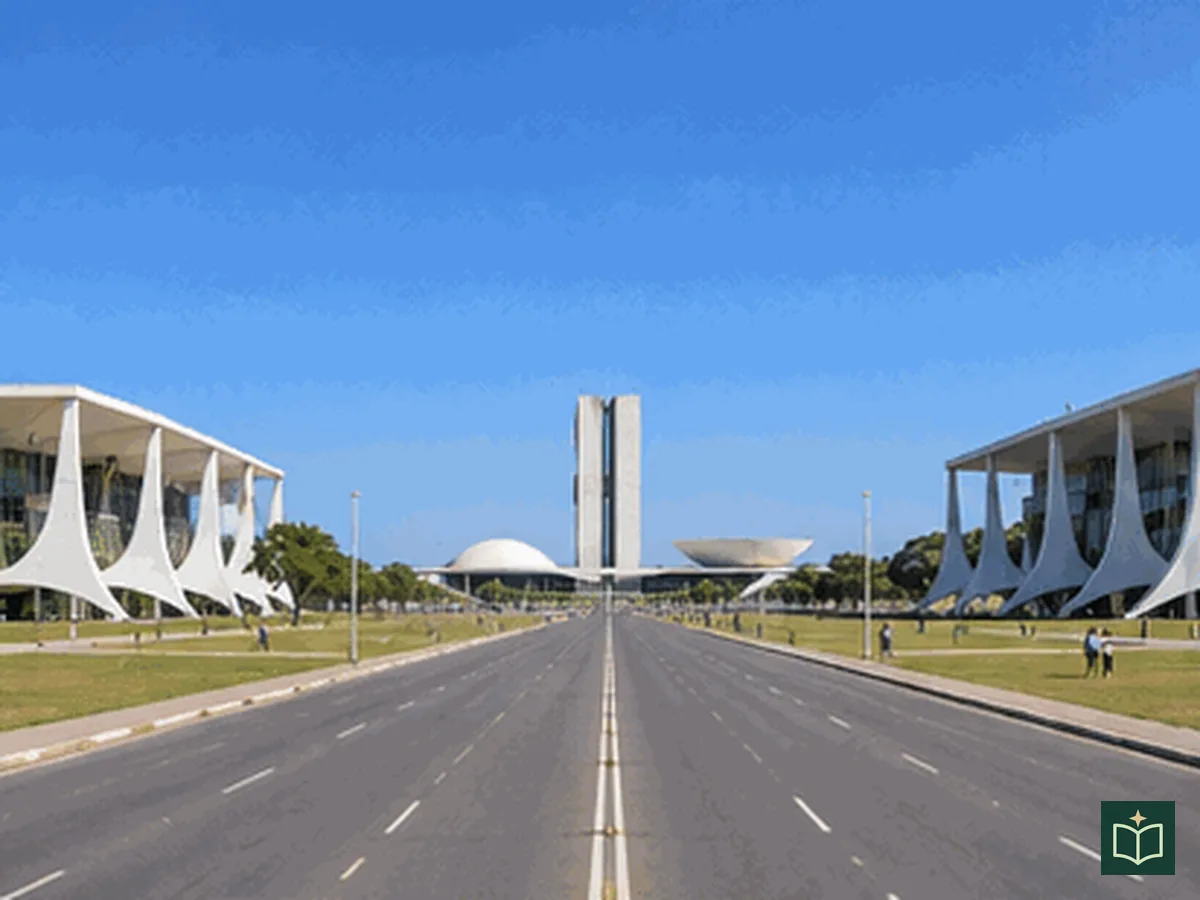
Brazil’s constitutions had called for an inland capital since 1891, but the project only took off under President Juscelino Kubitschek in the late 1950s. The site, on the high central plateau, was meant to pull development away from the crowded Atlantic coast. Urban planner Lúcio Costa designed the Plano Piloto, a cross-shaped layout often compared to an aeroplane or a bird, with government buildings along one axis and residential “superblocks” along the curved wings. Oscar Niemeyer designed its modernist landmarks. Brasília was inaugurated on 21 April 1960 after roughly four years of work and is now a World Heritage site, surrounded by satellite towns that grew far beyond the original plan.
Canberra: a compromise in the bush
When Australia federated in 1901, Sydney and Melbourne both wanted to be the capital. The constitution settled the dispute by requiring a new federal capital in New South Wales but at least 100 miles from Sydney, with Parliament sitting in Melbourne meanwhile. A site in the Limestone Plains was chosen, and an international design competition in 1911–12 was won by the Chicago architects Walter Burley Griffin and Marion Mahony Griffin. Their plan wrapped geometric avenues around hills and an artificial lake, later named Lake Burley Griffin. Parliament moved to Canberra in 1927. Growth was slow for decades, and it remains far smaller than Sydney or Melbourne.
Abuja and Islamabad
Nigeria decided in 1976 to replace Lagos, a crowded coastal city in the south-west, with a new capital near the centre of the country. Abuja’s site was seen as neutral ground between the country’s major regions and ethnic groups, and it became the official capital in December 1991. Pakistan made a similar move in the 1960s, choosing a site at the foot of the Margalla Hills to replace Karachi on the southern coast. The Greek planner Constantinos Doxiadis laid out Islamabad as a grid of self-contained sectors, each with its own markets and services. Neighbouring Rawalpindi served as the interim capital while it was built.
What the plans got wrong
Planned capitals often struggle with the gap between design and daily life. Many were laid out around cars and monumental distances, which can make them hard to cross on foot and costly for those without vehicles. Housing for the construction workers and service staff was frequently left out of the plan, so informal or satellite settlements grew at the edges, as happened around Brasília. Critics have also described some planned capitals as sterile compared with older cities that grew organically. Yet several have matured into lively places, and Canberra and Islamabad are frequently praised for their green space and quality of life.
New capitals still being built
The idea has not faded. Egypt has been building a New Administrative Capital in the desert east of Cairo, intended to house ministries and relieve congestion in the old city. Indonesia has begun building Nusantara on the island of Borneo, partly because Jakarta is crowded and parts of it are sinking as groundwater is pumped out. Both projects face questions about cost, timing and whether people will move. History suggests patience is needed: planned capitals usually take decades to grow into their role. The lesson from earlier examples is that choosing a site and drawing a plan are the easy parts; attracting a life of its own takes far longer.
Sources & further reading
Figures are rounded and widely published; check the linked organisations for the latest editions. These organisations do not endorse this website.