What the names mean
Most modern fragrances are aromatic oils, natural and synthetic, dissolved in alcohol with a little water. The French names on bottles describe how concentrated those oils are. Parfum, also called extrait, is the strongest, usually around 20 to 30% oil. Eau de parfum follows at roughly 15 to 20%, eau de toilette at about 5 to 15%, and eau de cologne at around 2 to 4%. Eau fraîche and body mists are lighter still. These ranges are conventions, not legal standards, and each fragrance house sets its own levels. The same scent can therefore be sold in several strengths, often with slightly adjusted formulas.
Why strength changes longevity
More oil generally means a scent lasts longer and projects further, although the ingredients matter as much as the percentage. Perfumers describe fragrances in three layers of notes. Top notes, such as citrus and light herbs, are made of small, volatile molecules that evaporate within minutes. Heart notes, often florals and spices, emerge next and last a few hours. Base notes, such as woods, resins, musks, vanilla and amber, are heavier molecules that evaporate slowly and can linger for many hours. As a rough guide, an eau de toilette may last a few hours, an eau de parfum longer, and a parfum longer still.
A worked comparison
Concentration also changes how to compare prices. Imagine a 100-millilitre eau de toilette at 15% oil and a 50-millilitre parfum at 25% oil. The first bottle contains about 15 millilitres of fragrance oil, the second about 12.5 millilitres. Despite being half the size, the parfum holds almost as much scent material, and each spray delivers more. That is why small bottles of parfum are priced far higher per millilitre than larger bottles of eau de toilette. The figures here are illustrative; actual concentrations are rarely printed on labels, and two fragrances of the same category can differ substantially in strength.
Oud and concentrated oils
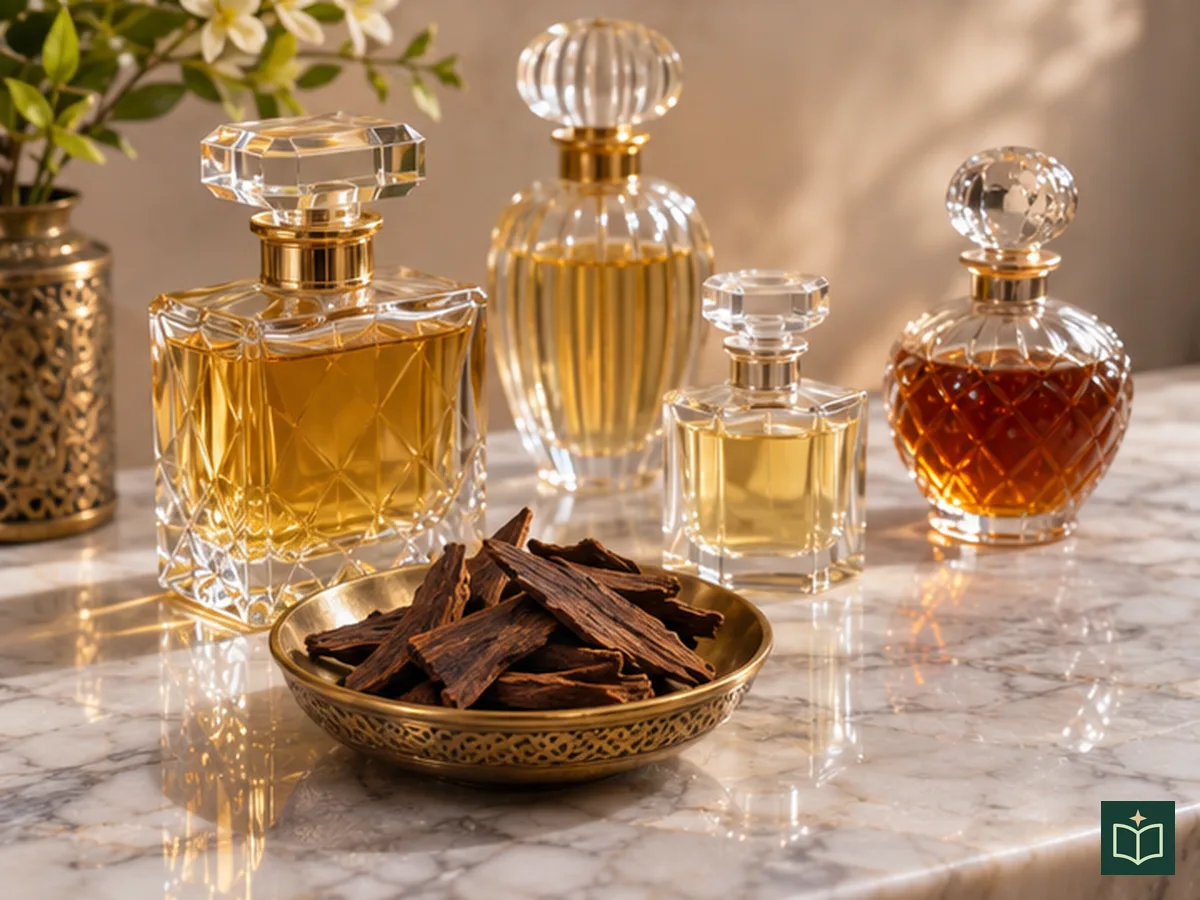
In the Gulf, many people favour concentrated perfume oils, often called attars, which contain no alcohol and are applied directly to skin or clothing. Among the most prized is oud, also known as agarwood: a dark, fragrant resin that forms in the heartwood of Aquilaria trees in South and Southeast Asia, usually after the wood is infected by a mould. Distilled oud oil is extremely expensive and very long-lasting, its heavy molecules clinging to skin and fabric for many hours. Oud wood chips are also burned as bakhoor to scent homes and clothes. Its deep, woody character has become a common ingredient in Western fragrances too.
Where cologne came from
The word cologne comes from Cologne, the German city where an Italian-born perfumer, Johann Maria Farina, launched a light citrus fragrance in 1709 called Eau de Cologne. It became fashionable across Europe, and the city's name came to describe light, refreshing scents. In many English-speaking countries, cologne is now used loosely to mean any men's fragrance, regardless of strength, which adds to the confusion. Similarly, toilette in eau de toilette refers to the old French sense of grooming and getting dressed, not to bathrooms. The labels therefore carry historical meanings that do not always match how the words are used in shops today.
Choosing and wearing
Stronger is not always better. A light eau de toilette may suit an office, a hot day or a crowded space, while a richer parfum or oil may suit evenings. Heat speeds evaporation, so scents project more strongly but fade faster in summer. Fragrance lasts longer on moisturised skin and on fabric, though oils can stain delicate materials. Testing on skin rather than on paper strips gives a truer impression, because body chemistry and temperature change how notes develop. People with sensitive skin or allergies should patch-test first, since some fragrance ingredients are common allergens regulated by the international fragrance industry's safety standards.
Sources & further reading
Figures are rounded and widely published; check the linked organisations for the latest editions. These organisations do not endorse this website.